Simplified function for predicting superconducting critical temperature
DOI:
https://doi.org/10.55713/jmmm.v36i2.2393Keywords:
Conventional superconductors, Critical temperature, Numerical methodsAbstract
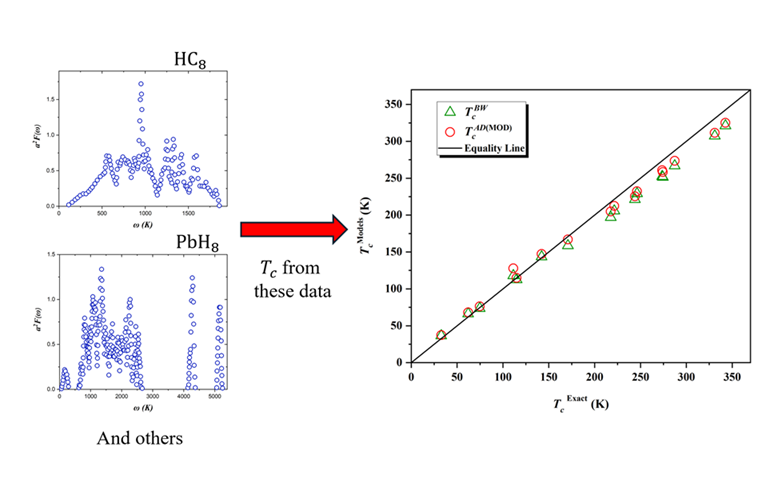
Currently, there is intense competition to develop models that can accurately estimate the critical temperature across a wide range of superconductors, while striving for straightforward derivations and comprehensive predictions. In this work, we present an approach to determining the critical temperature based on the linearized Eliashberg gap equations employing the bandwidth model. To verify the accuracy of our model, we collect Eliashberg spectral functions from various independent studies, compute the necessary parameters, and solve the Eliashberg gap equations numerically to obtain the exact solutions, along with utilizing the modified Allen-Dynes equation. The findings suggest that both models are in good agreement and exhibit a strong correlation with the exact solutions, although minor deviations are observed. The present study may provide a more effective approach to predicting the critical temperature of superconductors, particularly for materials exhibiting elevated transition temperatures, in future investigations.
Downloads
References
J. Bardeen, L. N. Cooper, and J. R. Schrieffer, “Theory of Superconductivity,” Physical Review, vol. 108, no. 5, pp. 1175–1204, 1957. DOI: https://doi.org/10.1103/PhysRev.108.1175
G. M. Eliashberg, “Interactions between electrons and lattice vibrations in a superconductor,” Journal of Experimental and Theoretical Physics, vol. 11, no. 3, pp. 966–976, 1960.
F. Marsiglio, “Eliashberg theory: A short review,” Annals of Physics, vol. 417, pp. 168102–168102, 2020. DOI: https://doi.org/10.1016/j.aop.2020.168102
U. Pinsook, N. Natkunlaphat, K. Rientong, P. Tasee, and J. Seeyangnok, “Analytic solutions of Eliashberg gap equations at superconducting critical temperature,” Physica scripta, 2024. DOI: https://doi.org/10.1088/1402-4896/ad4066
P. B. Allen, and R. C. Dynes, “Transition temperature of strong-coupled superconductors reanalyzed,” Physical Review B, vol. 12, no. 3, pp. 905–922, 1975. DOI: https://doi.org/10.1103/PhysRevB.12.905
W. L. McMillan, “Transition temperature of strong-coupled superconductors,” Physical Review, vol. 167, no. 2, pp. 331–344, 1968. DOI: https://doi.org/10.1103/PhysRev.167.331
C. R. Leavens, P. B. Allen, and R. C. Dynes, “The superconducting transition temperature for very large electron-phonon coupling,” Solid State Communications, vol. 30, no. 10, pp. 595–596, 1979 DOI: https://doi.org/10.1016/0038-1098(79)90103-0
G. D. Mahan, Many-Particle Physics. Springer Science & Business Media, 2013.
N. Natkunlaphat, P. Tasee, and U. Pinsook, “Analytical emergence of the logarithmic average phonon frequency in the super-conducting critical temperature formula,” Physica Scripta, vol. 100, no. 11, p. 115913, 2025. DOI: https://doi.org/10.1088/1402-4896/ae19ab
U. Pinsook, “In search for near-room-temperature superconducting critical temperature of metal superhydrides under high pressure: A review,” Journal of Metals, Materials and Minerals, vol. 30, no. 2, 2020. DOI: https://doi.org/10.55713/jmmm.v30i2.858
K. Rientong, N. Natkunlaphat, and U. Pinsook, “Analysis of superconducting critical temperature using numerical method,” Journal of Physics: Conference Series, vol. 2653, no. 1, p. 012054, 2023. DOI: https://doi.org/10.1088/1742-6596/2653/1/012054
U. Pinsook, and P. Tanthum, “Universal resistivity from electron-phonon interaction based on Einstein model: Application to near-room temperature superconductors,” Next Materials, vol. 6, pp. 100302–100302, 2025. DOI: https://doi.org/10.1016/j.nxmate.2024.100302
N. Na Ranong, N. Natkunlaphat, and U. Pinsook, “Simplified models for electron-phonon interactions in materials: insights from theory and experimental data,” Journal of Physics: Conference Series, vol. 2653, no. 1, pp. 012060–012060, 2023. DOI: https://doi.org/10.1088/1742-6596/2653/1/012060
A. Ghaffar, P. Song, K. Hongo, and R. Maezono, “High-Tc superconductivity of clathrate Y3EuH24,” arXiv (Cornell University), p. 05906, 2022.
Y.-P. Li, L. Yang, H.-D. Liu, N. Jiao, M.-Y. Ni, N. Hao, H.-Y. Lu, and P. Zhang, “Phonon-mediated superconductivity in two-dimensional hydrogenated phosphorus carbide: HPC3,” Physical Chemistry Chemical Physics, vol. 24, no. 16, pp. 9256–9262, 2022. DOI: https://doi.org/10.1039/D2CP00997H
J. Du, W. Sun, X. Li, and F. Peng, “Pressure-induced stability and superconductivity in LuH12 polyhydrides,” Physical Chemistry Chemical Physics, vol. 25, no. 19, pp. 13320–13324, 2023. DOI: https://doi.org/10.1039/D3CP00604B
H.-B. Ding, L.-Y. Wu, Y.-J. Feng, R. Niu, Y.-M. Liu, G.-H. Zhong, C.-L. Yang, X.-J. Chen, and H.-Q. Lin, “Super-conductivity at 117 K in H-doped diamond,” Materials Today Physics, vol. 35, pp. 101115–101115, 2023 DOI: https://doi.org/10.1016/j.mtphys.2023.101115
R. Niu, Y.-M. Liu, H.-B. Ding, Y.-J. Feng, C.-L. Yang, and G.-H. Zhong, “Structures and low-pressure high-temperature superconductivity of a SB-based hydride SBH7,” The Journal of Physical Chemistry C, vol. 127, no. 40, pp. 20169–20176, 2023. DOI: https://doi.org/10.1021/acs.jpcc.3c05265
B. Chen, L. J. Conway, W. Sun, X. Kuang, C. Lu, and A. Hermann, “Phase stability and superconductivity of lead hydrides at high pressure,” Physical Review B, vol. 103, no. 3, p. 035131, 2021. DOI: https://doi.org/10.1103/PhysRevB.103.035131
Z.-W. Liao, X.-W. Yi, J.-Y. You, B. Gu, and G. Su, “Family of binary transition metal pnictide superconductors,” Physical Review B, vol. 108, no. 1, p. 014501, 2023. DOI: https://doi.org/10.1103/PhysRevB.108.014501
Y.-L. Han, Y.-P. Li, L. Yang, H.-D. Liu, N. Jiao, B.-T. Wang, H.-Y. Lu, and P. Zhang, “High-temperature superconductivity in two-dimensional hydrogenated titanium diboride: Ti2B2H4,” Materials Today Physics, vol. 30, pp. 100954–100954, 2022. DOI: https://doi.org/10.1016/j.mtphys.2022.100954
T.-T. Pham, V.-H. Chu, and D.-L. Nguyen, “First principles prediction unveils high-Tc superconductivity in YSc2H24 cage structures under pressure,” Journal of Materials Chemistry C, no. 42, 2024. DOI: https://doi.org/10.1039/D4TC03145H
K. Gao, W. Cui, J. Shi, A. P. Durajski, J. Hao, S. Botti, M. A. L. Marques, and Y. Li, “Prediction of high- Tc superconductivity in ternary actinium beryllium hydrides at low pressure,” Physical review. B./Physical review. B, vol. 109, no. 1, p. 014501, 2024. DOI: https://doi.org/10.1103/PhysRevB.109.014501
P. Tasee, K. Rientong, N. Natkunlaphat, and U. Pinsook, “Evaluation of Eliashberg gap equations from analytic summations and big data from independent DFT works,” in The 49th International Congress on Science, Technology and Technology-based Innovation, Faculty of Science, Prince of Songkla University, Hat Yai Campus, Thailand, 2024.
Downloads
Published
How to Cite
License
Copyright (c) 2026 Journal of Metals, Materials and Minerals

This work is licensed under a Creative Commons Attribution-NonCommercial-NoDerivatives 4.0 International License.
Authors who publish in this journal agree to the following terms:
- Authors retain copyright and grant the journal right of first publication with the work simultaneously licensed under a Creative Commons Attribution License that allows others to share the work with an acknowledgment of the work's authorship and initial publication in this journal.
- Authors are able to enter into separate, additional contractual arrangements for the non-exclusive distribution of the journal's published version of the work (e.g., post it to an institutional repository or publish it in a book), with an acknowledgment of its initial publication in this journal.