Graphene-based materials from liquid phase exfoliation of graphite using mangosteen-peel extract: Experiments and molecular simulation
Experiments and Molecular Simulation
DOI:
https://doi.org/10.55713/jmmm.v36i3.2423Keywords:
Graphene, Graphite exfoliation, Mangosteen peel, Condensed tannin, Molecular simulationAbstract
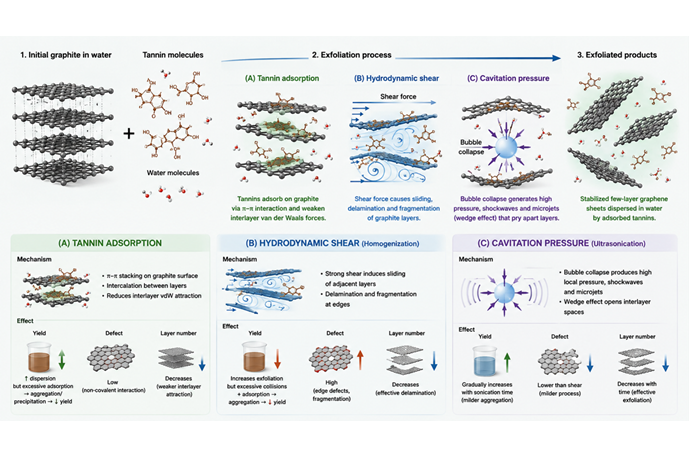
The conventional Hummers method for graphene production requires large quantities of hazardous chemicals, causing environmental impacts and sustainability concerns. This study investigated mangosteen-peel extract as a natural alternative in liquid phase exfoliation of graphite, exploiting the structural similarity between condensed tannins and graphite, which enables π−π interactions. Four exfoliation processes were studied: shear force via a homogenizer (9,500 rpm and 14,000 rpm for 41 min), sonication using an ultrasound bath (200 W and 400 kHz) for 2 h and 3 h at 50℃ and their sequential combinations. The results confirmed successful graphite exfoliation yielding samples with I2D/IG ratios of 0.51 to 0.55 which are comparable to commercial graphene-based products. This was also verified by the increased specific surface area using BET analysis and TEM imaging showing structures with five and more layers. The yields of exfoliated products from all processes were 4.39% to 8.5%. Lastly, Molecular dynamics simulation revealed that when changes of van der Waals interactions were considered, increasing condensed tannin concentration exerted the greatest effect on graphite exfoliation, followed by increases in pressure and temperature. This research demonstrates the potential use of mangosteen-peel extract as an environmentally friendly alternative for multi-layer graphene production.
Downloads
References
Y. Guo, X. Zuo, Y. Xue, J. Tang, M. Gouzman, Y. Fang, Y. Zhou, L. Wang, Y. Yu, and M. H. Rafailovich, “Engineering thermally and electrically conductive biodegradable polymer nanocomposites,” Composites Part B: Engineering, vol. 189, p. 107905, 2020. DOI: https://doi.org/10.1016/j.compositesb.2020.107905
T. Wang, C. Cheng, Z. Guan, T. Tao, Q. Xiao, and J. Zhu, “Chemical reduction-induced defect-rich bismuth oxide-reduced graphene oxide anode for high-performance supercapacitors,” Journal of Colloid and Interface Science, vol. 677, pp. 45–54, 2025. DOI: https://doi.org/10.1016/j.jcis.2024.07.213
M. P. Niharika, R. Garlapallya, K. Ruthvik, M. Velaga, and B. M. Rao, “Hydrogen production on g-C3N4 nanoflakes via photo-electrochemical water splitting,” Materials Today: Proceedings, 2023, DOI: https://doi.org/10.1016/j.matpr.2023.06.188
K. Ruthvik, A. Babu, P. Supraja, M. Navaneeth, V. Mahesh, K. U. Kumar, R. R. Kumar, B. M. Rao, D. Haranath, and K. Prakash, “High-performance triboelectric nanogenerator based on 2D graphitic carbon nitride for self-powered electronic devices,” Materials Letters, vol. 350, p. 134947, 2023. DOI: https://doi.org/10.1016/j.matlet.2023.134947
T. Semangoen, R. Chotigawin, T. Sangnim, N. Chailerd, S. Yodkeeree, T. Pahasup-anan, and K. Huanbutta, “Antimicrobial efficacy of mangosteen (Garcinia mangostana) peel extracts in airborne microbial control within livestock farming environments,” Microbial Pathogenesis, vol. 204, p. 107618, 2025. DOI: https://doi.org/10.1016/j.micpath.2025.107618
R. Li, B. S. Inbaraj, and B. Chen, “Quantification of xanthone and anthocyanin in mangosteen peel by UPLC-MS/MS and preparation of nanoemulsions for studying their inhibition effects on liver cancer cells,” International Journal of Molecular Sciences, vol. 24, p. 3934, 2023. DOI: https://doi.org/10.3390/ijms24043934
M. M. Han, P. Tangpromphan, A. Kaewchada, and A. Jaree, “Recovery and partial isolation of α-mangostin from mangosteen pericarps via sequential extraction and precipitation,” PLoS One, vol. 19, no. 10, p. e0310453, 2024. DOI: https://doi.org/10.1371/journal.pone.0310453
K. Moosophin, T. Wetthaisong, L. Seeratchakot, and W. Kokluecha, “Tannin extraction from mangosteen peel for protein precipitation in wine,” in Proceedings of the 3rd FerVAAP Conference, vol. 15, no. 5, pp. 377–385, 2010.
R. Navik, Y. Gai, W. Wang, and Y. Zhao, “Curcumin-assisted ultrasound exfoliation of graphite to graphene in ethanol,” Ultrasonics Sonochemistry, vol. 48, pp. 96–102, 2018. DOI: https://doi.org/10.1016/j.ultsonch.2018.05.010
U. T. Ferdous, A. Nurdin, S. Ismail, K. Shaari, and Z. N. Yusof, “A comparative study on antioxidant properties, total phenolics, total flavonoid contents, and cytotoxic properties of marine green microalgae and diatoms,” Journal of Genetic Engineering and Biotechnology, vol. 23, no. 1, p. 100456, 2025. DOI: https://doi.org/10.1016/j.jgeb.2024.100456
J. M. Monteiro, J. S. N. de Souza, E. M. F. Lins Neto, K. Scopel, and E. F. Trindade, “Does total tannin content explain the use value of spontaneous medicinal plants from the Brazilian semi-arid region?,” Revista Brasileira de Farmacognosia, vol. 24, no. 2, pp. 116–123, 2014. DOI: https://doi.org/10.1016/j.bjp.2014.02.001
T. P. Vo, D. N. Pham, T. V. Pham, H. Y. Nguyen, L. T. V. Vo, T. N. H. Tran, T. N. Tran, and D. Q. Nguyen, “Green extraction of total phenolic and flavonoid contents from mangosteen (Garcinia mangostana L.) rind using natural deep eutectic solvents,” Heliyon, vol. 9, no. 4, p. e14884, 2023. DOI: https://doi.org/10.1016/j.heliyon.2023.e14884
A. Amiri, M. Naraghi, G. Ahmadi, M. Soleymaniha, and M. Shanbedi, “A review on liquid-phase exfoliation for scalable production of pure graphene, wrinkled, crumpled and functionalized graphene and challenges,” FlatChem, vol. 8, pp. 40–71, 2018. DOI: https://doi.org/10.1016/j.flatc.2018.03.004
S. Lund, J. Kauppila, S. Sirkia, J. Palosaari, O. Eklund, R. M. Latonen, J. H. Smått, J. Peltonen, and T. Lindfors, “Fast high-shear exfoliation of natural flake graphite with temperature control and high yield,” Carbon, vol. 174, pp. 123–131, 2021. DOI: https://doi.org/10.1016/j.carbon.2020.11.094
G. Liu, M. Xiao, X. Zhang, C. Gal, X. Chen, L. Liu, S. Pan, J. Wu, L. Tang, and D. Clements-Croome, “A review of air filtration technologies for sustainable and healthy building ventilation,” Sustainable Cities and Society, vol. 32, pp. 375–396, 2017. DOI: https://doi.org/10.1016/j.scs.2017.04.011
Z. Li, L. Deng, I. A. Kinloch, and R. J. Young, “Raman spectro-scopy of carbon materials and their composites: Graphene, nanotubes and fibres,” Progress in Materials Science, vol. 135, p. 101089, 2023. DOI: https://doi.org/10.1016/j.pmatsci.2023.101089
A. Kaur, J. A. Morton, A. V. Tyurnina, A. Priyadarshi, M. Ghorbani, J. Mi, K. Porfyrakis, D. G. Eskin, and I. Tzanakis, “Dual frequency ultrasonic liquid phase exfoliation method for the production of few-layer graphene in green solvents,” Ultrasonics Sonochemistry, vol. 108, p. 106954, 2024. DOI: https://doi.org/10.1016/j.ultsonch.2024.106954
N. Jirasitthanit, and P. Danwanichakul, “Increasing the yield in the exfoliation of graphite using serum from skim natural rubber latex in ultrasound-induced and shear-induced systems,” Engineering and Applied Science Research, vol. 51, no. 1, pp. 42–49, 2024.
S. Amloy, T. Lukprang, M. Lertworapreecha, and P. Preechaburana, “Green synthesis of carbon dots from mangosteen peel for fluorescent cancer cells,” Journal of Metals, Materials and Minerals, vol. 34, p. 1957, 2024. DOI: https://doi.org/10.55713/jmmm.v34i2.1957
Y. Kurniawan, M. Fahmi, and L. Yuliati, “Isolation and optical properties of natural pigments from purple mangosteen peels,” IOP Conference Series: Materials Science and Engineering, vol. 833, p. 012018, 2020. DOI: https://doi.org/10.1088/1757-899X/833/1/012018
T. Wahyono, D. Astuti, K. Wiryawan, I. Sugoro, and A. Jayanegara, “Fourier transform mid-infrared (FTIR) spectroscopy to identify tannin compounds in the panicle of sorghum mutant lines,” IOP Conference Series: Materials Science and Engineering, vol. 546, p. 042045, 2019. DOI: https://doi.org/10.1088/1757-899X/546/4/042045
S. Zhao, S. Xie, Z. Shicheng, Z. Zhao, J. Zhang, L. Li, and Z. Xin, “Green and high-efficiency production of graphene by tannic acid-assisted exfoliation of graphite in water,” ACS Sustainable Chemistry & Engineering, vol. 6, no. 6, pp. 7652–7661, 2018. DOI: https://doi.org/10.1021/acssuschemeng.8b00497
K. L. Ng, B. M. Maciejewska, L. Qin, C. Johnston, J. Barrio, M. M. Titirici, I. Tzanakis, D. G. Eskin, K. Porfyrakis, J. Mi, and N. Grobert, “Direct evidence of the exfoliation efficiency and graphene dispersibility of green solvents toward sustainable graphene production,” ACS Sustainable Chemistry & Engineering, vol. 11, no. 1, pp. 58–66, 2023. DOI: https://doi.org/10.1021/acssuschemeng.2c03594
K. Nuilek, W. Wongwiriyapan, V. Sattayarut, A. Simon, D. Koncz- Horváth, T. Ferenczi, F. Kristály, and P. Baumli, “Comparison of acid exfoliators in carbon nanosheets synthesis from stinging nettle (Urtica dioica) for electrochemical applications,” Scientific Reports, vol. 10, no. 1, p. 17270, 2020. DOI: https://doi.org/10.1038/s41598-020-74286-4
L. P. Chun, J. Y. Wu, and W. R. Liu, “Green and facile synthesis of few-layer graphene via liquid exfoliation process for lithium-ion batteries,” Scientific Reports, vol. 8, p. 9766, 2018. DOI: https://doi.org/10.1038/s41598-018-27922-z
Y. Hou, F. Qing, T. Wen, and X. Li, “Rose-like graphene as transmission electron microscopy support film,” in Proceedings of the Ninth International Conference on Energy Materials and Electrical Engineering (ICEMEE 2023), 2024, p. 129791Q. DOI: https://doi.org/10.1117/12.3015332
J. J. de Groot, "Molecular dynamics simulation of atactic polystyrene using an all-atom model within materials studio," M.S. thesis, Eindhoven University of Technology, 2002.
W. Cai, J. Li, B. P. Uberuaga, and S. Yip, “Molecular dynamics,” in Comprehensive Nuclear Materials, 2nd ed., R. J. M. Konings and R. E. Stoller, Eds. Amsterdam, The Netherlands: Elsevier, 2020, pp. 573–594. DOI: https://doi.org/10.1016/B978-0-12-803581-8.11724-2
Downloads
Published
How to Cite
Issue
Section
Categories
License
Copyright (c) 2026 Journal of Metals, Materials and Minerals

This work is licensed under a Creative Commons Attribution-NonCommercial-NoDerivatives 4.0 International License.
Authors who publish in this journal agree to the following terms:
- Authors retain copyright and grant the journal right of first publication with the work simultaneously licensed under a Creative Commons Attribution License that allows others to share the work with an acknowledgment of the work's authorship and initial publication in this journal.
- Authors are able to enter into separate, additional contractual arrangements for the non-exclusive distribution of the journal's published version of the work (e.g., post it to an institutional repository or publish it in a book), with an acknowledgment of its initial publication in this journal.