Sodium alginate/aloe vera/mangosteen peel extraction hydrogel composite films with anti-staphylococcal properties as a promising alternative material in biomedical applications
DOI:
https://doi.org/10.55713/jmmm.v36i2.2557Keywords:
hydrogel, Sodium alginate, Mangosteen peel extract, Antibacterial, Biomedical applicationsAbstract
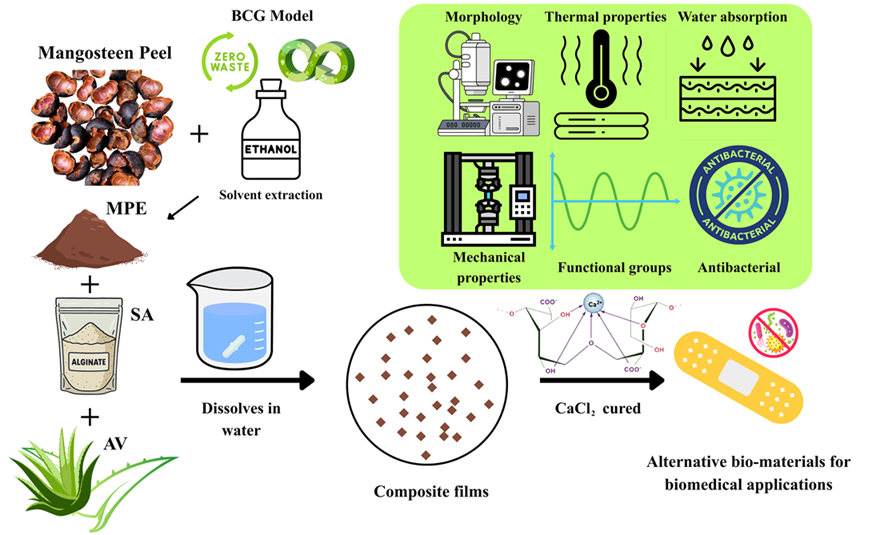
This study focuses on the development of alternative biodegradable hydrogel films from sodium alginate as a matrix and curing into a hydrogel by CaCl2. Thus, the aloe vera (AV) and the crude extract of mangosteen peels (MPE) were additionally blended. The polymer films were prepared using the casting film process, and their morphology, functional groups, water absorption, antibacterial, thermal, and mechanical properties were characterized using SEM, FTIR, water swelling test, disk diffusion method, DSC-TGA, and UTM. The results demonstrated the heterogeneity between the composites and the polymer matrix, and a lower polarity from the decreased %water swelling from 45% to 22%. The mechanical properties showed that the rigidity and strength of the composites were improved, while those without particle blends showed a superior elongation at break. The DSC-TGA revealed a lower melting temperature, but a higher thermal degradation temperature when the additives were added to the films. The Staphylococcus aureus protection provided a clear inhibition zone of 15 ± 1 mm. Lastly, the results of polymer composites hydrogel demonstrated a potential for biomedical applications, particularly as wound dressing materials.
Downloads
References
S. Buaruk, P. Somnuake, S. Gulyanon, S. Deepaisarn, S. Laitrakun, and P. Opaprakasit, "Membrane filter removal in FTIR spectra through dictionary learning for exploring explainable environmental microplastic analysis," Scientific Reports, vol. 14, no. 1, p. 20297, 2024. DOI: https://doi.org/10.1038/s41598-024-70407-5
A. S. Thar, S. Laitrakun, P. Somnuake, S. Deepaisarn, P. Opaprakasit, K. Athikulwongse, M. Yamaguch, and S. Gulyanon, "Enhancing microplastic classification through filter-interfered FTIR spectra using dimensionality reduction and deep learning in low-dimensional spaces," Marine Pollution Bulletin, vol. 221, p. 118548, 2025. DOI: https://doi.org/10.1016/j.marpolbul.2025.118548
K. I. Draget, G. Skjåk-Bræk, and O. Smidsrød, "Alginate based new materials," International journal of biological macromolecules, vol. 21, no. 1‒2, pp. 47‒55, 1997. DOI: https://doi.org/10.1016/S0141-8130(97)00040-8
H. Hecht, and S. Srebnik, "Structural characterization of sodium alginate and calcium alginate," Biomacromolecules, vol. 17, no. 6, pp. 2160-2167, 2016. DOI: https://doi.org/10.1021/acs.biomac.6b00378
N. K. Sachan, S. Pushkar, A. Jha, and A. Bhattcharya, "Sodium alginate: The wonder polymer for controlled drug delivery," Journal of Pharmacy Research, vol. 2, no. 8, pp. 1191‒1199, 2009.
B. Roopa, and S. Bhattacharya, "Alginate gels: I. Characterization of textural attributes," Journal of Food Engineering, vol. 85, no. 1, pp. 123‒131, 2008. DOI: https://doi.org/10.1016/j.jfoodeng.2007.07.012
H. Wang, L. Yang, and Y. Yang, "A review of sodium alginate-based hydrogels: Structure, mechanisms, applications, and perspectives," International Journal of Biological Macromolecules, vol. 292, p. 139151, 2025. DOI: https://doi.org/10.1016/j.ijbiomac.2024.139151
R. Pereira, A. Mendes, and P. Bártolo, "Alginate/Aloe vera hydrogel films for biomedical applications," Procedia CIRP, vol. 5, pp. 210‒215, 2013. DOI: https://doi.org/10.1016/j.procir.2013.01.042
B. Ishfaq, I. U. Khan, S. H. Khalid, and S. Asghar, "Design and evaluation of sodium alginate-based hydrogel dressings containing Betula utilis extract for cutaneous wound healing," Frontiers in Bioengineering and Biotechnology, vol. 11, p. 1042077, 2023. DOI: https://doi.org/10.3389/fbioe.2023.1042077
R. Pereira, A. Carvalho, D. C. Vaz, M. Gil, A. Mendes, and P. Bártolo, "Development of novel alginate based hydrogel films for wound healing applications," International journal of biological macromolecules, vol. 52, pp. 221‒230, 2013. DOI: https://doi.org/10.1016/j.ijbiomac.2012.09.031
M. Chelu, A. M. Musuc, M. Popa, and J. Calderon Moreno, "Aloe vera-based hydrogels for wound healing: Properties and therapeutic effects," Gels, vol. 9, no. 7, p. 539, 2023. DOI: https://doi.org/10.3390/gels9070539
Y. S. Lim, S. S. H. Lee, and B. C. Tan, "Antioxidant capacity and antibacterial activity of differentparts of mangosteen (Garcinia mangostana Linn.) extracts," Fruits, vol. 68, no. 6, pp. 483‒489, 2013. DOI: https://doi.org/10.1051/fruits/2013088
W. Suttirak, and S. Manurakchinakorn, "In vitro antioxidant properties of mangosteen peel extract," Journal of food science and technology, vol. 51, no. 12, pp. 3546‒3558, 2014. DOI: https://doi.org/10.1007/s13197-012-0887-5
T. Shan, Q. Ma, K. Guo, J. Liu, W. Li, F. Wang, and E. Wu, "Xanthones from mangosteen extracts as natural chemopreventive agents: Potential anticancer drugs," Current molecular medicine, vol. 11, no. 8, pp. 666‒677, 2011. DOI: https://doi.org/10.2174/156652411797536679
H. T. Nguyen, T. T. Nguyen, H. T. Do, L. V. K. Bui, T. A. Nguyen, H. T. Nguyen, and T. T. Thi, "Hydrogel based on cellulose and mangosteen rind extract with antibacterial activity: Preparation and characterization," Biopolymers, vol. 116, no. 3, p. e70024, 2025. DOI: https://doi.org/10.1002/bip.70024
N. Kusumawati, A. B. Santoso, M. M. Sianita, and S. Muslim, "Extraction, characterization, and application of natural dyes from the fresh mangosteen (Garcinia mangostana L.) peel," International Journal on Advanced Science, Engineering and Information Technology, vol. 7, no. 3, pp. 878‒884, 2017. DOI: https://doi.org/10.18517/ijaseit.7.3.1014
W. Widowati, L. Darsono, J. Suherman, Y. Yelliantty, and M. Maesaroh, "High performance liquid chromatography (HPLC) analysis, antioxidant, antiaggregation of mangosteen peel extract (Garcinia mangostana L.)," International Journal of Bioscience, Biochemistry and Bioinformatics, vol. 4, no. 6, pp. 458‒466, 2014. DOI: https://doi.org/10.17706/ijbbb.2014.4.6.458-466
B. Ovalle-Magallanes, D. Eugenio-Pérez, and J. Pedraza-Chaverri, "Medicinal properties of mangosteen (Garcinia mangostana L.): A comprehensive update," Food and Chemical Toxicology, vol. 109, pp. 102‒122, 2017. DOI: https://doi.org/10.1016/j.fct.2017.08.021
L. Zhou, K. Ke, M.-B. Yang, and W. Yang, "Recent progress on chemical modification of cellulose for high mechanical-performance Poly (lactic acid)/Cellulose composite: A review," Composites Communications, vol. 23, p. 100548, 2021. DOI: https://doi.org/10.1016/j.coco.2020.100548
J. Y. Chung, A. J. Nolte, and C. M. Stafford, "Surface wrinkling: A versatile platform for measuring thin‐film properties," Advanced materials, vol. 23, no. 3, pp. 349‒368, 2011. DOI: https://doi.org/10.1002/adma.201001759
B. E. Arteaga-Ballesteros, A. Guevara-Morales, E. S. Martín-Martínez, U. Figueroa-López, and H. Vieyra, "Composite of polylactic acid and microcellulose from kombucha membranes," e-Polymers, vol. 21, no. 1, pp. 015‒026, 2020. DOI: https://doi.org/10.1515/epoly-2021-0001
J. Cao, Y. Gao, G. Li, B. He, S. Ren, Y. Bai, and F. Wang, "A facile method for carbon nanotube/carbon fiber‐reinforced polylactic acid composites," Polymer Composites, vol. 46, no. 3, pp. 2772‒2780, 2024. DOI: https://doi.org/10.1002/pc.29138
R. Pereira, A. Tojeira, D. C. Vaz, A. Mendes, and P. Bártolo, "Preparation and characterization of films based on alginate and aloe vera," International Journal of Polymer Analysis and Characterization, vol. 16, no. 7, pp. 449‒464, 2011. DOI: https://doi.org/10.1080/1023666X.2011.599923
C. Badita, D. Aranghel, C. Burducea, and P. Mereuta, "Characterization of sodium alginate based films," Romanian Journal of Physics, vol. 65, no. 1‒2, pp. 1‒8, 2020.
Z. Belattmania, S. Kaidi, E. A. Samir, C. Katif, F. Bentiss, C. Jama, A. Reani, B. Sabour, and V. Vasconcelos, "Isolation and FTIR-ATR and 1H NMR characterization of alginates from the main alginophyte species of the atlantic coast of Morocco," Molecules, vol. 25, no. 18, p. 4335, 2020. DOI: https://doi.org/10.3390/molecules25184335
M. Z. Mollah, M. R. Faruque, D. Bradley, M. U. Khandaker, and S. Al Assaf, "FTIR and rheology study of alginate samples: Effect of radiation," Radiation Physics and Chemistry, vol. 202, p. 110500, 2023. DOI: https://doi.org/10.1016/j.radphyschem.2022.110500
S. Wacharawichanant, N. Wimonsupakit, and S. Kuhaudomlap, "Comparison of morphology and mechanical properties of polyoxymethylene/cellulose and poly(lactic acid)/cellulose composites," Materials Science Forum, vol. 916, pp. 19‒23, 2018. DOI: https://doi.org/10.4028/www.scientific.net/MSF.916.19
J. Grdadolnik, "ATR-FTIR spectroscopy: Its advantage and limitations," Acta Chimica Slovenica, vol. 49, no. 3, pp. 631‒642, 2002.
N. Wathoni, N. Yuniarsih, A. Cahyanto, and M. Muhctaridi, "α-Mangostin hydrogel film based chitosan–alginate for recurrent aphthous stomatitis," Applied Sciences, vol. 9, no. 23, p. 5235, 2019. DOI: https://doi.org/10.3390/app9235235
S. Van Nguyen, and B. K. Lee, "Polyvinyl alcohol/cellulose nanocrystals/alkyl ketene dimer nanocomposite as a novel biodegradable food packing material," International Journal of Biological Macromolecules, vol. 207, pp. 31‒39, 2022. DOI: https://doi.org/10.1016/j.ijbiomac.2022.02.184
W. Teeka, K. Srisujaritpanich, P. Somnuake, and S. Wacharawichanant, "Development of biodegradable poly (lactic acid)/lignin treated alkyl ketene dimer properties for packaging applications," Advances in Science and Technology, vol. 150, pp. 11‒20, 2024. DOI: https://doi.org/10.4028/p-8xjsRk
P. Somnuake, P. Puttawong, and S. Wacharawichanant, "Morphology and properties of poly (lactic acid)/ethylene propylene diene monomer blends with micro-cellulose fibers from paper pulp," Advances in Science and Technology, vol. 150, pp. 3‒10, 2024. DOI: https://doi.org/10.4028/p-D4crNi
Y. V. Milman, I. Gridneva, and A. Golubenko, "Construction of stess-strain curves for brittle materials by indentation in a wide temperature range," Science of Sintering, vol. 39, no. 1, pp. 67‒75, 2007. DOI: https://doi.org/10.2298/SOS0701067M
M. A. AlMaadeed, S. Labidi, I. Krupa, and M. Ouederni, "Effect of waste wax and chain structure on the mechanical and physical properties of polyethylene," Arabian Journal of Chemistry, vol. 8, no. 3, pp. 388‒399, 2015. DOI: https://doi.org/10.1016/j.arabjc.2014.01.006
B. Z. Maniania, M. M. Senzedi, J. M. Tsumbu, A. M. Bafubiandi, R. B. M. Lepiba, and L. Eyumu, "Study of the adsorption of nickel ions on sodium alginate polymeric membrane in hydro-metallurgical effluents: étude de l'adsorption des ions de nickel sur une membrane polymérique d'alginate de sodium dans les effluents hydrométallurgiques," Revue Congolaise des Sciences et Technologies, vol. 3, no. 1, pp. 121‒129, 2024. DOI: https://doi.org/10.59228/rcst.024.v3.i1.75
O. M. Oluba, S. Muthusamy, N. Subbiah, and T. Palanisamy, "Sustainable packaging using Aloe vera infused mango starch–wool keratin biocomposite films to extend the shelf life of mango," Scientific Reports, vol. 15, no. 1, p. 29098, 2025. DOI: https://doi.org/10.1038/s41598-025-07945-z
T. M. Swamy, B. Ramaraj, and Siddaramaiah, "Sodium alginate and poly (ethylene glycol) blends: Thermal and morphological behaviors," Journal of Macromolecular Science, Part A: Pure and Applied Chemistry, vol. 47, no. 9, pp. 877‒881, 2010. DOI: https://doi.org/10.1080/10601325.2010.501296
S. B. Shah, C. P. Patel, and H. C. Trivedi, "Thermal behaviour of graft copolymers of sodium alginate," Die Angewandte Makromolekulare Chemie: Applied Macromolecular Chemistry and Physics, vol. 235, no. 1, pp. 1‒13, 1996. DOI: https://doi.org/10.1002/apmc.1996.052350101
A. El Idrissi, O. Dardari, F. N. N. N. Metomo, Y. Essamlali, A. Akil, O. Amadine, S. Adoulhrouz, and M. Zahouily, "Effect of sodium alginate-based superabsorbent hydrogel on tomato growth under different water deficit conditions," International Journal of Biological Macromolecules, vol. 253, p. 127229, 2023. DOI: https://doi.org/10.1016/j.ijbiomac.2023.127229
N. A. Mohammad, D. N. A. Zaidel, I. I. Muhamad, M. A. Hamid, H. Yaakob, and Y. M. M. Jusoh, "Optimization of the antioxidant-rich xanthone extract from mangosteen (Garcinia mangostana L.) pericarp via microwave-assisted extraction," Heliyon, vol. 5, no. 10, 2019. DOI: https://doi.org/10.1016/j.heliyon.2019.e02571
L. Hou, and P. Wu, "Exploring the hydrogen-bond structures in sodium alginate through two-dimensional correlation infrared spectroscopy," Carbohydrate polymers, vol. 205, pp. 420‒426, 2019. DOI: https://doi.org/10.1016/j.carbpol.2018.10.091
D. Sachdev, S. Gupta, N. K. Bhullar, and G. Verma, "Recent progress on the correlation between hydrophobicity and the water absorption of different materials," Journal of Inorganic and Organometallic Polymers and Materials, pp. 1‒26, 2025. DOI: https://doi.org/10.1007/s10904-024-03586-3
K. Bartlet, S. Movafaghi, L. P. Dasi, A. K. Kota, and K. C. Popat, "Antibacterial activity on superhydrophobic titania nanotube arrays," Colloids and Surfaces B: Biointerfaces, vol. 166, pp. 179‒186, 2018. DOI: https://doi.org/10.1016/j.colsurfb.2018.03.019
P. Somnuake, P. Opaprakasit, and A. Petchsuk, "Electrospun nanofibers of polylactide (PLA) stereocomplex with super-hydrophobic surfaces for potential use in facial mask and bio-medical applications," Thammasat University, 2021.
U. Eduok, J. Szpunar, and E. Ebenso, "Superhydrophobic anti-bacterial polymer coatings," in Superhydrophobic Polymer Coatings, 2019, pp. 245‒279. DOI: https://doi.org/10.1016/B978-0-12-816671-0.00012-6
Z. Cao, Y. Luo, Z. Li, L. Tan, X. Liu, C. Li, Y. Zheng, Z. Cui, K. Yeung, Y. Liang, S. Zhu, and S. Wu, "Antibacterial hybrid hydrogels," (in eng), Macromolecular Bioscience, vol. 21, no. 1, p. e2000252, 2021. DOI: https://doi.org/10.1002/mabi.202000252
GBD 2019 Antimicrobial Resistance Collaborators, "Global mortality associated with 33 bacterial pathogens in 2019: A systematic analysis for the Global Burden of Disease Study 2019," The Lancet, vol. 400, no. 10369, pp. 2221‒2248, 2022.
A. H. Rasmi, E. F. Ahmed, A. M. A. Darwish, and G. F. M. Gad, "Virulence genes distributed among Staphylococcus aureus causing wound infections and their correlation to antibiotic resistance," (in eng), BMC Infectious Diseases, vol. 22, no. 1, p. 652, 2022. DOI: https://doi.org/10.1186/s12879-022-07624-8
Y. Guo, G. Song, M. Sun, J. Wang, and Y. Wang, "Prevalence and Therapies of Antibiotic-Resistance in Staphylococcus aureus," (in eng), Frontiers in Cellular and Infection Microbiology, vol. 10, p. 107, 2020. DOI: https://doi.org/10.3389/fcimb.2020.00107
D. M. Rata, A. N. Cadinoiu, M. Popa, L. I. Atanase, O. M. Daraba, I. Popescu, L. E. Romila, and D. L. Ichim, "Biocomposite hydrogels for the treatment of bacterial infections: Physico-chemical characterization and in vitro assessment," (in eng), Pharmaceutics, vol. 13, no. 12, p. 2079, 2021. DOI: https://doi.org/10.3390/pharmaceutics13122079
S. Narasimhan, S. Maheshwaran, I. A. Abu-Yousef, A. F. Majdalawieh, J. Rethavathi, P. E. Das, and P. Poltronieri, "Anti-bacterial and anti-fungal activity of xanthones obtained via semi-synthetic modification of α-mangostin from garcinia
mangostana," (in eng), Molecules, vol. 22, no. 2, p. 275, 2017. DOI: https://doi.org/10.3390/molecules22020275
W. Pothitirat, M. T. Chomnawang, R. Supabphol, and W. Gritsanapan, "Comparison of bioactive compounds content, free radical scavenging and anti-acne inducing bacteria activities of extracts from the mangosteen fruit rind at two stages of maturity," (in eng), Fitoterapia, vol. 80, no. 7, pp. 442‒447, 2009. DOI: https://doi.org/10.1016/j.fitote.2009.06.005
K. Phumlek, A. Itharat, P. Pongcharoen, P. Chakkavittumrong, H-Y. Lee, G-S. Moon, M-H. Han, S. Panthong, W. Ketjinda, and N. M. Davies, "Garcinia mangostana hydrogel patch: bactericidal activity and clinical safety for acne vulgaris treatment," (in eng), Research in Pharmaceutical Sciences, vol. 17, no. 5, pp. 457‒467, 2022. DOI: https://doi.org/10.4103/1735-5362.355195
Downloads
Published
How to Cite
Issue
Section
License
Copyright (c) 2026 Journal of Metals, Materials and Minerals

This work is licensed under a Creative Commons Attribution-NonCommercial-NoDerivatives 4.0 International License.
Authors who publish in this journal agree to the following terms:
- Authors retain copyright and grant the journal right of first publication with the work simultaneously licensed under a Creative Commons Attribution License that allows others to share the work with an acknowledgment of the work's authorship and initial publication in this journal.
- Authors are able to enter into separate, additional contractual arrangements for the non-exclusive distribution of the journal's published version of the work (e.g., post it to an institutional repository or publish it in a book), with an acknowledgment of its initial publication in this journal.