Mechanical behavior of porous Mg-10Zn bone scaffolds fabricated via low-temperature powder metallurgy
DOI:
https://doi.org/10.55713/jmmm.v36i4.2587Keywords:
Powder Metallurgy, Porous magnesium scaffold, Mg-Zn alloys, Mechanical propertiesAbstract
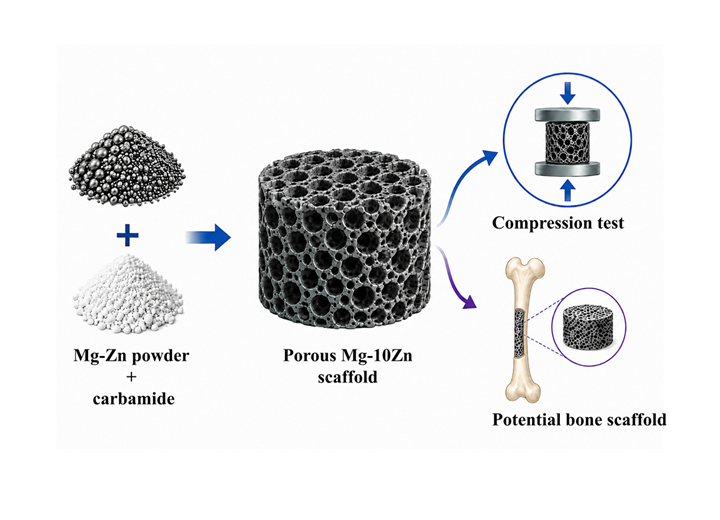
The development of bone scaffold materials must balance the conflict between high porosity for biological integration and sufficient mechanical strength to support physiological loads. This reasoning underpins the investigation of biodegradable magnesium alloys, which offer biocompatibility and a bone-like modulus to prevent stress-shielding. This study focuses on the low-temperature fabrication of a porous Mg-10 wt% Zn alloy scaffold via powder metallurgy route, with the purpose of rigorously characterizing its mechanical properties and establish a critical structure-property relationships fabricated for bone implant applications. Therefore, scaffolds with target porosities of 40%, 60%, and 70% were fabricated, with the resultant architectural analysis confirming achieved porosities of 40.65%, 60.38%, and 68.70%, respectively. Their mechanical performance was evaluated through Vickers microhardness measurements and uniaxial compressive testing. Interestingly, the microhardness of the scaffolds remained nearly constant at approximately 42.3 ± 3.0 HV, irrespective of porosity. Whereas, the compressive strength demonstrated a predictable decline with increasing porosity, from 20.11 ± 0.40 MPa to 3.81 ± 0.45 MPa. Crucially, all three scaffold variants exhibited compressive strength and elastic modulus values that fall within the documented range for human cancellous bone. The results demonstrate that low-temperature fabricated Mg-10 wt% Zn scaffolds provide tunable porosity and predictable mechanical performance, offering a basis for future investigations into their degradation behavior and biological response.
Downloads
References
Y. Liu, L. He, L. Cheng, X. Li, M. Gao, Q. Li, J. Gao, and M. Ramalingam, “Enhancing bone grafting outcomes: A comprehensive review of antibacterial artificial composite bone scaffolds,” Medical Science Monitor, vol. 29, p. e939972, 2023. DOI: https://doi.org/10.12659/MSM.939972
S. Singhawannurat, P. Lawtae, C. Rojviriya, and C. Phoovasawat, “Development of PLA/HA porous scaffolds with controlled pore sizes using the combined freeze drying and sucrose leaching technique for bone tissue engineering,” Journal of Metals, Materials and Minerals, vol. 34, no. 2, p. 1928, 2024. DOI: https://doi.org/10.55713/jmmm.v34i2.1928
D. B. Burr, “Bone morphology and organization,” in Basic and Applied Bone Biology, Elsevier, 2019, pp. 3–26. DOI: https://doi.org/10.1016/B978-0-12-813259-3.00001-4
M. F. S. F. de Moura, and N. Dourado, “Fracture and fatigue characterisation of cortical bone tissue,” Boca Raton: CRC Press, 2024. DOI: https://doi.org/10.1201/9781003375081
P. Baskaran, B. Muthiah, and V. Uthirapathy, “A systematic review on biomaterials and their recent progress in biomedical applications: bone tissue engineering,” Reviews in Inorganic Chemistry, vol. 45, no. 4, pp. 747‒781, 2025. DOI: https://doi.org/10.1515/revic-2024-0062
H. Shao, K. Wen, R. Liu, N. Ding, Y. Gong, Y. Zhuang, and Y. He, “3D Printing of Bioceramic Multifunctional Scaffolds for Bone Tissue Engineering,” Advanced Functional Materials, vol. 35, no. 49, 2025. DOI: https://doi.org/10.1002/adfm.202509039
X. Gu, Y. Zheng, Y. Cheng, S. Zhong, and T. Xi, “In vitro corrosion and biocompatibility of binary magnesium alloys,” Biomaterials, vol. 30, no. 4, pp. 484–498, 2009. DOI: https://doi.org/10.1016/j.biomaterials.2008.10.021
F. Witte, V. Kaese, H. Haferkamp, E. Switzer, A. Meyer-Lindenberg, C. J. Wirth, and H. Windhagen, “In vivo corrosion of four magnesium alloys and the associated bone response,” Biomaterials, vol. 26, no. 17, pp. 3557–3563, 2005. DOI: https://doi.org/10.1016/j.biomaterials.2004.09.049
G. Song, “Control of biodegradation of biocompatable magnesium alloys,” Corrosion Science, vol. 49, no. 4, pp. 1696–1701, 2007. DOI: https://doi.org/10.1016/j.corsci.2007.01.001
B. Homayun, and A. Afshar, “Microstructure, mechanical properties, corrosion behavior and cytotoxicity of Mg–Zn–Al–Ca alloys as biodegradable materials,” Journal of Alloys and Compounds, vol. 607, pp. 1–10, 2014. DOI: https://doi.org/10.1016/j.jallcom.2014.04.059
L. M. Plum, L. Rink, and H. Haase, “The essential toxin: Impact of zinc on human health,” International Journal of Environmental Research and Public Health, vol. 7, no. 4, pp. 1342–1365, 2010. DOI: https://doi.org/10.3390/ijerph7041342
A. Cheng, Z. Schwartz, A. Kahn, X. Li, Z. Shao, M. Sun, Y. Ao, B. D. Boyan, and H. Chen, “Advances in porous scaffold design for bone and cartilage tissue engineering and regeneration,” Tissue Engineering Part B: Reviews, vol. 25, no. 1, pp. 14–29, 2019. DOI: https://doi.org/10.1089/ten.teb.2018.0119
G. Hannink, and J. J. C. Arts, “Bioresorbability, porosity and mechanical strength of bone substitutes: What is optimal for bone regeneration?,” Injury, vol. 42, pp. S22–S25, 2011. DOI: https://doi.org/10.1016/j.injury.2011.06.008
Y. Hu, X. Guo, Y. Qiao, X. Wang, and Q. Lin, “Preparation of medical Mg–Zn alloys and the effect of different zinc contents on the alloy,” Journal of Materials Science: Materials in Medicine, vol. 33, no. 1, p. 9, 2022. DOI: https://doi.org/10.1007/s10856-021-06637-0
B. Arifvianto, and J. Zhou, “Fabrication of metallic biomedical scaffolds with the space holder method: A review,” Materials, vol. 7, no. 5, pp. 3588–3622, 2014. DOI: https://doi.org/10.3390/ma7053588
S. Sathaiah, L. Singh, N. R. Gorhe, T. C. Joshi, A. Pandey, A. N. Ch. Venkat, G. K. Gupta, L. M. Joshi, K. K. Saxena, and D. P. Mondal, “Effect of compaction pressure on microstructural, mechanical, and thermal properties of aluminum foams processed through space-holder technique,” Journal of Materials Engineering and Performance, vol. 34, no. 1‒2, pp. 6351–6361, 2025. DOI: https://doi.org/10.1007/s11665-024-09614-0
V. Moeun, and S. Asavavisithchai, “Effect of compaction pressure on the structure and mechanical properties of functionally graded aluminium-glass microsphere (FGAGM) foams produced by powder metallurgy process,” Journal of Metals, Materials and Minerals, vol. 35, no. 4, p. e2432, 2025. DOI: https://doi.org/10.55713/jmmm.v35i4.2432
P. Jiang, C. Blawert, and M. L. Zheludkevich, “The corrosion performance and mechanical properties of Mg-Zn based alloys—A review,” Corrosion and Materials Degradation, vol. 1, no. 1, pp. 92–158, 2020. DOI: https://doi.org/10.3390/cmd1010007
F. Stein, and A. Leineweber, “Laves phases: A review of their functional and structural applications and an improved fundamental understanding of stability and properties,” Journal of Materials Science, vol. 56, no. 9, pp. 5321–5427, 2021. DOI: https://doi.org/10.1007/s10853-020-05509-2
J. Dong, P. Lin, N. E. Putra, N. Tumer, M. A. Leeflang, Z. Huan, L. E. Fratila-Apachitei, J. Chang, A. A. Zadpoor, and J. Zhou, “Extrusion-based additive manufacturing of Mg-Zn/bioceramic composite scaffolds,” Acta Biomaterialia, vol. 151, pp. 628–646, 2022. DOI: https://doi.org/10.1016/j.actbio.2022.08.002
A. Mostafa, and M. Medraj, “Phase equilibria of the Ce-Mg-Zn ternary system at 300℃,” Metals, vol. 4, no. 2, pp. 168–195, 2014. DOI: https://doi.org/10.3390/met4020168
C. C. Kammerer, N. S. Kulkarni, R. J. Warmack, and Y. H. Sohn, “Interdiffusion and impurity diffusion in polycrystalline Mg solid solution with Al or Zn,” Journal of Alloys and Compounds, vol. 617, pp. 968–974, 2014. DOI: https://doi.org/10.1016/j.jallcom.2014.07.193
M. A. F. Romzi, J. Alias, and M. I. M. Ramli, “Effect of zinc (Zn) on the microstructure and corrosion behaviour of magnesium (Mg),” Materials Today: Proceedings, vol. 48, pp. 1873–1879, 2022. DOI: https://doi.org/10.1016/j.matpr.2021.09.261
J. M. Byun, J. M. Yu, D. K. Kim, T.-Y. Kim, W.-S. Jung, and Y. Do Kim, “Corrosion behavior of Mg2Zn11 and MgZn2 single phases,” Korean Journal of Metals and Materials, vol. 51, no. 6, pp. 413–419, 2013. DOI: https://doi.org/10.3365/KJMM.2013.51.6.413
M. Valant, D. Suvorov, R. C. Pullar, K. Sarma, and N. McN. Alford, “A mechanism for low-temperature sintering,” Journal of the European Ceramic Society, vol. 26, no. 13, pp. 2777–2783, 2006. DOI: https://doi.org/10.1016/j.jeurceramsoc.2005.06.026
Z. Chen, T. Takeda, and K. Ikeda, “Microstructural evolution of reactive-sintered aluminum matrix composites,” Composites Science and Technology, vol. 68, no. 10–11, pp. 2245–2253, 2008. DOI: https://doi.org/10.1016/j.compscitech.2008.04.006
T. N. Saraçoğlu, S. Polat, E. Koç, M. Mashrah, A. Najah Saud, and M. Michalska-Domańska, “Investigating the oxidation behavior of Mg-Zn alloy: Effects of heating rates, gas flow, protective atmosphere, and alloy composition,” Journal of Metals, Materials and Minerals, vol. 34, no. 3, p. 2033, 2024. DOI: https://doi.org/10.55713/jmmm.v34i3.2033
H. Yang, B. Jia, Z. Zhang, X. Qu, G. Li, W. Lin, D. Zhu, K. Dai, and Y. Zheng, “Alloying design of biodegradable zinc as promising bone implants for load-bearing applications,” Nature Communications, vol. 11, no. 1, p. 401, 2020. DOI: https://doi.org/10.1038/s41467-019-14153-7
S. Wu, X. Liu, K. W. K. Yeung, C. Liu, and X. Yang, “Biomimetic porous scaffolds for bone tissue engineering,” Materials Science and Engineering: R: Reports, vol. 80, pp. 1–36, 2014. DOI: https://doi.org/10.1016/j.mser.2014.04.001
X. Wang, S. Xu, S. Zhou, W. Xu, M. Leary, P. Choong, M. Qian, M. Brandt, and Y. M. Xie, “Topological design and additive manufacturing of porous metals for bone scaffolds and orthopaedic implants: A review,” Biomaterials, vol. 83, pp. 127–141, 2016. DOI: https://doi.org/10.1016/j.biomaterials.2016.01.012
S. Teslia, M. Kovalenko, M. Teslia, M. Vterkovskiy, I. Solodkyi, P. Loboda, and T. Soloviova, “The activation of magnesium sintering by zinc addition,” Alloys, vol. 3, no. 3, pp. 178–189, 2024. DOI: https://doi.org/10.3390/alloys3030011
Z. S. Seyedraoufi, and Sh. Mirdamadi, “Synthesis, microstructure and mechanical properties of porous Mg Zn scaffolds,” Journal of the Mechanical Behavior of Biomedical Materials, vol. 21, pp. 1–8, 2013. DOI: https://doi.org/10.1016/j.jmbbm.2013.01.023
Q. Fu, E. Saiz, M. N. Rahaman, and A. P. Tomsia, “Toward strong and tough glass and ceramic scaffolds for bone repair,” Advanced Functional Materials, vol. 23, no. 44, pp. 5461–5476, 2013. DOI: https://doi.org/10.1002/adfm.201301121
L. J. Gibson, “The mechanical behaviour of cancellous bone,” Journal of Biomechanics, vol. 18, no. 5, pp. 317–328, 1985. DOI: https://doi.org/10.1016/0021-9290(85)90287-8
B. Parveez, N. A. Jamal, H. Anuar, Y. Ahmad, A. Aabid, and M. Baig, “Microstructure and mechanical properties of metal foams fabricated via melt foaming and powder metallurgy technique: A review,” Materials, vol. 15, no. 15, p. 5302, 2022. DOI: https://doi.org/10.3390/ma15155302
L. J. Gibson, and M. F. Ashby, “Material properties,” in Cellular Solids Structure and Properties, Cambridge University Press, 1997, pp. 52–92. DOI: https://doi.org/10.1017/CBO9781139878326.005
G. Luo, Y. Zhu, R. Zhang, C. Peng, Q. Liu, J. Zhang, Y. San, H. Yuan, W. Guo, Q. Shen, and L. Zhang, “A review on mechanical models for cellular media: Investigation on material characterization and numerical simulation,” Polymers, vol. 13, no. 19, p. 3283, 2021. DOI: https://doi.org/10.3390/polym13193283
K. Ćwieka, and J. Skibiński, “Elastic properties of open cell metallic foams—modeling of pore size variation effect,” Materials, vol. 15, no. 19, p. 6818, 2022. DOI: https://doi.org/10.3390/ma15196818
J. O. Osorio-Hernández, M. A. Suarez, R. Goodall, G. A. Lara-Rodriguez, I. Alfonso, and I. A. Figueroa, “Manufacturing of open-cell Mg foams by replication process and mechanical properties,” Materials & Design, vol. 64, pp. 136–141, 2014. DOI: https://doi.org/10.1016/j.matdes.2014.07.015
X. Wang, Z. Li, Y. Huang, K. Wang, X. Wang, and F. Han, “Processing of magnesium foams by weakly corrosive and highly flexible space holder materials,” Materials & Design, vol. 64, pp. 324–329, 2014. DOI: https://doi.org/10.1016/j.matdes.2014.07.049
Y. Yan, Y. Kang, D. Li, K. Yu, T. Xiao, Q. Wang, Y. Deng, H. Fang, D. Jiang, and Y. Zhang, “Microstructure, mechanical properties and corrosion behavior of porous Mg-6 wt% Zn Scaffolds for bone tissue engineering,” Journal of Materials Engineering and Performance, vol. 27, no. 3, pp. 970–984, 2018. DOI: https://doi.org/10.1007/s11665-018-3189-x
N. Zou, and Q. Li, “Mechanical properties of lightweight porous magnesium processed through powder metallurgy,” JOM, vol. 70, no. 5, pp. 650–655, 2018. DOI: https://doi.org/10.1007/s11837-018-2772-9
J. Trinidad, I. Marco, Q. Arruebarrena, J. Wendt, D. Letzig, E. S. de Argandona, and R. Goodall, “Processing of magnesium porous structures by infiltration casting for biomedical applications,” Advanced Engineering Materials, vol. 16, no. 2, pp. 241–247, 2014. DOI: https://doi.org/10.1002/adem.201300236
G. Jiang, and G. He, “A new approach to the fabrication of porous magnesium with well-controlled 3D pore structure for orthopedic applications,” Materials Science and Engineering C, vol. 43, pp. 317–320, 2014. DOI: https://doi.org/10.1016/j.msec.2014.07.033
G. L. Hao, F. S. Han, and W. D. Li, “Processing and mechanical properties of magnesium foams,” Journal of Porous Materials, vol. 16, no. 3, pp. 251–256, 2009. DOI: https://doi.org/10.1007/s10934-008-9194-y
S. F. Aida, H. Zuhailawati, and A. S. Anasyida, “The Effect of space holder content and sintering temperature of magnesium foam on microstructural and properties prepared by sintering dissolution process (SDP) using carbamide space holder,” Procedia Engineering, vol. 184, pp. 290–297, 2017. DOI: https://doi.org/10.1016/j.proeng.2017.04.097
S. Toghyani, and M. Khodaei, “Modified spacer removal and optimum sintering temperature for porous magnesium scaffold fabrication,” Journal of Tissue and Materials, vol. 2, pp. 48‒57, 2019.
Downloads
Published
How to Cite
Issue
Section
Categories
License
Copyright (c) 2026 Journal of Metals, Materials and Minerals

This work is licensed under a Creative Commons Attribution-NonCommercial-NoDerivatives 4.0 International License.
Authors who publish in this journal agree to the following terms:
- Authors retain copyright and grant the journal right of first publication with the work simultaneously licensed under a Creative Commons Attribution License that allows others to share the work with an acknowledgment of the work's authorship and initial publication in this journal.
- Authors are able to enter into separate, additional contractual arrangements for the non-exclusive distribution of the journal's published version of the work (e.g., post it to an institutional repository or publish it in a book), with an acknowledgment of its initial publication in this journal.