Tailoring energy storage properties of epoxy composites using ferroelectric, anti-ferroelectric particles and hybrid ceramic fillers
DOI:
https://doi.org/10.55713/jmmm.v37i1.2683Keywords:
Ferroelectric, Antiferroelectric, Epoxy-based composites, Energy storage performanceAbstract
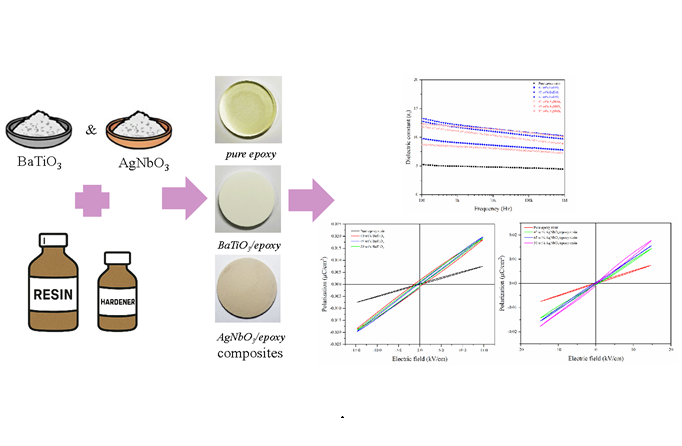
Epoxy-based dielectric composites reinforced with ferroelectric BaTiO3 and antiferroelectric AgNbO3 were fabricated and comprehensively evaluated to investigate the influence of filler type and composition on dielectric and energy storage performance. Structural, spectroscopic and microstructural analyses confirmed the successful incorporation of the ceramic fillers within the epoxy matrix. BaTiO3/epoxy composites exhibited markedly enhanced dielectric permittivity and polarization, resulting in a maximum recoverable energy density of 134.4 mJ·cm‒3, albeit with moderate charge-discharge efficiency due to hysteresis-induced energy loss. In contrast, AgNbO3/epoxy composites displayed lower permittivity but significantly reduced dielectric loss and excellent efficiency, reaching up to 96.7%, owing to low remanent polarization and a highly reversible dielectric response. Building on these complementary characteristics, hybrid BaTiO3-AgNbO3/epoxy composites were developed and found to provide complementary improvements in dielectric and energy-storage performance. The optimal hybrid formulation (15 wt% BaTiO3/30 wt% AgNbO3) achieved the highest recoverable energy density of 155.8 mJ·cm‒3, while the equimolar hybrid (22.5/22.5) provided exceptional efficiency of 99.06% with minimal energy loss. These enhancements arise from the complementary dielectric responses of the two ceramic fillers together with polymer-ceramic interfacial effects. The results demonstrate that combining ferroelectric and antiferroelectric fillers offers a powerful strategy for tailoring the dielectric response and optimizing energy storage performance in polymer-based composites.
Downloads
References
P. Premwichit, S. Jaila, and S. Prasertpalichat, “Effect of lanthanum doping on phase transition, piezoelectric and energy storage properties of lead-free 0.93(Bi0.5Na0.5)TiO3-0.07BaTiO3 ceramics,” Journal of Metals, Materials and Minerals, vol. 35, no. 4, p. e2358, 2025. DOI: https://doi.org/10.55713/jmmm.v35i4.2358
S. Priya, and D. J. Inman, Energy Harvesting Technologies. New York, NY, USA: Springer, 2009. DOI: https://doi.org/10.1007/978-0-387-76464-1
Z.-M. Dang, J.-K. Yuan, J.-W. Zha, T. Zhou, S.-T. Li, and G.-H. Hu, “Fundamentals, processes and applications of high-permittivity polymer-matrix composites,” Progress in Materials Science, vol. 57, pp. 660‒723, 2012. DOI: https://doi.org/10.1016/j.pmatsci.2011.08.001
G. H. Haertling, “Ferroelectric ceramics: History and technology,” Journal of the American Ceramic Society, vol. 82, no. 4, pp. 797-818, 1999. DOI: https://doi.org/10.1111/j.1151-2916.1999.tb01840.x
M. Krupska-Klimczak, S. M. Fathabad, D. Kajewski, R. Sitko, V. V. Shvartsman, D. C. Lupascu, I. Jankowska-Sumara, “Dielectric, piezoelectric, ferroelectric, and electrocaloric properties of Ba, Sr-doped PZT,” Ceramics International, vol. 51, pp. 19649‒19660, 2025, DOI: https://doi.org/10.1016/j.ceramint.2025.02.139
S. A. Behera, S. Hajra, S. Panda, A. Amanat, and P. G. R. Achary, “Structural and electrical properties of 0.98(K0.5Na0.5NbO3)-0.02(Bi0.5Na0.5TiO3) ceramics,” Journal of Metals, Materials and Minerals, vol. 33, no. 4, p. 1894, 2023. DOI: https://doi.org/10.55713/jmmm.v33i4.1894
G. Liu, S. Zhang, W. Jiang, and W. Cao, “Losses in ferroelectric materials,” Materials Science and Engineering: R: Reports, vol. 89, pp. 1-48, 2015. DOI: https://doi.org/10.1016/j.mser.2015.01.002
Z. Liu, T. Lu, J. Ye, G. Wang, X. Dong, R. Withers, and Y. Liu, “Antiferroelectrics for energy storage applications: A review,” Advanced Materials Technologies, vol. 3, p. 1800111, 2018. DOI: https://doi.org/10.1002/admt.201800111
H. Moriwake, A. Konishi, T. Ogawa, C. A. J. Fisher, A. Kuwabara, and D. Fu, “The electric field induced ferroelectric phase transition of AgNbO3,” Journal of Applied Physics, vol. 119, no. 6, p. 064102, 2016. DOI: https://doi.org/10.1063/1.4941319
M. Cao, L. Li, W. B. Hong, S. Y. Wu, and X. M. Chen, “Greatly enhanced permittivity in BaTiO3-epoxy dielectric composites with improved connectivity of ceramic phase,” Journal of Materiomics, vol. 7, pp. 1‒7, 2021. DOI: https://doi.org/10.1016/j.jmat.2020.07.007
J. Liu, X. You, N. Chen, and G. Du, “Fabrication of BaTiO3/ epoxy composites exhibiting large dielectric constant, low dielectric loss and high flexural strength,” Journal of Wuhan University of Technology-Materials Science Edition, vol. 34, pp. 1266‒1273, 2019. DOI: https://doi.org/10.1007/s11595-019-2188-6
G. Jian, Y. Jiao, Q. Meng, Z. Wei, J. Zhang, C. Yan, K. -s. Moon, and C. P. Wong “Enhanced dielectric constant and energy density in a BaTiO3/polymer-matrix composite sponge,” Communications Materials, vol. 1, p. 91, 2020. DOI: https://doi.org/10.1038/s43246-020-00092-0
H.-Y. Yao, Y.-W. Lin, and T.-H. Chang, “Dielectric properties of BaTiO3-epoxy nanocomposites in the microwave regime,” Polymers, vol. 13, no. 9, p. 1391, 2021. DOI: https://doi.org/10.3390/polym13091391
M. Z. Khan, F. Aslam, and F. Alsaif, “Enhancing the dielectric characteristics and DC flashover of epoxy resin composites by surface modification of AgNbO3 nanoparticles,” Scientific Reports, vol. 15, p. 23522, 2025. DOI: https://doi.org/10.1038/s41598-025-09151-3
K. An, G. Li, T. Fan, F. Huang, W. Wang, and J. Wang, “Enhanced energy storage performance of AgNbO3:xCeO2 by synergistic strategies of tolerance factor and density regulations,” Coatings, vol. 13, no. 3, p. 534, 2023. DOI: https://doi.org/10.3390/coatings13030534
Z. Wang, T. Zhao, D. Wu, Y. Xue, Z. Yi, J. Kang, R. Ye, and N. Guo, “Enhancing dielectric properties and energy storage performance of polyvinylidene fluoride composite by surface-modified AgNbO3 nanoparticles,” High Voltage, vol. 9, pp. 939-947, 2024. DOI: https://doi.org/10.1049/hve2.12438
L. You, B. Liu, H. Hua, H. Jiang, C. Yin, and F. Wen, “Energy storage performance of polymer-based dielectric composites with two-dimensional fillers,” Nanomaterials, vol. 13, p. 2842, 2023. DOI: https://doi.org/10.3390/nano13212842
R.Cheng, Y. Wang, R. Men, Z. Lei, J. Song, Y. Li, and M. Guo, “High-energy-density polymer dielectrics via compositional and structural tailoring for electrical energy storage,” iScience, vol. 25, p. 104837, 2022. DOI: https://doi.org/10.1016/j.isci.2022.104837
J. Hodgkin, “Thermosets: Epoxies and polyesters,” in Encyclopedia of Materials: Science and Technology. Elsevier, 2001, pp. 9215‒9221. DOI: https://doi.org/10.1016/B0-08-043152-6/01660-0
I. Pasuk, F. Neaţu, S. Neatu, M. Florea, M. C. Istrate, I. Pintilie, and L. Pintilie “Structural details of BaTiO3 nanopowders deduced from the anisotropic XRD peak broadening,” Nanomaterials, vol. 11, no. 5, p. 1121, 2021. DOI: https://doi.org/10.3390/nano11051121
G. Li, S. Yan, Z. Wang, X. Wang, Z. Li, J. Ye, and Z. Zou, “Synthesis and visible light photocatalytic property of poly-hedron-shaped AgNbO3,” Dalton Transactions, no. 40, pp. 8519‒8524, 2009. DOI: https://doi.org/10.1039/b906799j
H. Liu, X. Wu, Y. Liu, Z. Guo, Q. Ge, and Z. Sun, “The curing characteristics and properties of bisphenol A epoxy resin/ maleopimaric acid curing system,” Journal of Materials Research and Technology, vol. 21, pp. 1655-1665, 2022. DOI: https://doi.org/10.1016/j.jmrt.2022.10.008
E. Stefan, T. Didriksen, T. O. Sunde, M. L. Fontaine, H. Ræder, and P. M. Rørvik “Effects of powder properties on the 3D printing of BaTiO3 ceramic resins by stereolithography,” Progress in Additive Manufacturing, vol. 8, pp. 1641-1651, 2023. DOI: https://doi.org/10.1007/s40964-023-00431-w
M. Sabu, E. Bementa, Y. J. V. Ruban, and S. G. Mon, “A novel analysis of the dielectric properties of hybrid epoxy composites,” Advanced Composites and Hybrid Materials, vol. 3, pp. 325‒335, 2020. DOI: https://doi.org/10.1007/s42114-020-00166-0
A. Roy, S. Panda, J. Gupta, Anu, R. P. Singh, Deeksha, P. Kour, M. P. Sharma, and K. Yadav, “Effects of interfacial interactions on structural, optical, thermal degradation properties and photo-catalytic activity of low-density polyethylene/BaTiO3 nano-composite,” Polymer, vol. 276, p. 125932, 2023. DOI: https://doi.org/10.1016/j.polymer.2023.125932
I. A. Asimakopoulos, G. C. Psarras, and L. Zoumpoulakis, “Barium titanate/polyester resin nanocomposites,” Express Polymer Letters, vol. 8, no. 9, pp. 692‒707, 2014. DOI: https://doi.org/10.3144/expresspolymlett.2014.72
J.-H. Son, C. A. Ohlin, and W. H. Casey, “Highly soluble iron- and nickel-substituted decaniobates,” Dalton Transactions, vol. 42, pp. 7529‒7533, 2013. DOI: https://doi.org/10.1039/c3dt50887k
X. S. Xing, and R. K. Y. Li, “Wear behavior of epoxy matrix composites filled with sub-micron silica particles,” Wear, vol. 256, pp. 21‒26, 2004. DOI: https://doi.org/10.1016/S0043-1648(03)00220-5
Y. R. Uhm, J. Kim, K. J. Son, and C. S. Kim, “Effect of particle size and dispersion on W reinforced polymer composites,” Research on Chemical Intermediates, vol. 40, pp. 2145‒2153, 2014. DOI: https://doi.org/10.1007/s11164-013-1110-7
M. Samet, A. Kallel, and A. Serghei, “Maxwell-Wagner-Sillars interfacial polarization in composite dielectrics,” Journal of Composite Materials, vol. 56, no. 20, pp. 3197‒3217, 2022. DOI: https://doi.org/10.1177/00219983221090629
O. Gulahmadov, L. R. Qahramanli, M. Muradov, N. N. Musayeva, S. Bellucci, and C. Trapalis, “Optimization of MWCNT concentration in polysiloxane nanocomposites for TENGs,” ACS Omega, vol. 10, no. 42, pp. 50511-50520, 2025. DOI: https://doi.org/10.1021/acsomega.5c08067
Z. Wang, R. Ye, D. Wu, Y. Xue, Z. Yi, and Y. Li “Effect of AgNbO3 morphology on dielectric and energy storage properties of polyvinylidene fluoride-based nanocomposites,” ACS Applied Nano Materials, vol. 6, no. 15, pp. 14374‒14382, 2023. DOI: https://doi.org/10.1021/acsanm.3c02385
K. Xu, S. Tang, C. Guo, Y. Song, and H. Huang, “Antiferroelectric domain modulation enhancing energy storage performance,” Journal of Materiomics, vol. 11, p. 100901, 2025. DOI: https://doi.org/10.1016/j.jmat.2024.04.016
X. Tang, Z. Zhang, K. Zheng, Y. Wu, Z. Chen, C. Wang, and Z. Shi “Low dielectric loss in poly(vinyl alcohol)/graphene metacomposite films with negative permittivity prepared by spin coating,” Polymer, vol. 281, p. 126092, 2023. DOI: https://doi.org/10.1016/j.polymer.2023.126092
K. C. Kao, Dielectric Phenomena in Solids. Elsevier, 2004.
S. Bronnikov, S. Kostromin, M. Asandulesa, D. Pankin, and A. Podshivalov, “Interfacial polarization in polyazomethine/ MWCNTs nanocomposites,” Composites Science and Technology, vol. 190, p. 108049, 2020. DOI: https://doi.org/10.1016/j.compscitech.2020.108049
M. Feng, M. Chen, J. Qiu, M. He, Y. Huang, and J. Lin, “Improving dielectric properties of poly(arylene ether nitrile) composites,” Journal of Alloys and Compounds, vol. 856, p. 158213, 2021. DOI: https://doi.org/10.1016/j.jallcom.2020.158213
H. Wang, and L. Yang, “Dielectric properties and model analysis of electroactive polymers,” Polymer Testing, vol. 120, p. 107965, 2023. DOI: https://doi.org/10.1016/j.polymertesting.2023.107965
R. Landauer, “The electrical resistance of binary metallic mixtures,” Journal of Applied Physics, vol. 23, no. 7, pp. 779‒784, 1952. DOI: https://doi.org/10.1063/1.1702301
K. Lichtenecker, and K. Rother, “Die Herleitung des logarithmischen Mischungsgesetzes,” Physikalische Zeitschrift, vol. 32, pp. 255‒260, 1931.
J. C. M. Garnett, “Colours in metal glasses and metallic films,” Philosophical Transactions of the Royal Society of London Series A, vol. 203, pp. 385‒420, 1904. DOI: https://doi.org/10.1098/rsta.1904.0024
N. Jayasundere, and B. V. Smith, “Dielectric constant for binary piezoelectric 0-3 composites,” Journal of Applied Physics, vol. 73, no. 5, pp. 2462‒2466, 1993. DOI: https://doi.org/10.1063/1.354057
A. Bouhamed, S. Missaoui, A. B. Ayed, A. Attaoui, D. Missaoui, K. Jeder, N. Guesmi, A. Njeh, H. Khemakhem, and O. Kanoun, “A comprehensive review of strategies toward efficient flexible piezoelectric polymer composites based on BaTiO3 for next-generation energy harvesting,” Energies, vol. 17, p. 4066, 2024. DOI: https://doi.org/10.3390/en17164066
J. Zhou, Z. Xu, H. Yang, L. Chu, L. Chen, H. Li, J. Ding, S. Ran, Z. Sun, and X. Hao, “Excellent energy storage performance of lead-based antiferroelectric ceramics via enhancing dielectric breakdown mechanism,” Chemical Engineering Journal, vol. 487, p. 150476, 2024. DOI: https://doi.org/10.1016/j.cej.2024.150476
Downloads
Published
How to Cite
Issue
Section
Categories
License
Copyright (c) 2026 Journal of Metals, Materials and Minerals

This work is licensed under a Creative Commons Attribution-NonCommercial-NoDerivatives 4.0 International License.
Authors who publish in this journal agree to the following terms:
- Authors retain copyright and grant the journal right of first publication with the work simultaneously licensed under a Creative Commons Attribution License that allows others to share the work with an acknowledgment of the work's authorship and initial publication in this journal.
- Authors are able to enter into separate, additional contractual arrangements for the non-exclusive distribution of the journal's published version of the work (e.g., post it to an institutional repository or publish it in a book), with an acknowledgment of its initial publication in this journal.