Utilization of scrap in casting process to increase inventory turnover: A case study in a Thai foundry
DOI:
https://doi.org/10.55713/jmmm.v37i1.2733Keywords:
Inventory turnover, Carbon content, Riser scrap, Casting process, Stainless steelAbstract
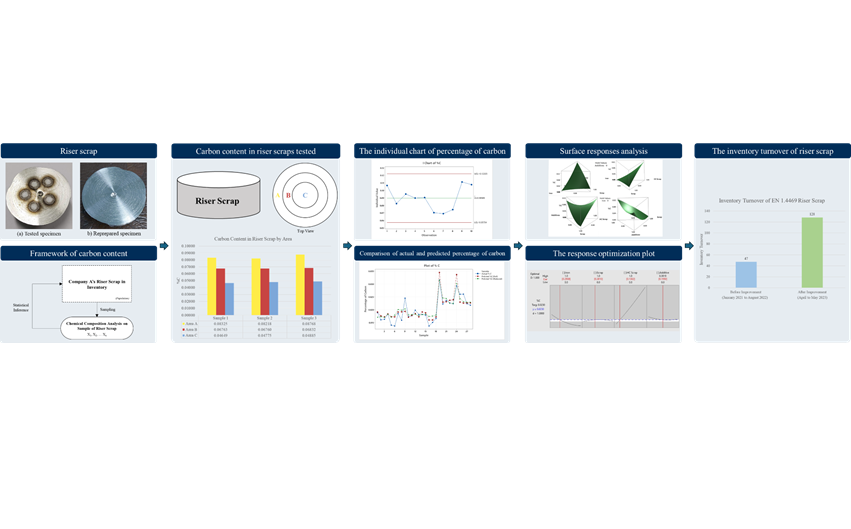
This research aims to enhance inventory turnover by optimizing the utilization of in-house riser scrap in a Thai foundry manufacturing EN 1.4469 stainless steel casting. The foundry currently faces a challenge with excess riser scrap containing high carbon content, which restricts its reuse in the melting process. To address this issue, a mixture design approach using quadratic regression analysis was applied to develop a predictive model for carbon content based on four charge material components: iron, gate-and-runner scrap, high-carbon riser scrap, and additives. Historical production data from 2022 were analyzed, and the optimal charge composition was identified through response optimization. The resulting model exhibited high predictive accuracy, with an adjusted R2 of 94.20% and a mean absolute percentage error (MAPE) of less than 10%. Implementation of the optimized charge mix increased the average proportion of riser scrap from 3% to 13%, leading to a significant improvement in inventory turnover from 47 to 128 within a two-month period. These findings demonstrate the practical value of integrating statistical modeling into foundry operations to improve material efficiency and reduce production waste.
Downloads
References
P. Bhandubanyong, and J. T. Pearce, “Appraisal of SME casting industry in Thailand,” International Scientific Journal of Engineering and Technology (ISJET), vol. 1, no. 1, pp. 1–8. 2017.
S. Cvetkovski, “World casting industry – Preview,” Machines. Technologies. Materials., vol. 9, no. 4, pp. 3–7, 2015.
Marketline. (2022). Global metals & mining. Marketline. Retrieved from https://advantage.marketline.com
M. Holtzer, R. Dańko, and S. Żymankowska-Kumon, “Foundry industry – current state and future development,” Metalurgija, vol. 51, no. 3, pp. 337–340, 2012.
J. De Mast, and J. Lokkerbol, “An analysis of the Six Sigma DMAIC method from the perspective of problem solving. International Journal of Production Economics, vol. 139, no. 2, pp. 604–614, 2012. DOI: https://doi.org/10.1016/j.ijpe.2012.05.035
H. Hsiang-Chin, and S. Ming-Hsien, “Applying Six Sigma to manufacturing processes in the food industry to reduce quality cost,” Scientific Research and Essays, vol. 6, no. 3, pp. 580–591, 2011.
G., Sharma, and P. S. Rao, “A DMAIC approach for process capability improvement: An engine crankshaft manufacturing process,” Journal of Industrial Engineering International, vol. 10, no. 2, pp. 1–11, 2014. DOI: https://doi.org/10.1007/s40092-014-0065-7
A. Kumaravadivel, and U. Natarajan, “Application of Six-Sigma DMAIC methodology to sand-casting process with response surface methodology,” The International Journal of Advanced Manufacturing Technology, vol. 69, no. 5, pp. 1403–1420. 2013. DOI: https://doi.org/10.1007/s00170-013-5119-2
C. Beckermann, and M. C. Schneider, “Simulation of convection and macrosegregation in steel casting,” in Proceedings of the 50th SFSA Technical and Operating Conference, Steel Founders’ Society of America, Chicago, IL, p. 1, 1996.
K. D. Carlson, and C. Beckermann, “Prediction of riser carbon macrosegregation due to shrinkage flow in steel casting,” in Proceedings Of The 64th SFSA Technical And Operating Conference, Paper no. 3.2, 2010.
S. Gao, M. Wang, X. Xie, M. Liu, and Y. Bao, “Behavior of nitrogen in GH4169 superalloy melt during vacuum induction melting using returned materials,” Metals, vol. 11, no. 7, p. 1119, 2021. DOI: https://doi.org/10.3390/met11071119
P. Futáš, A. Pribulová, G. Fedorko, and V. Molnár, “Influence of steel scrap in the charge on the properties of gray cast iron,” ISIJ International, vol. 57, no. 2, pp. 374–379, 2017. DOI: https://doi.org/10.2355/isijinternational.ISIJINT-2016-270
P. Li, X. Li, and F. Li, “A novel recycling and reuse method of iron scraps from machining process,” Journal of Cleaner Production, vol. 266, p. 121732, 2020. DOI: https://doi.org/10.1016/j.jclepro.2020.121732
S. Dutta, A. Lele, and N. Pancholi, “Studies on direct reduced iron melting in induction furnace,” Transactions of the Indian Institute of Metals, vol. 57, no. 5, pp. 467–473, 2004.
M. Poornesh, S. Bhat, E. Gijo, P. K. Bellairu, and O. McDermott, Multi-response modelling and optimisation of mechanical properties of Al-Si alloy using mixture design of experiment approach,” Processes, vol. 10, no. 11, p. 2246, 2022. DOI: https://doi.org/10.3390/pr10112246
D. P. Singh, V. K. Dwivedi, and M. Agarwal, “Application of the DoE approach to the fabrication of cast Al2O3-LM6 composite material and evaluation of its mechanical and microstructural properties. Materials Today: Proceedings, 2023.
Downloads
Published
How to Cite
Issue
Section
Categories
License
Copyright (c) 2026 Journal of Metals, Materials and Minerals

This work is licensed under a Creative Commons Attribution-NonCommercial-NoDerivatives 4.0 International License.
Authors who publish in this journal agree to the following terms:
- Authors retain copyright and grant the journal right of first publication with the work simultaneously licensed under a Creative Commons Attribution License that allows others to share the work with an acknowledgment of the work's authorship and initial publication in this journal.
- Authors are able to enter into separate, additional contractual arrangements for the non-exclusive distribution of the journal's published version of the work (e.g., post it to an institutional repository or publish it in a book), with an acknowledgment of its initial publication in this journal.