Enhancing aqueous solubility of a psoralen derivative via cyclodextrin inclusion complexation: In silico and in vitro study
DOI:
https://doi.org/10.55713/jmmm.v36i3.2610Keywords:
Psoralen derivative, β-Cyclodextrins, Inclusion complex, Computational study, Experimental validationAbstract
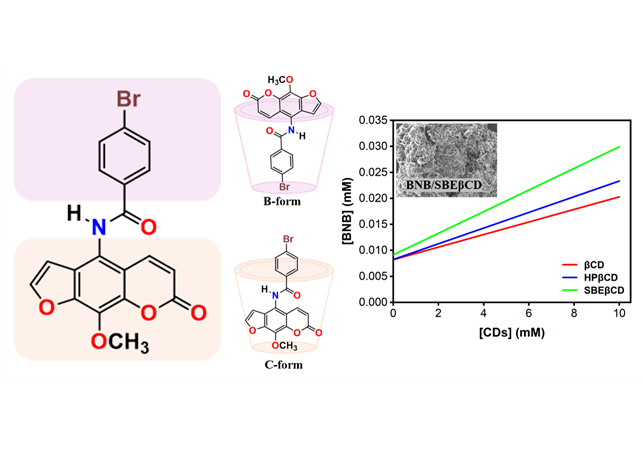
N-(4-Bromobenzoyl)-8-methoxypsoralen-4-amine (BNB) is a psoralen derivative with potent cytotoxic activity against breast cancer cells but with limited pharmaceutical application and therapeutic potential due to its extremely low aqueous solubility. To overcome this limitation, β-cyclodextrin (βCD) and its derivatives dimethyl-βCD (DMβCD), hydroxypropyl-βCD (HPβCD), and sulfobutylether-βCD (SBEβCD) were investigated as carriers to enhance BNB's aqueous solubility via cyclodextrin inclusion complexation. A combined computational–experimental strategy was employed, integrating molecular docking, 500-ns all-atom molecular dynamics simulations in quintuplicate runs (2.5 µs in total), and experimental validation by phase solubility analysis, scanning electron microscopy (SEM), and differential scanning calorimetry (DSC). Docking and simulations revealed stable host–guest interactions, with SBEβCD showing the most favorable binding free energies, the highest number of atomic contacts, and the lowest solvent-accessible surface area, indicative of deep and stable encapsulation. Phase solubility studies corroborated these findings, with BNB/SBEβCD exhibiting the highest apparent stability constant. The formation of the inclusion complex was further supported by SEM and DSC, which revealed pronounced morphological changes and thermal evidence consistent with encapsulation, including suppression of the BNB melting endotherm. 1H NMR spectroscopic analysis further confirmed complex formation through observed peak broadening and chemical shift perturbations upon complexation. Collectively, these results identify SBEβCD as a highly effective carrier for BNB, offering a rational approach to improve solubility through stable complex formation, and supporting its potential as a promising chemotherapeutic candidate for breast cancer treatment.
Downloads
References
U. Veronesi, P. Boyle, A. Goldhirsch, R. Orecchia, and G. Viale, "Breast cancer," Lancet, vol. 365, no. 9472, p. 1727–1741, 2005. DOI: https://doi.org/10.1016/S0140-6736(05)66546-4
R. L. Siegel, K. D. Miller, N. S. Wagle, and A. Jemal, "Cancer statistics, 2023," CA: A Cancer Journal for Clinicians, vol. 73, no. 1, p. 17–48, 2023. DOI: https://doi.org/10.3322/caac.21763
K. Barzaman, J. Karami, Z. Zarei, A. Hosseinzadeh, M. H. Kazemi, S. Moradi-Kalbolandi, E. Safari, and L. Farahmand, "Breast cancer: Biology, biomarkers, and treatments," International Immunopharmacology, vol. 84, p. 106535, 2020. DOI: https://doi.org/10.1016/j.intimp.2020.106535
R. Matsuyama, S. Reddy, and T. J. Smith, "Why do patients choose chemotherapy near the end of life? A review of the perspective of those facing death from cancer," Journal of Clinical Oncology, vol. 24, no. 21, p. 3490–3496, 2006. DOI: https://doi.org/10.1200/JCO.2005.03.6236
K. H. Antman, P. A. Rowlings, W. P. Vaughan, C. J. Pelz, J. W. Fay, K. K. Fields C. O. Freytes, R. P. Gale, B. E. Hillner, H. K. Hollang, M. J. Kennedy, J. P. Klein, H. M. Lazarus, P. L. Mc Carthy Jr, R. Saez, G. Spitzer, E. A. Stadtmauer, S. F. Williams, S. Wolff, K. A. Sobocinski, J. O. Armitage, and M. M. Horowitz, "High-dose chemotherapy with autologous hematopoietic stem-cell support for breast cancer in North America," Journal of Clinical Oncology, vol. 15, no. 5, p. 1870–1879, 1997. DOI: https://doi.org/10.1200/JCO.1997.15.5.1870
C. Aekrungrueangkit, S. Wangngae, A. Kamkaew, R. Ardkhean, S. Thongnest, J. Boonsombat, S. Ruchirawat, and T. Khotavivattana, "Novel psoralen derivatives as anti-breast cancer agents and their light-activated cytotoxicity against HER2 positive breast cancer cells," Scientific Reports, vol. 12, no. 1, p. 13487, 2022. DOI: https://doi.org/10.1038/s41598-022-17625-x
W. Saenger, "Cyclodextrin Inclusion compounds in research and industry," Angewandte Chemie International Edition, vol. 19, no. 5, p. 344–362, 2003. DOI: https://doi.org/10.1002/anie.198003441
J. Szejtli, "Introduction and general overview of cyclodextrin chemistry," Chemical Reviews, vol. 98, no. 5, p. 1743–1754, 1998. DOI: https://doi.org/10.1021/cr970022c
V. Aiassa, C. Garnero, A. Zoppi, and M. R. Longhi, "Cyclodextrins and their derivatives as drug stability modifiers," Pharmaceuticals, vol. 16, no. 8, p. 1074, 2023. DOI: https://doi.org/10.3390/ph16081074
K. Kerdpol, J. Kicuntod, P. Wolschann, S. Mori, C. Rungnim, M. Kunaseth, H. Okumura, N. Kungwan, and T. Rungrotmongkol, "Cavity closure of 2-hydroxypropyl-beta-cyclodextrin: Replica exchange molecular dynamics simulations," Polymers (Basel), vol. 11, no. 1, p. 145, 2019. DOI: https://doi.org/10.3390/polym11010145
E. M. M. Del Valle, "Cyclodextrins and their uses: A review. Process Biochemistry, vol. 39, no. 9, p. 1033–1046, 2004. DOI: https://doi.org/10.1016/S0032-9592(03)00258-9
S. Tommasini, D. Raneri, R. Ficarra, M. L. Calabro, R. Stancanelli, and P. Ficarra, Improvement in solubility and dissolution rate of flavonoids by complexation with beta-cyclodextrin," Journal of Pharmaceutical and Biomedical Analysis, vol. 35, no. 2, p. 379–87, 2004. DOI: https://doi.org/10.1016/S0731-7085(03)00647-2
G. Astray, C. Gonzalez-Barreiro, J. C. Mejuto, R. Rial-Otero, and J. Simal-Gándara, "A review on the use of cyclodextrins in foods," Food Hydrocolloids, vol. 23, no. 7, p. 1631–1640, 2009. DOI: https://doi.org/10.1016/j.foodhyd.2009.01.001
M. J Frisch, G. W Trucks, H. B Schlegel, G. E Scuseria, M. A Robb, J. R Cheeseman, G Scalmani, V Barone, G. A Petersson, H. Nakatsuji, X. Li, M. Caricato, A.V. Marenich, J. Bloino, B.G. Janesko, R. Gomperts, B. Mennucci, H. P. Hratchian, J.V. Ortiz, A. F. Izmaylov, J. L. Sonnenberg, D. Williams-Young, F. Ding, F. Lipparini, F. Egidi, J. Goings, B. Peng, A. Petrone, T. Henderson, D. Ranasinghe, V. G. Zakrzewski, J. Gao, N. Rega, G. Zheng, W. Liang, M. Hada, M. Ehara, K. Toyota, R. Fukuda, J. Hasegawa, M. Ishida, T. Nakajima, Y. Honda, O. Kitao, H. Nakai, T. Vreven, K. Throssell, J. A. Montgomery Jr, J. E. Peralta, F. Ogliaro, M. J. Bearpark, J. J. Heyd, E. N. Brothers, K. N. Kudin, V. N. Staroverov, T. A. Keith, R. Kobayashi, J. Normand, K. Raghavachari, A. P. Rendell, J. C. Burant, S. S. Iyengar, J. Tomasi, M. Cossi, J. M. Millam, M. Klene, C. Adamo, R. Cammi, J. W. Ochterski, R. L. Martin, K. Morokuma, O. Farkas, J. B. Foresman, and D. J. Fox, "Gaussian 16 Rev. C.01," Wallingford CT, no. 421, 2016.
Marvin. 23.14.0. (2023).
A. Oo, P. Mahalapbutr, K. Krusong, P. Liangsakul, S. Thanasan-surapong, V. Reutrakul, C. Kuhakarn, P. Maitarad, A. Silsirivanit, P. Wolschann, S. Putthisen, K. Kerdpol, and T. Rungrotmongkol, "Inclusion complexation of emodin with various β-cyclodextrin derivatives: Preparation, characterization, molecular docking, and anticancer activity," Journal of Molecular Liquids, vol. 367, Art. no. 120314, 2022. DOI: https://doi.org/10.1016/j.molliq.2022.120314
H. M. A. D. A. Case, K. A. A. Belfon, I. Y. Ben-Shalom, J. T. Berryman, S. R. Brozell, D. S. Cerutti, et al.,, "Amber 2022," 2022.
K. N. Kirschner, A. B. Yongye, S. M. Tschampel, J. Gonzalez-Outeirino, C. R. Daniels, B. L. Foley, and R. J. Woods, "GLYCAM06: A generalizable biomolecular force field," Journal of Computational Chemistry, vol. 29, no. 4, p. 622–655, 2008. DOI: https://doi.org/10.1002/jcc.20820
J. Wang, R. M. Wolf, J. W. Caldwell, P. A. Kollman, and D. A. Case, "Development and testing of a general amber force field. Journal of Computational Chemistry, vol. 25, no. 9, p. 1157–1174, 2004. DOI: https://doi.org/10.1002/jcc.20035
W. L. Jorgensen, J. Chandrasekhar, J. D. Madura, R. W. Impey, and M. L. Klein, "Comparison of simple potential functions for simulating liquid water," Journal of Computational Physics, vol. 79, no. 2, p. 926–935, 1983. DOI: https://doi.org/10.1063/1.445869
J. Ryckaert, G. Ciccotti, and H. J. C. Berendsen, "Numerical integration of the cartesian equations of motion of a system with constraints: molecular dynamics of n-alkanes," Journal of Computational Physics, vol. 23, no. 3, p. 327–341, 1977. DOI: https://doi.org/10.1016/0021-9991(77)90098-5
D. M. York, T. A. Darden, and L. G. Pedersen, "The effect of long-range electrostatic interactions in simulations of macro-molecular crystals: A comparison of the Ewald and truncated list methods," Journal of Computational Physics, vol. 99, no. 10, p. 8345–8348, 1993. DOI: https://doi.org/10.1063/1.465608
T. Higuchi, and A. L. Connors, "Phase solubility techniques," Advances in Analytical Chemistry and Instrumentation, vol. 4, pp. 117–212, 1965.
J. A. Kamimura, E. H. Santos, L. E. Hill, and C. L. Gomes, "Antimicrobial and antioxidant activities of carvacrol micro-encapsulated in hydroxypropyl-beta-cyclodextrin," LWT - Food Science and Technology, vol. 57, no. 2, p. 701–709, 2014. DOI: https://doi.org/10.1016/j.lwt.2014.02.014
C. S. Marques, S. G. Carvalho, L. D. Bertoli, J. C. O. Villanova, P. F. Pinheiro, D. C. M. Dos Santos, M. I. Yoshida, J. C. C. de Freitas, D. F. Cipriano, and P. C. Bernardes, "ꞵ-Cyclodextrin inclusion complexes with essential oils: Obtention, characterization, antimicrobial activity and potential application for food preservative sachets," Food Research International, vol. 119, p. 499–509, 2019. DOI: https://doi.org/10.1016/j.foodres.2019.01.016
C. Preuksarattanawut, W. Mangmee, M. Prousoontorn, E. Nisarattanaporn, and K. Siraleartmukul, "Enhancing stability and antioxidant efficacy of fisetin by encapsulating as β-cyclodextrin inclusion complex with porous polylactic acid film from breath figure," Journal of Metals, Materials and Minerals, vol. 31, no. 1, 2021. DOI: https://doi.org/10.55713/jmmm.v31i1.1028
N. Yasuda, S. Ali, A. Aman, K. Krusong, N. Herfindo, W. Chavasiri, K. Choowongkomon, P. Wolschann, P. Mahalapbutr, T. Rungrotmongkol, and S. Hannongbua, "In vitro and in silico studies of the inclusion complexation of 8-bromobaicalein with beta-cyclodextrins," Journal of Molecular Graphics and Modelling, vol. 132, p. 108840, 2024. DOI: https://doi.org/10.1016/j.jmgm.2024.108840
S. Ali, P. Saokaew, A. Aman, D. Todsaporn, K. Sanachai, K. Krusong, S. Hannongbua, P. Eolscann, P. Mahalapbutr, and T. Rungrotmongkol, "Enhancing solubility and stability of piperine using beta-cyclodextrin derivatives: computational and experimental investigations," Journal of Biomolecular Structure and Dynamics, vol. 43, no. 5, p. 2596–2609, 2025. DOI: https://doi.org/10.1080/07391102.2024.2305696
J. He, Z. P. Zheng, Q. Zhu, F. Guo, and J. Chen, "Encapsulation mechanism of oxyresveratrol by ꞵ-cyclodextrin and hydroxypropyl- beta-cyclodextrin and computational analysis," Molecules, vol. 22, no. 11, 2017. DOI: https://doi.org/10.3390/molecules22111801
A. Matencio, F. Garcia-Carmona, and J. M. Lopez-Nicolas, "The inclusion complex of oxyresveratrol in modified cyclo-dextrins: A thermodynamic, structural, physicochemical, fluorescent and computational study," Food Chemistry, vol. 232, p. 177–184, 2017. DOI: https://doi.org/10.1016/j.foodchem.2017.04.027
A. S. Jain, A. A. Date, R. R. Pissurlenkar, E. C. Coutinho, and M. S. Nagarsenker, "Sulfobutyl ether(7) beta-cyclodextrin (SBE(7) beta-CD) carbamazepine complex: Preparation, characterization, molecular modeling, and evaluation of in vivo anti-epileptic activity," American Association of Pharmaceutical Scientists PharmSciTech, vol. 12, no. 4, p. 1163–75, 2011. DOI: https://doi.org/10.1208/s12249-011-9685-z
S. Ali, A. Aman, K. Hengphasatporn, L. Oopkaew, B. Todee, R. Fujiki, et al., Evaluating solubility, stability, and inclusion complexation of oxyresveratrol with various beta-cyclodextrin derivatives using advanced computational techniques and experimental validation. Computational Biology and Chemistry, vol. 12, p. 108111, 2024. DOI: https://doi.org/10.1016/j.compbiolchem.2024.108111
A. Aman, S. Ali, P. Mahalapbutr, K. Krusong, P. Wolschann, and T. Rungrotmongkol, "Enhancing solubility and stability of sorafenib through cyclodextrin-based inclusion complexation: in silico and in vitro studies," RSC Advances, vol. 13, no. 39, p. 27244–27254, 2023. DOI: https://doi.org/10.1039/D3RA03867J
F. F. Vincieri, G. Mazzi, N. Mulinacci, M. Bambagiotti-Alberti, F. Dall' Acqua, and D. Vedaldi, "Improvement of dissolution characteristics of psoralen by cyclodextrins complexation," Farmaco, vol. 50, no. 7-8, p. 543–547, 1995.
R. D. Machado, J. C. G. Silva, L. A. D. Silva, G. A. R. Oliveira, L. M. Liao, E. M. Lima, M. C. de Morais, E. C. da Conceicao, and K. R. Rezende, "Improvement in solubility-permeability Interplay of psoralens from brosimum gaudichaudii plant extract upon complexation with hydroxypropyl-beta-cyclodextrin," Molecules, vol. 27, no. 14, 2022. DOI: https://doi.org/10.3390/molecules27144580
P. Mahalapbutr, K. Thitinanthavet, T. Kedkham, H. Nguyen, L. t. h. Theu, S. Dokmaisrijan, L. Huyuh, N. Kungwan, and T. Rungrotmongkol, "A theoretical study on the molecular encapsulation of luteolin and pinocembrin with various derivatized beta-cyclodextrins," Journal of Molecular Structure, vol. 1180, p. 480–490, 2019. DOI: https://doi.org/10.1016/j.molstruc.2018.12.025
S. Li, L. Yuan, Y. Chen, W. Zhou, and X. Wang, "Studies on the inclusion complexes of daidzein with beta-cyclodextrin and derivatives," Molecules, vol. 22, no. 12, 2017. DOI: https://doi.org/10.3390/molecules22122183
A. Aman, S. Ali, L. Oopkaew, P. Mahalapbutr, A. Ismail, K. Krusong, P. Wolschann, and T. Rungrotmongkol, "Inclusion complexes of regorafenib with beta- and gamma-cyclodextrin derivatives: In silico and in vitro studies," Journal of Molecular Liquids, vol. 411, 2024. DOI: https://doi.org/10.1016/j.molliq.2024.125645
D. Wang, G. Chen, and L. Ren, "Preparation and characterization of the sulfobutylether-beta-cyclodextrin inclusion complex of amiodarone hydrochloride with enhanced oral bioavailability in fasted state," American Association of Pharmaceutical Scientists PharmSciTech, vol. 18, no. 5, p. 1526–1535, 2017. DOI: https://doi.org/10.1208/s12249-016-0646-4
P. Mura, "Analytical techniques for characterization of cyclo-dextrin complexes in the solid state: A review," Journal of Pharmaceutical and Biomedical Analysis, vol. 113, p. 226–238, 2015. DOI: https://doi.org/10.1016/j.jpba.2015.01.058
F. Giordano, C. Novak, and J. R. Moyano, "Thermal analysis of cyclodextrins and their inclusion compounds. Thermochimica Acta, vol. 380, no. 2, p. 123–151, 2001. DOI: https://doi.org/10.1016/S0040-6031(01)00665-7
W. Sangpheak, J. Kicuntod, R. Schuster, T. Rungrotmongkol, P. Wolschann, N. Kungwan, H. Viernstein, M. Mueller, and P. Pongsawasdi, "Physical properties and biological activities of hesperetin and naringenin in complex with methylated beta-cyclodextrin," The Beilstein Journal of Organic Chemistry, vol. 11, p. 2763–2773, 2015. DOI: https://doi.org/10.3762/bjoc.11.297
J. Kicuntod, K. Sangpheak, M. Mueller, P. Wolschann, H. Viernstein, S. Yanaka, K. Kato, W. Chavasiri, P. Pongsawasdi, N. Kungwan, and T. Rungrotmongkol, "Theoretical and experimental studies on inclusion complexes of pinostrobin and beta-cyclo-dextrins," Scientia Pharmaceutica, vol. 86, no. 1, 2018. DOI: https://doi.org/10.3390/scipharm86010005
A. K. Gatiatulin, I. A. Grishin, A. V. Buzyurov, T. A. Mukha-metzyanov, M. A. Ziganshin, and V. V. Gorbatchuk, "Determination of melting parameters of cyclodextrins using fast scanning calorimetry," International Journal of Molecular, vol. 23, no. 21, 2022. DOI: https://doi.org/10.3390/ijms232113120
Downloads
Published
How to Cite
Issue
Section
Categories
License
Copyright (c) 2026 Journal of Metals, Materials and Minerals

This work is licensed under a Creative Commons Attribution-NonCommercial-NoDerivatives 4.0 International License.
Authors who publish in this journal agree to the following terms:
- Authors retain copyright and grant the journal right of first publication with the work simultaneously licensed under a Creative Commons Attribution License that allows others to share the work with an acknowledgment of the work's authorship and initial publication in this journal.
- Authors are able to enter into separate, additional contractual arrangements for the non-exclusive distribution of the journal's published version of the work (e.g., post it to an institutional repository or publish it in a book), with an acknowledgment of its initial publication in this journal.