The effect of granule composition on the densification and strength of two different compacted 92% aluminas
DOI:
https://doi.org/10.55713/jmmm.v36i3.2615Keywords:
Alumina, Granules, Sintering, Shrinkage, Weight lossAbstract
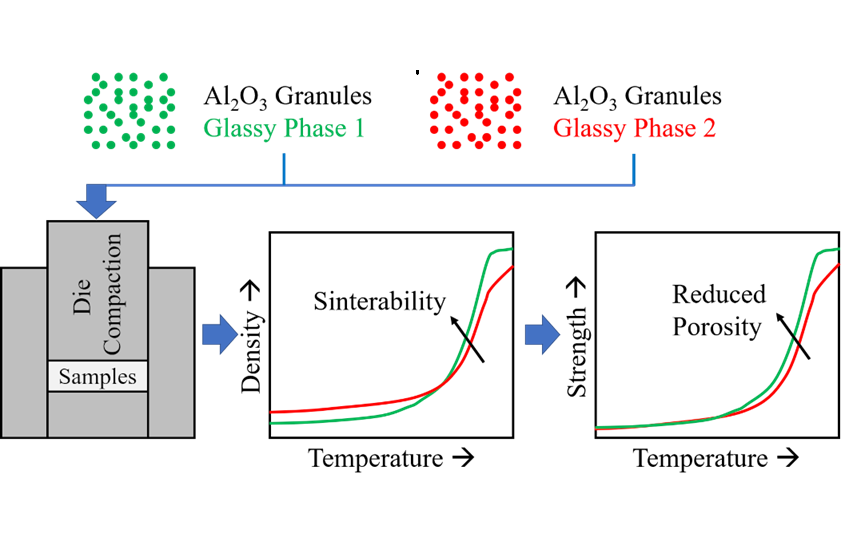
High-alumina (Al2O3) ceramics are an important, but sometimes overlooked industrial material. Two 92% alumina spray-dried granules, which contained different sintering aid compositions, were studied. The two alumina granules, called MT and JP, were die compacted to form bend bars and heated at temperatures from 200℃ to 1600℃. The effect of the sintering aid composition on the shrinkage, density, and fracture strength of samples were investigated. It was found that MT samples had a lower density than the JP samples up to 1100℃, due to a greater weight loss following binder removal. However, between 1200℃ to 1600℃, the MT samples had higher density (95.45%. vs. 94.40%), shrinkage (18.1% vs. 14.4%), and fracture strength (315 MPa vs. 264 MPa) than the JP samples, due to a 100℃ lower onset of liquid phase sintering. An analysis using glass formation principles determined that the MT sintering aid contained more glass network modifiers and property modifiers, which likely reduced the sintering liquid formation temperature and viscosity.
Downloads
References
R. Oberacker. “Powder compaction by dry pressing,” in Ceramic Science and Technology: Synthesis and Processing, vol. 3, Wiley-VCH, Germany, pp. 3‒37, 2012. DOI: https://doi.org/10.1002/9783527631957.ch1
M. Dondi, “Powder granulation and compaction,” in Encyclopedia of Materials: Technical Ceramics and Glasses, vol. 1, Elsevier Inc., pp. 136‒145, 2021. DOI: https://doi.org/10.1016/B978-0-12-803581-8.12103-4
D. E. Niesz, “A review of ceramic powder compaction,” KONA Powder and Particle Journal, vol. 14, pp. 44‒51, 1996. DOI: https://doi.org/10.14356/kona.1996009
S. Balasubramanian, D. J. Shanefield, and D. E. Niesz, “Effect of internal lubricants on defects in compacts made from spray-dried powders,” Journal of the American Ceramic Society, vol. 86, no. 1, pp. 134‒138, 2002. DOI: https://doi.org/10.1111/j.1151-2916.2002.tb00054.x
S. Balasubramanian, D. J. Shanefield, and D. E. Niesz, “Effect of externally applied plasticizer on compaction behavior of spray-dried powders,” Journal of the American Ceramic Society, vol 86, no. 4, pp. 749‒754, 2002. DOI: https://doi.org/10.1111/j.1151-2916.2002.tb00167.x
K. Somton, K, Dateraksa, and R. McCuiston, “A study of alumina spray dried granules on packing density and sintering shrinkage of simple and complex shape,” Key Engineering Materials, vol. 608, pp. 175‒180, 2014. DOI: https://doi.org/10.4028/www.scientific.net/KEM.608.175
K. Somton, K. Dateraksa, P. Laoratanakul, and R. McCuiston, “Shrinkage and properties of die pressed alumina produced from different granule sources,” AIP Conference Proceedings, vol. 2279, pp. 1‒7, 2020. DOI: https://doi.org/10.1063/5.0023313
C. Qian, K. Hu, Z. Shen, Q. Wang, P. Li, and Z. Lu, “Effect of sintering aids on mechanical properties and microstructure of alumina ceramic via stereolithography,” Ceramics International, vol. 49, no.11, pp. 17506‒17523, 2023. DOI: https://doi.org/10.1016/j.ceramint.2023.02.118
D. Ding, Y. Guan, G. Xiao, Z. Mao, X. Shi, K. Gao, X. Chong, J. Luo, and C. Lei, “Effects of sintering temperature on micro-structure and mechanical properties of pressureless sintering alumina ceramics with Al2O3–SiO2–CaO sintering aids,” Refractories and Industrial Ceramics, vol. 64, no. 2, pp. 136‒146, 2023. DOI: https://doi.org/10.1007/s11148-023-00816-y
N. Liu, X. Sun, Z. Chen, Z. Xu, N. Dai, G. Shi, S. Cai, X. Lv, and C. Zheng, “Direct ink writing of dense alumina ceramics prepared by rapid sintering,” Ceramics International, vol. 48, no. 20, pp. 30767‒30778, 2022. DOI: https://doi.org/10.1016/j.ceramint.2022.07.028
J. B. Wachtman, and R. A. Haber, “Advanced ceramics involving alumina,” in Alumina Chemicals: Science and Technology Handbook, L.D. Hart Ed., The American Ceramic Society, Inc., pp. 329‒335, 1990.
E. Dörre, and H. Hübner, “Alumina: Processing, Properties, and Applications,” Springer-Verlag, Germany, 1984. DOI: https://doi.org/10.1007/978-3-642-82304-6
K. Somton, K. Dateraksa, D. Atong, and R. McCuiston, “The effect of granule morphology and composition on the compaction behavior and mechanical properties of 92% alumina spray dried granules,” Journal of Metals, Materials and Minerals, vol. 22, no. 2, pp. 41‒47, 2012.
ASTM C373 Standard test method for water absorption, bulk density, apparent porosity, and apparent specific gravity of fired whiteware products, Annual Book of ASTM Standards, West Conshohocken, PA, USA, 2006.
H. H. Murray, “Clays,” in Ullmann’s Encyclopedia of Industrial Chemistry, Wiley-VCH, Germany. pp. 1‒34, 2012.
J. S. Reed, “Principles of ceramic processing”, 2nd ed., John Wiley & Sons, NY, USA, 1995.
W. R. Cannon, E. Gugel, G. Leimer, G. Woetting, and R. Heimann, “Ceramics, advanced structural products,” in Ullmann’s Encyclopedia of Industrial Chemistry, Wiley-VCH, Germany, pp. 1‒34, 2011.
L. Barbieri, A. Bomartini Corradi, C. Leonelli, T. Manfredini, M. Romagnoli, and C. Siligardi, “The microstructure and mechanical properties of sintered celsian and strontium-celsian glass-ceramics,” Material Research Bulletin, vol. 30, no. 1, pp. 27‒41, 1995. DOI: https://doi.org/10.1016/0025-5408(94)00103-0
J. E. Shelby, “Introduction to glass science and technology,” 2nd ed., The Royal Society of Chemistry, UK., 2005. DOI: https://doi.org/10.1039/9781847551160
A. K. Varshneya, and J. C. Mauro, “Fundamentals of Inorganic Glasses,” 3rd ed., Elsevier Inc., 2019. DOI: https://doi.org/10.1016/B978-0-12-816225-5.00022-5
R. McCuiston, W. Nonthathi, and C. Auechalitanukul, “Forming and properties of glasses made from two Thai bottom ashes,” Suranaree Journal of Science and Technology, vol. 31, no. 1, pp. 1‒13, 2024. DOI: https://doi.org/10.55766/sujst-2024-01-e02100
R. E. Dinnebier, and S. J. L. Billinge, “Powder Diffraction, Theory and Practice,” The Royal Society of Chemistry, UK., 2008. DOI: https://doi.org/10.1039/9781847558237
M. L. Huggins, and K. H. Sun, “Calculation of density and optical constants of a glass from its composition in weight percentage,” Journal of the American Ceramic Society, vol. 26, no. 1, pp. 4‒11, 1943. DOI: https://doi.org/10.1111/j.1151-2916.1943.tb15176.x
R. Morrell, “Handbook of Properties of Technical & Engineering Ceramics, Part 2. Data Reviews, Section I. High-Alumina ceramics,” H.M. Stationary Office, London, U.K., 1987.
A. M. Abyzov, “Aluminum oxide and alumina ceramics (Review). Part 1. Properties of Al2O3 and commercial production of dispersed Al2O3,” Refractories and Industrial Ceramics, vol. 60, no. 1, pp. 24‒32, 2019. DOI: https://doi.org/10.1007/s11148-019-00304-2
W. Dong, H. Jain, and M. P. Harmer, “Liquid phase sintering of alumina, I. microstructure evolution and densification,” Journal of the American Ceramic Society, vol. 88, no. 7, pp. 1702‒1707, 2005. DOI: https://doi.org/10.1111/j.1551-2916.2005.00147.x
R. L. Coble, “Sintering alumina: Effect of atmospheres,” Journal of the American Ceramic Society, vol. 45, no. 3, pp. 123‒127, 1962. DOI: https://doi.org/10.1111/j.1151-2916.1962.tb11099.x
W. Dong, H. Jain, and M. P. Harmer, “Liquid phase sintering of alumina, III. effect of trapped gases in pores on densification,” Journal of the American Ceramic Society, vol. 88, no. 7, pp. 1714‒1719, 2005. DOI: https://doi.org/10.1111/j.1551-2916.2005.00149.x
Downloads
Published
How to Cite
License
Copyright (c) 2026 Journal of Metals, Materials and Minerals

This work is licensed under a Creative Commons Attribution-NonCommercial-NoDerivatives 4.0 International License.
Authors who publish in this journal agree to the following terms:
- Authors retain copyright and grant the journal right of first publication with the work simultaneously licensed under a Creative Commons Attribution License that allows others to share the work with an acknowledgment of the work's authorship and initial publication in this journal.
- Authors are able to enter into separate, additional contractual arrangements for the non-exclusive distribution of the journal's published version of the work (e.g., post it to an institutional repository or publish it in a book), with an acknowledgment of its initial publication in this journal.