Effects of various heat treatment cycles on mechanical properties and wear resistance of 65Mn carbon steel
DOI:
https://doi.org/10.55713/jmmm.v36i2.2502Keywords:
65Mn carbon steel, Tensile strength, Hardness, Toughness, WearAbstract
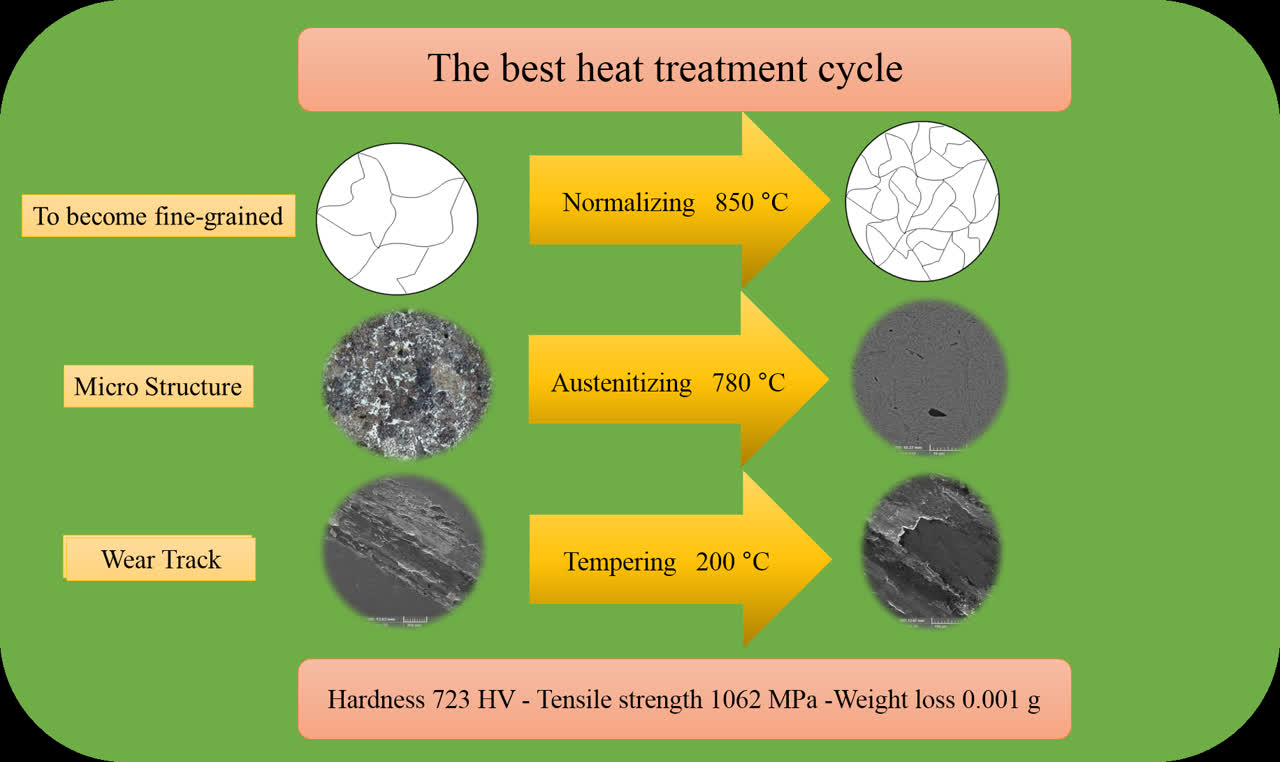
The aim of the present study is to investigate the effect of various heat treatment cycles on mechanical properties and wear resistance of 65Mn carbon steel. For this purpose, five different heat treatment cycles including normalizing, austenitizing, quenching, and tempering were performed at different austenitization temperatures and tempering times. Subsequently, effects of the parameters on tensile strength, toughness, hardness, and wear resistance of the heat-treated samples were investigated. X-ray diffraction (XRD) and scanning electron microscopy (SEM) equipped with energy dispersive X-ray spectroscopy (EDS) were employed to analyze microstructure of heat-treated samples. To study the wear resistance of the samples after heat treatment, pin-on-disk wear test was conducted. The results revealed that the optimal mechanical and wear properties, including a hardness of 723 HV, a tensile strength of 1062 MPa, a fracture toughness of 14.7 J∙cm‒2, and a weight loss of 0.001 g, were achieved after the heat treatment cycle of normalizing at 850℃ for 30 min, austenitizing at 780℃ for 30 min, oil quenching, and then tempering at 200℃ for 60 min. These results were obtained due to the achievement of a two-phase martensite-ferrite microstructure with the minimum initial austenite grain size among different austenitization temperatures.
Downloads
References
A. Li, M. Hu, and X. Wang, "Influence of sub-temperature quenching temperature on microstructure and property of 65Mn steel," Advanced Materials Research, vol. 102–104, pp. 460‒464, 2010. DOI: https://doi.org/10.4028/www.scientific.net/AMR.102-104.460
P. Apichai, "Influence of six-step heat treatment on micro-structures and mechanical properties of 5160 alloy steel," Journal of metals, Materials and minerals, vol. 32, no.1, pp. 72‒78, 2022. DOI: https://doi.org/10.55713/jmmm.v32i1.1141
P. Apichai,"Effects of quenchants on microstructures and mechanical properties of steel grade AISI 5160, " Journal of metals, Materials and minerals, vol. 30, no. 3, pp. 15‒23, 2020. DOI: https://doi.org/10.55713/jmmm.v30i3.631
S. Ge, Q. Wang, and J. Wang, "The impact wear-resistance enhancement of medium manganese steel and its application in mining machines," Wear, vol. 376, no. 377, pp. 1097‒1104, 2017. DOI: https://doi.org/10.1016/j.wear.2017.01.015
G. Huang, G. Jiao, D. Wen, Ch. Zhou, and K. Wu,"Mechanical properties of heat treated 65Mn steel produced by compact strip production," Advanced materials research, vol. 168, no. 170, pp. 832‒836, 2011. DOI: https://doi.org/10.4028/www.scientific.net/AMR.168-170.832
M. A. Hafeez, "Microstructural and mechanical properties of one-step quenched and partitioned 65Mn steel," Arabian Journal for Science and Engineering, vol. 46, pp. 2261–2267, 2021. DOI: https://doi.org/10.1007/s13369-020-05075-4
S. N. Ghali, and M. K. El-Fawkhry, "Simulation of cooling process effect on mechanical properties of 65Mn strip," Materials Science, Engineering, 2015.
Y. Huang, and G. Zhang, "Microstructure and property of 65Mn steel preheated by laser strengthening," Transactions of the Chinese Society of Agricultural Engineering , vol. 31. no. 1, pp. 53‒57, 2015.
A. Li, and M. Hu,"Microstructure and properties of 65Mn steel after austenite inverse phase transformation by sub-temperature quenching," Advanced materials research, vol. 194, no. 196, pp. 89‒94, 2011. DOI: https://doi.org/10.4028/www.scientific.net/AMR.194-196.89
R. Dalai, S. Das, and K. Das,"Effect of thermos-mechanical processing on the low impact abrasion and low stress sliding wear resistance of austenitic high manganese steels," Wear, vol. 420, no. 421, pp. 176‒183, 2019. DOI: https://doi.org/10.1016/j.wear.2018.10.013
Y. Wang, J. Sun, T. Jiang, C. Yang, Q. Tan, S. Guo, and Y. Liu,"Super strength of 65Mn spring steel obtained by appropriate
quenching and tempering in an ultrafine grain condition," Materials Science and Engineering: A, vol. 754, pp.1‒8. 2019. DOI: https://doi.org/10.1016/j.msea.2019.03.059
B. C. Kandpal, D. K. Gupta, A. Kumar, A. K. Jaisal, A. K. Ranjan, A. Srivastava, and P. Chaudhary, "Effect of heat treatment on properties and microstructure of steels" Materials Today: Proceedings, vol. 44, pp. 199‒205, 2021. DOI: https://doi.org/10.1016/j.matpr.2020.08.556
M. S. Htun, S. T. Kyaw, and K. T. Lwin, "Effect of heat treatment on microstructures and mechanical properties of spring steel," Materials and Minerals, vol. 18, no. 2, pp. 191‒197, 2008.
L. D. Barlow, and M. D, Toit,"Effect of austenitizing heat treatment on the microstructure and hardness of martensitic stainless steel AISI 420," Journal of materials engineering and performance, vol. 21 pp. 1327–1336, 2012. DOI: https://doi.org/10.1007/s11665-011-0043-9
M. A. Golozar, Fundamental and application of heat treatment
of steels and cast irons, "(Ed) IUT Publication, 7th Print 2008.
A. Li, "Influence of pretreatment process on microstructure and properties of 65Mn steel after subcritical quenching," Mechanics and Materials, vol. 310, pp 55‒58, 2013. DOI: https://doi.org/10.4028/www.scientific.net/AMM.310.55
N. M. Islami, N. A. Amir Khatif, M. Kecik, and M. Shaharudin, "The effect of heat treatment on the hardness and impact properties of medium carbon steel," Materials Science and Engineering, vol. 144, p. 012108, 2016. DOI: https://doi.org/10.1088/1757-899X/114/1/012108
K. Song, and M. Aindow, "Grain growth and particle pinning in a model Ni-based superalloy," Materials Science and Engineering, vol. A 479, pp. 365–372, 2008 . DOI: https://doi.org/10.1016/j.msea.2007.09.055
M. Apel, B. Bottger, J. Rudnizki, Ph. Schaffnit, and I. Steinbach,"Grain growth simulations including particle pinning using the multiphase-field concept," ISIJ International, Vol. 49, no. 7, pp. 1024–1029, 2009. DOI: https://doi.org/10.2355/isijinternational.49.1024
T. Zhou, H. Zurob, R. Omalley, and K. Rehman, "Model Fe-Al steel with exceptional resistance to high temperature coarsening Part I: Coarsening mechanism and particle pinning effects," Metallurgical and Materials Transactions A, vol. 46, no. 1, pp. 178‒189, 2015. DOI: https://doi.org/10.1007/s11661-014-2611-8
W. Liu, X. Wang, F. Guo, and Ch. Shang,"Carbides dissolution in 5Cr15MoV martensitic stainless steel and new insights into its effect on microstructure and hardness," Materials, vol. 15, p. 8742, 2022. DOI: https://doi.org/10.3390/ma15248742
C. A. Suski, and C. A. S. Oliveira,"Effect of austenitization temperature on the precipitation of carbides in quenched low carbon boron steel," Metallography, Microstructure, and Analysis, vol. 2, pp. 79–87, 2013. DOI: https://doi.org/10.1007/s13632-012-0057-1
T. Senthilkumar, and T.K. Ajiboye, "Effect of heat treatment processes on the mechanical properties of medium carbon steel," Journal of Minerals & Materials Characterization & Engineering, vol. 11, no. 2, pp. 143‒152, 2012. DOI: https://doi.org/10.4236/jmmce.2012.112011
A. Jha, B. K. Prasad, O. P. Modi, and S. Das, A. H. Yegneswaran, "Correlating microstructural features and mechanical properties abrasion resistance of a high strength low alloy steel,” Wear, vol. 254, pp. 120‒128, 2003. DOI: https://doi.org/10.1016/S0043-1648(02)00309-5
J. Rendon, and M. Olsson, "Abrasive wear resistance of some commercial abrasion resistant steels evaluated by laboratory test methods," Wear, vol. 267, pp. 2055–2061, 2009. DOI: https://doi.org/10.1016/j.wear.2009.08.005
X. Xu, W. Xu , F. H. Ederveen, and S. Zwaag, "Design of low hardness abrasion resistant steels," Wear, vol. 310, pp. 89‒93, 2013. DOI: https://doi.org/10.1016/j.wear.2013.01.002
G. Bregliozzi, A. Di Schino, J. M. Kenny, and H. Haefke, "The influence of atmospheric humidity and grain size on the friction and wear of AISI 304 austenitic stainless steel," Materials Letters, vol. 57, pp. 4505–4508, 2003. DOI: https://doi.org/10.1016/S0167-577X(03)00351-3
D. Bhattacharyya, A. Hajra, A. Basu, and S. Jana, "The effect of grain size on the wear characteristics of high-speed steel tools," Wear, vol. 42, pp. 63–69, 1977. DOI: https://doi.org/10.1016/0043-1648(77)90167-3
S. Gündüz, R. Kaçar, and H. Ş. Soykan, "Wear behavior of forging steels with different microstructure during dry sliding," Tribology International, vol. 41, no. 5, pp. 348–355, 2008. DOI: https://doi.org/10.1016/j.triboint.2007.09.002
L. Zhou, G. Liu, Z. Han, and K. Lu," Grain size effect on wear resistance of a nanostructured AISI52100 steel," Scripta Materialia, vol. 58, pp. 445–448, 2008. DOI: https://doi.org/10.1016/j.scriptamat.2007.10.034
A. Sundstrom, J. Rendon, and M. Olsson," Wear behavior of
some low alloyed steels under combined impact/abrasion contact conditions," Wear, vol. 250, pp. 744‒754, 2001. DOI: https://doi.org/10.1016/S0043-1648(01)00712-8
T. W. Chenje, D. J. Simbi, and E. Navara, "Relationship between microstructure, hardness, impact toughness and wear performance of selected grinding media for mineral ore milling operations," Materials and Design, vol. 25, pp. 11–18, 2004. DOI: https://doi.org/10.1016/S0261-3069(03)00168-7
S. A. Sajjadi, "Mechanical Behavior of Materials (Ed)," Ferdowsi University of Mashhad Publication, 7th Print, 2022.
K. Enayati, and F. Sayyedan, “Study of dry sliding wear behavior of Ti-48Al-2Nb-2Cr alloy," Tribology - Materials, Surfaces & Interfaces, vol. 16, no. 2, p. 1881876, 2022. DOI: https://doi.org/10.1080/17515831.2021.1881876
S. Jahanmir, N. P. Suh, and E. P. Abrahamson II,"The delamination theory of wear and the wear of a composite surface," Wear, vol. 32, no. 1, pp. 33–49, 1975. DOI: https://doi.org/10.1016/0043-1648(75)90203-3
Downloads
Published
How to Cite
License
Copyright (c) 2026 Journal of Metals, Materials and Minerals

This work is licensed under a Creative Commons Attribution-NonCommercial-NoDerivatives 4.0 International License.
Authors who publish in this journal agree to the following terms:
- Authors retain copyright and grant the journal right of first publication with the work simultaneously licensed under a Creative Commons Attribution License that allows others to share the work with an acknowledgment of the work's authorship and initial publication in this journal.
- Authors are able to enter into separate, additional contractual arrangements for the non-exclusive distribution of the journal's published version of the work (e.g., post it to an institutional repository or publish it in a book), with an acknowledgment of its initial publication in this journal.