Finite element simulation of surface repair welding of grade R260 railway rails using thermite welding
DOI:
https://doi.org/10.55713/jmmm.v36i2.2508คำสำคัญ:
Thermite welding, Railway rail repair, Finite element simulation, Mold design, R260 rail steelบทคัดย่อ
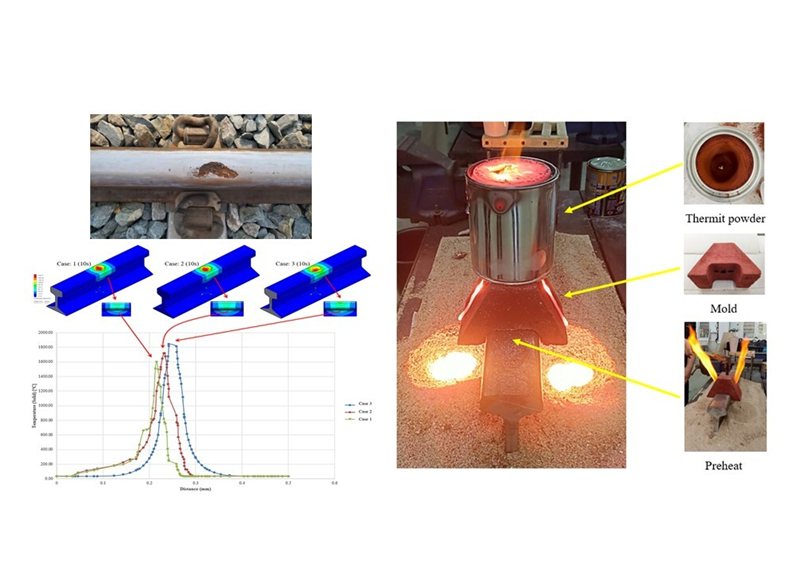
Railway rails subjected to repetitive wheel-rail contact loads experience surface damage, including shallow cracks, groove wear, and material loss. Conventional arc welding repair presents limitations in costs, repair time, and quality consistency. This study investigates thermite welding for surface repair of pearlitic rail steel grade R260, emphasizing the effects of mold overflow configuration on thermal behavior, molten metal flow, and weld quality. A finite element framework incorporating thermal-fluid coupling was developed to simulate temperature distribution and molten metal penetration. Three mold overflow configurations were evaluated: overflow at the wear groove outer edge (Case 1), near the pouring gate (Case 2), and above the pouring gate (Case 3). The Herschel-Bulkley model captured yield-controlled flow and shear-thinning behavior of molten thermite steel. Numerical predictions were validated experimentally. Case 1 achieved a 1620℃ peak temperature with shallow heat dispersion, causing incomplete fusion. Case 2 reached 1750℃ to 1800℃ but exhibited porosity from unbalanced flow. Case 3 demonstrated optimal performance: 1880℃ peak temperature, uniform thermal distribution, complete groove filling, and minimal defects. Microstructural examination confirmed dense welds with negligible porosity meeting ISO 5817 standards. Strong correlation between numerical and experimental results validates the modeling framework, demonstrating that mold overflow geometry critically governs heat transfer, flow stability, and weld integrity. Case 3 represents the optimal configuration for thermite-based rail surface repair, providing practical design guidance for improving repair efficiency in railway maintenance operations.
Downloads
เอกสารอ้างอิง
M. Akama, “Rolling contact fatigue and wear of rails and wheels: A comprehensive review,” Machines, vol. 13, no. 10, p. 970, 2025. DOI: https://doi.org/10.3390/machines13100970
S. L. Grassie, “Rolling contact fatigue on the rail head: micro-scopic observations and mechanical interpretation,” Wear, vol. 265, no. 9-10, pp. 1212‒1223, 2012.
C. Esveld, “MRT selection: a guide to modern railway track design and maintenance,” The Netherlands: Esveld, 2001.
D. F. Cannon, K. O. Edel, S. L. Grassie, and K. J. Sawley, “Rail defects: An overview,” Fatigue & Fracture of Engineering Materials & Structures, vol. 26, no. 10, pp. 865–886, 2003. DOI: https://doi.org/10.1046/j.1460-2695.2003.00693.x
H. Z. Oo, and P. Muangjunburee, “Microstructure and wear behavior of repair weld on the flash-butt welded rail,” The Indonesian Journal of Science and Technology, vol. 11, no. 2, pp. 189–204, 2026 DOI: https://doi.org/10.17509/ijost.v11i2.89691
Y. Chen, F. V. Lawrence, C. P. L. Barkan, and J. A. Dantzig, “Heat transfer modelling of rail thermite welding,” Proceedings of the Institution of Mechanical Engineers, Part F: Journal of Rail and Rapid Transit, vol. 220, no. 3, pp. 207–217, 2006. DOI: https://doi.org/10.1243/09544097F01505
S. Kou, “Welding metallurgy,” 2nd ed. New York, USA: John Wiley & Sons; 2003.
R. G. Kewalramani, I. Riehl, J. Hantusch, and T. A. Fieback, “CFD model to simulate thermal mould-filling and solid–liquid phase change during aluminothermic welding of rails,” in book: Advances in Computational Heat and Mass Transfer, pp. 662–671, 2023. DOI: https://doi.org/10.1007/978-3-031-66609-4_61
M. M. Maglio, “Finite element analysis of thermal fields during repair welding of discrete rail defects,” Master’s thesis. Chalmers University of Technology; 2017.
S. Weiss, I. Riehl, J. Hantusch, and U. Gross, “Numerical investigation on the crucible discharge of steel and slag during the aluminothermic welding process,” Archives of Metallurgy
and Materials, vol. 63, no. 1, pp. 173–180, 2018. DOI: https://doi.org/10.3917/spir.063.0173
P. K. Sen, M. Bhiwapurkar, and S. P. Harsha, “A 3-D numerical simulation of fatigue crack growth in an alumino thermite welded UIC60 rail joint under different loading conditions,” Materials Today: Proceedings, vol. 59, pp. 405–412, 2022. DOI: https://doi.org/10.1016/j.matpr.2021.11.360
B. Andersson, and B. L. Josefson, “Simulation-based failure analysis of faulty and regulatory railhead repair welding procedures,” Engineering Failure Analysis, vol. 182, p. 110185, 2025. DOI: https://doi.org/10.1016/j.engfailanal.2025.110185
European Committee for Standardization. EN 13674-1: Railway applications—Track—Rail—Part 1: Vignole railway rails 46 kg/m and above. Brussels, Belgium: CEN; 2017.
T. DebRoy, H. L. Wei, J. S. Zuback, T. Mukherjee, J. W. Elmer, J. O. Milewski, A. M. Beese, A. Wilson-Heid, A. De, and W. Zhang, “Additive manufacturing of metallic components – process, structure and properties,” Progress in Materials Science, vol. 92, pp. 112–224, 2018. DOI: https://doi.org/10.1016/j.pmatsci.2017.10.001
Y. Chen, F. V. Lawrence, C. P. L. Barkan, and J. A. Dantzig, “Weld defect formation in rail thermite welds,” Proceedings of the Institution of Mechanical Engineers, Part F: Journal of Rail and Rapid Transit, vol. 220, no. 4, pp. 373–384, 2006. DOI: https://doi.org/10.1243/0954409JRRT44
R. W. Fox, A. T. McDonald, and P. J. Pritchard, “Introduction to fluid mechanics,” 8th ed. Hoboken, NJ, USA: John Wiley & Sons; 2011.
S. V. Patankar, “Numerical heat transfer and fluid flow,” New York, USA: Hemisphere Publishing Corporation; 1980.
V. R. Voller, and C. A. Prakash, “Fixed grid numerical modelling methodology for convection–diffusion mushy region phase-change problems,” International Journal of Heat and Mass Transfer, vol. 30, no. 8, pp. 1709–1719, 1987. DOI: https://doi.org/10.1016/0017-9310(87)90317-6
C. Beckermann, and J. A. Ni, “Volume-averaged two-phase model for transport phenomena during solidification,” Metallurgical and Materials Transactions B, vol. 22, no. 3, pp. 349–361, 1991. DOI: https://doi.org/10.1007/BF02651234
A. Varma, A. S. Rogachev, A. S. Mukasyan, and S. Hwang, “Combustion synthesis of advanced materials: principles and applications,” Progress in Energy and Combustion Science, vol. 34, no. 2, pp. 216–285, 2008.
R. B. Bird, R. C. Armstrong, and O. Hassager, “Dynamics of polymeric liquids, vol. 1: fluid mechanics,” 2nd ed. New York, USA: John Wiley & Sons; 1987.
F. Campbell, “Complete casting handbook: Metal casting processes, metallurgy, techniques and design,” 2nd ed. Oxford, UK: Butterworth-Heinemann; 2015.
S. Chaowakarnkool, K. Uttarasak, S. Jaipayuk, N. Jantaping, and M. Tuiprae, “The effect of Fe–Ni–Mn–Mo high entropy alloy electrode on enhancing the weldability and mechanical properties of railway steel 900A,” Journal of Metals, Materials and Minerals, vol. 35, no. 1, p. e2292, 2025. DOI: https://doi.org/10.55713/jmmm.v35i1.2292
A. Chanpahol, “The study of metallurgical structure of 50-pound railway hard surfacing welding by shielded metal arc welding process,” KKU Research Journal (Graduate Studies), vol. 19, no. 3, pp. 28–35, 2019.
A. Chanpahol, and B. Kongruang, “Comparative study of H350R and E8016 electrode in surface hard-facing welding of 100 pound/yard railway by shielded metal arc welding,” Integration Apply Engineering and Industrial Technology, vol. 12, no. 2, pp. 96–105. 2019;
A. Chanpahol, and S. Srisawad, “Study on microstructure through scanning electron microscope from welding repair of railway surface 70 pound/yard with welding electrodes E110-16G and E1-UM-350,” Pathumthani University Academic Journal, vol. 11, no. 31, pp. 1–8, 2021.
International Organization for Standardization. ISO 5817: Welding—Fusion-welded joints in steel, nickel, titanium and their alloys—Quality levels for imperfections. Geneva, Switzerland: ISO; 2014.
ดาวน์โหลด
เผยแพร่แล้ว
วิธีการอ้างอิง
การอนุญาต
ลิขสิทธิ์ (c) 2026 วารสารโลหะ, วัสดุ และแร่

This work is licensed under a Creative Commons Attribution-NonCommercial-NoDerivatives 4.0 International License.
Authors who publish in this journal agree to the following terms:
- Authors retain copyright and grant the journal right of first publication with the work simultaneously licensed under a Creative Commons Attribution License that allows others to share the work with an acknowledgment of the work's authorship and initial publication in this journal.
- Authors are able to enter into separate, additional contractual arrangements for the non-exclusive distribution of the journal's published version of the work (e.g., post it to an institutional repository or publish it in a book), with an acknowledgment of its initial publication in this journal.