Eco-friendly preparation and characterization of avocado waste-derived silver nanoparticles-embedded alginate films for potential wound dressing use
DOI:
https://doi.org/10.55713/jmmm.v37i1.2799Keywords:
Alginate films, Avocado peel waste, Green synthesis, Silver nanoparticles, Wound dressing applicationsAbstract
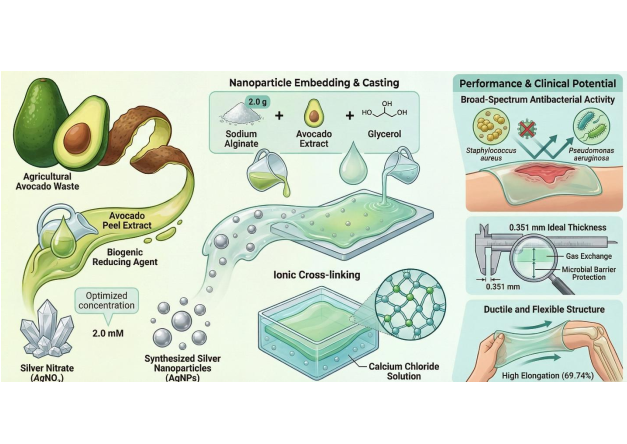
The ever-increasing volume of waste generated in the avocado industry poses an environmental problem; however, thanks to the valuable bio-components contained within this waste, this situation presents a potential to be transformed from a problem into an opportunity. In this study, silver nanoparticles (AgNPs) were synthesized using a green method with avocado peel extract as a biogenic reducing and stabilizing agent; the synthesized AgNPs were embedded into sodium alginate (SA) films to obtain functional biomaterials for wound dressing applications. The changes in physicochemical properties (Water resistance, swelling index, gel fraction, degradation behavior, and water vapor transmission rate (WVTR)) of the prepared AgNPs@SA films were investigated by varying the amounts of their components (alginate amount, AgNO3 concentration, and extract concentration). In terms of the obtained physicochemical properties, the film formulation using 2.0 g alginate, 2.0 mM AgNO3, and 0.20 g·mL‒1 extract was selected as optimum. The film synthesized with the determined optimum formulation was found to have an average thickness of 0.351 mm, a suitable WVTR value, and antibacterial activity against Staphylococcus aureus and Pseudomonas aeruginosa. Mechanical analysis results show that AgNPs@SA films exhibit a ductile and viscoelastic structure characterized by high elongation and sufficient tensile strength, indicating potential for use as a flexible and stable wound dressing. Characterization studies (SEM, EDX, FTIR, XRD, and XPS) supported the successful green synthesis of AgNPs and provided evidence consistent with their incorporation into the alginate films, while indicating the involvement of plant-derived components in nanoparticle synthesis. The findings indicate that avocado peel waste can be transformed into a value-added product for environmentally friendly wound dressing applications.
Downloads
References
G. Şahin, “One of the new actors of turkish agriculture: avocado (Persea americana Mill.),” Journal of Anatolian Geography, vol. 2, no. 2, pp. 70–83, 2024.
A. Féliz-Jiménez, and R. Sanchez-Rosario, “Bioactive compounds, composition and potential applications of avocado agro-industrial residues: A review,” Applied Sciences (Switzerland), vol. 14, no. 21, p. 10070, 2024. DOI: https://doi.org/10.3390/app142110070
M. A. Oke, E. A. Adebayo, N. A. Ajisope, B. M. Olowe, and O. S. Fasuan, ”Avocado (Persea americana) peel: A promising source of bioactive compounds,” Frontiers in Nutrition, vol. 12, no. october, p. 1642969, 2025, DOI: https://doi.org/10.3389/fnut.2025.1642969
D. Merino, L. Bertolacci, U. C. Paul, R. Simonutti, and A. Athanassiou, “Avocado peels and seeds: Processing strategies for the development of highly antioxidant bioplastic films,” ACS Applied Materials & Interfaces, vol. 13, no. 32, pp. 38688–38699, 2021. DOI: https://doi.org/10.1021/acsami.1c09433
A. P. S. Nascimento, M. E. M. Duarte, A. P. T. Rocha, and A. N. Barros, “Valorization of avocado (Persea americana) peel and seed: Functional potential for food and health applications,” Antioxidants, vol. 14, no. 9, pp. 1–20, 2025. DOI: https://doi.org/10.3390/antiox14091032
F. Anjum, A. Saddiqa, M. M. Nazir, R. Naseer, M. Riaz, and A. Ashraf, “Avocado peel-derived polyphenols and date palm mucilage as natural macromolecules in the green synthesis of antimicrobial silver nanoparticles for wound dressing applications,” International Journal of Biological Macromolecules, vol. 329, no. 1, Art. no. 147771, 2025. DOI: https://doi.org/10.1016/j.ijbiomac.2025.147771
V. U. M. Nallal, K. Prabha, and M. Razia, “Avocado-waste mediated synthesis of silver nanoparticles and exploration of their potential biological properties,” in Materials Today: Proceedings, Elsevier Ltd, Jan. 2022, pp. 1745–1749. DOI: https://doi.org/10.1016/j.matpr.2022.05.537
N. Jayarambabu, A. Akshaykranth, T. Venkatappa Rao, K. Venkateswara Rao, and R. Rakesh Kumar, “Green synthesis of Cu nanoparticles using Curcuma longa extract and their application in antimicrobial activity,” Materials Letters, vol. 259, Art. no. 126813, 2020. DOI: https://doi.org/10.1016/j.matlet.2019.126813
A. Estifanos, H. B. Abebe, and B. Gelagay, “Green Synthesis and analysis of Ni–Cu, Ni–Ag, and Cu–Ag bimetallic nano-particles using avocado (Persea Americana) peel extract for sustainable antibacterial applications,” Journal of Nanotechnology, vol. 2025, no. 1, Art. no. 8879390, 2025. DOI: https://doi.org/10.1155/jnt/8879390
S. A. Behera, A. Amanat, and P. G. R. Achary, “Photocatalytic degradation of ciprofloxacin drug utilizing novel PVDF/polyaniline/ lanthanum strontium manganate@Ag composites,” Journal of Metals, Materials and Minerals, vol. 34, no. 1, Art. no. 1896, 2024. DOI: https://doi.org/10.55713/jmmm.v34i1.1896
E. Ali, S. H. Abu-Hussien, E. Hesham, S. Ahmed, H. Mostafa, A. Gamal, S. M. El-Sayed, B. Hemdan, A. Bakry, N. M. Ebeed, H. Elhariry, A. Galal, and B. T. Abd-Elhalim, “Compatibility and antimicrobial activity of silver nanoparticles synthesized using Lycopersicon esculentum peels,” AMB Express, vol. 14, no. 1, Art. no. 124, 2024. DOI: https://doi.org/10.1186/s13568-024-01774-5
A. S. Rodrigues, J. G. S. Batista, M. Á. V. Rodrigues, V. C. Thipe, L. A. R. Minarini, P. S. Lopes, and A. B. Lugão, “Advances in silver nanoparticles: A comprehensive review on their potential as antimicrobial agents and their mechanisms of action elucidated by proteomics,” Frontiers in Microbiology vol. 15, p. 1440065, 2024. DOI: https://doi.org/10.3389/fmicb.2024.1440065
R. K. Kandikonda, R. Katru, N. Madathil, N. Venkatesh, R. Nagapuri, R. K. Rajaboina, H. Divi, C. R. Mallu, M. Dhayalan, G. Murugadoss, and K. U. Kumar, “Metal-displacement-derived silver nanoparticles for visible-light catalysis and TENG-enabled circuit integration,” Scientific Reports, vol. 16, no. 1, Art. no. 14780, 2026. DOI: https://doi.org/10.1038/s41598-026-44065-8
A. Subhadarshini, E. Subudhi, P. G. R. Achary, S. A. Behera, N. Parwin, and B. Nanda, “ZIF-8 supported Ag3PO4/g-C3N4 a Double Z-scheme heterojunction: An efficient photocatalytic, antibacterial and hemolytic nanomaterial,” Journal of Water Process Engineering, vol. 65, Art. no. 105901, 2024. DOI: https://doi.org/10.1016/j.jwpe.2024.105901
N. Kučuk, M. Primožič, Ž. Knez, and M. Leitgeb, “Sustainable biodegradable biopolymer-based nanoparticles for healthcare applications,” International Journal of Molecular Sciences, vol. 24, no. 4, p. 3188, 2023. DOI: https://doi.org/10.3390/ijms24043188
R. Abka-khajouei, L. Tounsi, N. Shahabi, A. K. Patel, S. Abdelkafi, and P. Michaud, “Structures, properties and applications of alginates,” Marine Drugs, vol. 20, no. 364, pp. 1–18, 2022. DOI: https://doi.org/10.3390/md20060364
I. P. S. Fernando, W. W. Lee, E. J. Han, and G. Ahn, “Alginate-based nanomaterials: Fabrication techniques, properties, and applications,” Chemical Engineering Journal, vol. 391, no. July 2019, p. 123823, 2020. DOI: https://doi.org/10.1016/j.cej.2019.123823
Y. Wang, Q. Li, X. Peng, Z. Li, J. Xiang, Y. Chen, K. Hao, S. Wang, D. Nie, Y. Cui, F. Lv, Y. Wang, W. Wu, D, Guo, and H. Si, “Green synthesis of silver nanoparticles through oil: Promoting full-thickness cutaneous wound healing in methicillin-resistant Staphylococcus aureus infections,” Frontiers in Bioengineering and Biotechnology, vol. 10, no. August, pp. 1–19, 2022. DOI: https://doi.org/10.3389/fbioe.2022.856651
A. Gudimalla, J. Jose, J. V. Rajendran, G. Gurram, and S. Thomas, “Synthesis of silver nanoparticles by plant extract, incorporated into alginate films and their characterizations,” Chemical Papers, vol. 76, no. 2, pp. 1031–1043, 2022. DOI: https://doi.org/10.1007/s11696-021-01923-1
D. P. da Silva, A. d. S. Silva, J. V. M. da Silva, L. M. de Melo Silva, J. J. da Silva Neto, I. F. Moreira, R.Moreira, and A. C. A. Silva, “Emerging trends in wound management using alginate- based dressings functionalized with metallic nanoparticles : A scoping review,” Journal of Exploratory Research in Pharmacology, vol. 10, no. 4, p. e00029, 2025. DOI: https://doi.org/10.14218/JERP.2025.00029
A. Barbu, B. Neamtu, M. Zăhan, G. M. Iancu, C. Bacila, and V. Mireșan, “Current trends in advanced alginate-based wound dressings for chronic wounds,” Journal of Personalized Medicine, vol. 11, no. 9, p. 890, 2021. DOI: https://doi.org/10.3390/jpm11090890
V. Ambrogi, D. Pietrella, A. Donnadio, L. Latterini, A. D. Michele, I. Luffarelli, and M. Ricci, “Biocompatible alginate silica supported silver nanoparticles composite films for wound dressing with antibiofilm activity,” Materials Science and Engineering C, vol. 112, p. 110863, 2020. DOI: https://doi.org/10.1016/j.msec.2020.110863
M. Alloisio, A. Dodero, S. Alberti, S. Vicini, and M. Castellano, “Electrospun alginate mats embedding silver nanoparticles with bioactive properties,” International Journal of Biological Macromolecules, vol. 213, pp. 427–434, 2022. DOI: https://doi.org/10.1016/j.ijbiomac.2022.05.183
F. R. Diniz, R. C. A. P Maia, L. Rannier, L. N. Andrade, M. V. Chaud, C. F. da Silva, C. B. Corrêa, R. L. C. de Albuquerque Junior, L. P. da Costa, S. R. Shin, S. Hassan, E. Sanchez-Lopez, E. B. Souto, and P Severino, “Silver nanoparticles-composing alginate/gelatine hydrogel improves wound healing in vivo,” Nanomaterials, vol. 10, no. 2, p. 390, 2020. DOI: https://doi.org/10.3390/nano10020390
A. Froelich, E. Jakubowska, M. Wojtyłko, B. Jadach, M. Gackowski, P. Gadziński, O. Napierała, Y. Ravliv, and T. Osmałek, “Alginate-based materials loaded with nanoparticles in wound healing,” Pharmaceutics, vol. 15, no. 4, p. 1142, 2023. DOI: https://doi.org/10.3390/pharmaceutics15041142
I. Panda, and S. A. Behera, “Multifunctional polyvinyl alcohol/ ionic liquid/silver composite for biomedical and electrical applications,” Polymer Bulletin, vol. 82, no. 15, pp. 10051–10073, 2025. DOI: https://doi.org/10.1007/s00289-025-05944-8
M. Ansari, S.Ahmed, A. Abbasi, M. T. Khan, M. Subhan, N. A. Bukhari, A. A. Hatamleh, and N. R. Abdelsalam, “Plant mediated fabrication of silver nanoparticles, process optimization, and impact on tomato plant,” Scientific Reports, vol. 13, no. 1, pp. 1–19, 2023. DOI: https://doi.org/10.1038/s41598-023-45038-x
L. Motelica, D. Ficai, O.-C. Oprea, A. Ficai, V.-L. Ene, B.-S. Vasile, E. Andronescu, and A.-M. Holban, “Antibacterial bio-degradable films based on alginate with silver nanoparticles and lemongrass essential oil–innovative packaging for cheese,” Nanomaterials, vol. 11, no. 9, p. 2377, 2021. DOI: https://doi.org/10.3390/nano11092377
R. Abdulbari, D. Uzunoğlu Doğruyol, and A. Özer, “Preparation and identification of alginate wound dressing/ biofilm loaded with silver nanoparticles biosynthesized from Avocado (Persea Americana) waste,” in 9th International Ankara Multidisciplinary Studies Congress,” 2025, pp. 338–375.
M. M. Delavari, and I. Stiharu, “Preparing and Characterizing novel biodegradable starch/PVA-based films with nano-sized zinc-oxide particles for wound-dressing applications,” Applied Sciences (Switzerland), vol. 12, no. 8, p. 4001, 2022. DOI: https://doi.org/10.3390/app12084001
J. Gubitosa, V. Rizzi, C. Marasciulo, F. Maggi, G. Caprioli, A. M. Mustafa, P. Fini, N. De Vietro, A. M. Aresta, and P. Cosma, “Realizing eco-friendly water-resistant sodium-alginate-based films blended with a polyphenolic aqueous extract from grape pomace waste for potential food packaging applications,” International Journal of Molecular Sciences, vol. 24, no. 14, p. 11462, 2023. DOI: https://doi.org/10.3390/ijms241411462
M. Puccetti, A. Donnadio, M. Ricci, L. Latterini, G. Quaglia, D. Pietrella, A. Di Michele, and V. Ambrogi, “Alginate Ag/AgCl nanoparticles composite films for wound dressings with anti-biofilm and antimicrobial activities,” Journal of Functional Biomaterials, vol. 14, no. 2, p. 84, 2023. DOI: https://doi.org/10.3390/jfb14020084
S. A. Asiri, A. Matar, A. M. Ismail, and H. A. S. Farag, “Sodium alginate edible films incorporating cactus pear extract: Anti-microbial, chemical, and mechanical properties,” Italian Journal of Food Science, vol. 36, no. 4, pp. 151–168, 2024. DOI: https://doi.org/10.15586/ijfs.v36i4.2675
B. Deepa, E. Abraham, L. A. Pothan, N. Cordeiro, M. Faria, and S. Thomas, “Biodegradable nanocomposite films based on sodium alginate and cellulose nanofibrils,” Materials, vol. 9, no. 1, pp. 1–11, 2016. DOI: https://doi.org/10.3390/ma9010050
M. Moura-Alves, V. G. L. Souza, J. A. Silva, A. Esteves, L. M. Pastrana, C. Saraiva, and M. A. Cerqueira, “Characterization of sodium alginate-based films blended with olive leaf and laurel leaf extracts obtained by ultrasound-assisted technology,” Foods, vol. 12, no. 22, p. 4076, 2023. DOI: https://doi.org/10.3390/foods12224076
J. H. Lee, D. Jeong, and P. Kanmani, “Study on physical and mechanical properties of the biopolymer/silver based active nanocomposite films with antimicrobial activity,” Carbohydrate Polymers, vol. 224, no. August, p. 115159, 2019. DOI: https://doi.org/10.1016/j.carbpol.2019.115159
L. M. Júnior, E. Jamróz, S. de Á. Gonçalves, R. G. da Silva, R. M. V. Alves, and R. P. Vieira, “Preparation and characterization of sodium alginate films with propolis extract and nano-SiO2,” Food Hydrocolloids for Health, vol. 2, no. September, p. 100094, 2022, DOI: https://doi.org/10.1016/j.fhfh.2022.100094
K. Kanjanamekanant, T. Thanyacharoen, S. Techasakul, and P. Chuysinuan, “Fabrication of a cellulose-based wound dressing membrane from sugarcane bagasse biowaste,” ACS Omega, vol. 10, no. 39, pp. 45232–45240, 2025. DOI: https://doi.org/10.1021/acsomega.5c04589
B. Chen, B. He, A. M. Tucker, I. Biluck, T. H. Leung, T. P. Schaer, and S. Yang, “An Environmentally stable, biocompatible, and multilayered wound dressing film with reversible and strong adhesion,” Advanced Healthcare Materials, vol. 13, no. 31, pp. 1–15, 2024. DOI: https://doi.org/10.1002/adhm.202400827
K. Y. Lee, and D. J. Mooney, “Alginate: Properties and bio-medical applications,” Progress in Polymer Science (Oxford), vol. 37, no. 1, pp. 106–126, 2012. DOI: https://doi.org/10.1016/j.progpolymsci.2011.06.003
Y. M. S. Jamil, A. N. Al-Hakimi, H. M. A. Al-Maydama, G. Y. Almahwiti, A. Qasem, and S. M. Saleh, “Optimum green synthesis, characterization, and antibacterial activity of silver nanoparticles prepared from an extract of aloe fleurentinorum,” International Journal of Chemical Engineering, vol. 2024, no. 1, p. 2804165, 2024. DOI: https://doi.org/10.1155/2024/2804165
H. Basalius, A. Mani, A. Michael, S. M. Mary, M. Lenin, P. Chelliah, M. R. Siddiqui, S. M. Wabaidur, and A. Islam, “Green synthesis of nano-silver using Syzygium samarangense flower extract for multifaceted applications in biomedical and photocatalytic degradation of methylene blue,” Applied Nanoscience (Switzerland), vol. 13, no. 6, pp. 3735–3747, 2023. DOI: https://doi.org/10.1007/s13204-022-02523-5
B. O. Aljohny, A. A. A. Almaliki, Y. Anwar, M. Ul-Islam, and T. Kamal, “Antibacterial and catalytic performance of green synthesized silver nanoparticles embedded in crosslinked PVA sheet,” Journal of Polymers and the Environment, vol. 29, no. 10, pp. 3252–3262, 2021. DOI: https://doi.org/10.1007/s10924-021-02110-9
V. P. Manjamadha and K. Muthukumar, “Ultrasound assisted green synthesis of silver nanoparticles using weed plant,” Bioprocess and Biosystems Engineering, vol. 39, no. 3, pp. 401–411, 2016. DOI: https://doi.org/10.1007/s00449-015-1523-3
Y. Shao, C. Wu, T. Wu, C. Yuan, S. Chen, T. Ding, X. Ye, and Y. Hu, “Green synthesis of sodium alginate-silver nanoparticles and their antibacterial activity,” International Journal of Biological Macromolecules, vol. 111, pp. 1281–1292, 2018. DOI: https://doi.org/10.1016/j.ijbiomac.2018.01.012
E. Susilowati, L. Mahardiani, and R. D. Hardini, “The effect of silver nanoparticles toward properties and antibacterial activity of silver-alginate nanocomposite films,” Frontiers in Sustainable Food Systems, vol. 6, p. 1340-1341, 2022. DOI: https://doi.org/10.3389/fsufs.2022.913750
S. Iswarya, N. Hariram, T. Theivasanthi, and S. C. B. Gopinath, “Green synthesis and formation of sodium alginate/silver nanocomposite as electroconductive films with enhanced anti-bacterial effects for biomedical applications,” Colloid and Polymer Science, vol. 303, no. 12, pp. 2543–2557, 2025. DOI: https://doi.org/10.1007/s00396-025-05503-7
K. Ramachandraiah, N. T. B. Gnoc, and K. B. Chin, “Bio-synthesis of silver nanoparticles from persimmon byproducts and incorporation in biodegradable sodium alginate thin film,” Journal of Food Science, vol. 82, no. 10, pp. 2329–2336, 2017. DOI: https://doi.org/10.1111/1750-3841.13865
M. Amutha, P. Lalitha, and M. J. Firdhouse, “Biosynthesis of silver nanoparticles using Kedrostis foetidissima (Jacq.) Cogn,” Journal of Nanotechnology, vol. 2014, no. 1, p. 860875, 2014, DOI: https://doi.org/10.1155/2014/860875
G. Marslin, R. K. Selvakesavan, G. Franklin, B. Sarmento, and A. C. P. Dias, “Antimicrobial activity of cream incorporated with silver nanoparticles biosynthesized from Withania somnifera,” International Journal of Nanomedicine, vol. 10, pp. 5955–5963, 2015. DOI: https://doi.org/10.2147/IJN.S81271
S. Jain, and M. S. Mehata, “Medicinal plant leaf extract and pure flavonoid mediated green synthesis of silver nanoparticles and their enhanced antibacterial property,” Scientific Reports, vol. 7, no. 1, Art. no. 15867, 2017. DOI: https://doi.org/10.1038/s41598-017-15724-8
V. U. M. Nallal, K. Prabha, I. VethaPotheher, B. Ravindran, A. Baazeem, S. W. Chang, G. A. Otunola, and M. Razia, ”Sunlight-driven rapid and facile synthesis of silver nanoparticles using Allium ampeloprasum extract with enhanced antioxidant and antifungal activity,” Saudi Journal of Biological Sciences, vol. 28, no. 7, pp. 3660–3668, 2021. DOI: https://doi.org/10.1016/j.sjbs.2021.05.001
N. Kahya, A. Kartun, I. N. Korkut, C. Usta, D. S. Kuruca, and A. Gürarslan, “Silver nanowire-coated porous alginate films for wound dressing applications: Antibacterial Activity, cell proliferation, and physical characterization,” ACS Omega, vol. 9, no. 50, pp. 49032–49042, 2024. DOI: https://doi.org/10.1021/acsomega.4c02467
Downloads
Published
How to Cite
Issue
Section
Categories
License
Copyright (c) 2026 Journal of Metals, Materials and Minerals

This work is licensed under a Creative Commons Attribution-NonCommercial-NoDerivatives 4.0 International License.
Authors who publish in this journal agree to the following terms:
- Authors retain copyright and grant the journal right of first publication with the work simultaneously licensed under a Creative Commons Attribution License that allows others to share the work with an acknowledgment of the work's authorship and initial publication in this journal.
- Authors are able to enter into separate, additional contractual arrangements for the non-exclusive distribution of the journal's published version of the work (e.g., post it to an institutional repository or publish it in a book), with an acknowledgment of its initial publication in this journal.