Synergy of ground granulated blast-furnace slag and limestone powder in ternary cement: Effects on heat of hydration and strength development
DOI:
https://doi.org/10.55713/jmmm.v36i1.2394คำสำคัญ:
Ground granulated blast-furnace slag, Limestone powder, Heat of hydration, Strength, Cementบทคัดย่อ
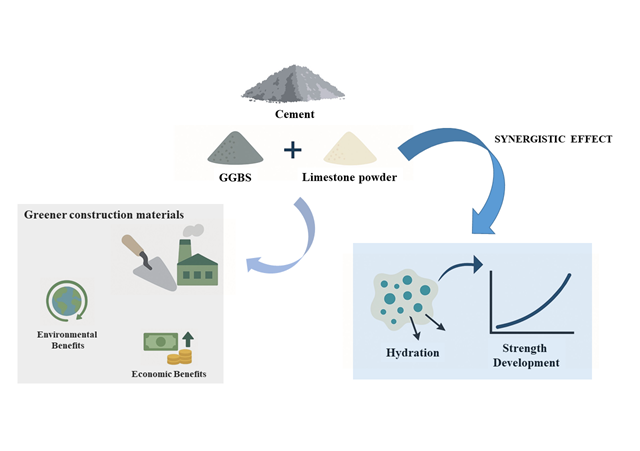
This study explores the synergistic effect of ground granulated blast-furnace slag (GGBS) and limestone powder (LS) on the hydration behavior and mechanical performance of ternary cement systems. Calorimetry revealed that 30GGBS mix showed a significantly lower peak of about 2.3 mW∙g‒1 and a delayed response. In contrast, the incorporation of LS enhanced early hydration, with the 30LS mix reaching a peak of approximately 2.8 mW∙g‒1 around 6 h. Among ternary blends, 15GGBS–15LS exhibited the highest and earliest heat flow peak (about 2.55 mW∙g‒1 around 7.5 h), while 25GGBS–5LS showed a slower response (about 2.45 mW∙g‒1 around 9.5 h). Despite differences in kinetics, all ternary mixes showed similar cumulative heat at 48 h (226.6 J∙g‒1 to 229.4 J∙g‒1), indicating that GGBS–LS synergy balances early kinetics and total heat evolution. Thermogravimetric analysis confirmed the formation of key hydration phases, including C–S–H, ettringite, monocarboaluminate, and calcium carbonate. The lowest Ca(OH)2 content was found in the 25GGBS–5LS mix, indicating active pozzolanic reaction. The formation of monocarboaluminate phases in ternary systems further indicated chemical synergy between LS and GGBS. At 28 day, the 25GGBS–5LS mix achieved the highest compressive strength of 51.68 MPa, surpassing the control (50.12 MPa), and maintained superior performance up to 180 day. Flexural strength followed a similar trend, the 25GGBS–5LS mixes reaching the highest flexural strength among all ternary blends. A strong linear correlation was found between compressive and flexural strength (R2 = 0.906). These results demonstrate that the synergistic combination of GGBS and LS not only enhances hydration kinetics but also contributes to superior strength development and improved sustainability in blended cement systems. The 25GGBS–5LS formulation was identified as optimal in balancing early hydration and long-term mechanical performance.
Downloads
เอกสารอ้างอิง
M. Z. Khaiyum, S. Sarker, and G. Kabir, “Evaluation of carbon emission factors in the cement industry: An emerging economy context,” Sustainability, vol. 15, p. 15407, 2023. DOI: https://doi.org/10.3390/su152115407
K.-H. Yang, Y.-B. Jung, M.-S. Cho, and S.-H. Tae, “Effect of supplementary cementitious materials on reduction of CO2 emissions from concrete,” Journal of Cleaner Production, vol. 103, pp. 774–783, 2015. DOI: https://doi.org/10.1016/j.jclepro.2014.03.018
B. Lothenbach, K. Scrivener, and R. D. Hooton, “Supplementary cementitious materials,” Cement and Concrete Research, vol. 41, no. 12, pp. 1244–1256, 2011. DOI: https://doi.org/10.1016/j.cemconres.2010.12.001
M. E. Shabab, K. Shahzada, B. Gencturk, M. Ashraf, and M. Fahad, “Synergistic effect of fly ash and bentonite as partial replacement of cement in mass concrete,” KSCE Journal of Civil Engineering, vol. 20, no. 5, pp. 1987–1995, 2016. DOI: https://doi.org/10.1007/s12205-015-0166-x
P. Sonprasarn, P. Chakartnarodo, P. Ineure, and W. Prakaypan, “Effects of the chemical treatment on coal-fired bottom ash for the utilization in fiber-reinforced cement composites,” Journal of Metals, Materials and Minerals, vol. 29, no. 4, pp. 55–60, 2019. DOI: https://doi.org/10.55713/jmmm.v29i4.488
S. Sriprasertsuk and S. Daosukho, “Production of autoclaved lightweight concretes using pottery stone and bagasse ash,” Journal of Metals, Materials and Minerals, vol. 33, no. 2, pp. 53–57, 2023. DOI: https://doi.org/10.55713/jmmm.v33i2.1601
S. Chokkha, J. Ayawanna, A. Poowancum, T. Singlaem, and P. Mitsomwang, “Fabrication of porous geopolymers utilizing aluminum wastes as foaming agent,” Journal of Metals, Materials and Minerals, vol. 34, no. 2, p. 1966, 2024. DOI: https://doi.org/10.55713/jmmm.v34i2.1966
T. T. Win, R. Wattanapornprom, L. Prasittisopin, W. Pansuk, and P. Pheinsusom, “Investigation of fineness and calcium-oxide content in fly ash from ASEAN region on properties and durability of cement–fly ash system,” Engineering Journal, vol. 26, no. 5, pp. 77–90, 2022. DOI: https://doi.org/10.4186/ej.2022.26.5.77
L. Prasittisopin, “Power plant waste (fly ash, bottom ash, biomass ash) management for promoting circular economy in sustainable construction: emerging economy context,” Smart and Sustainable Built Environment, 2024. DOI: https://doi.org/10.1108/SASBE-09-2024-0395
J. Ahmad, K. J. Kontoleon, A. Majdi, M. T. Naqash, A. F. Deifalla, N. Ben Kahla, H. F. Isleem, and S. M. A. Qaidi, “A comprehensive review on the ground granulated blast furnace slag (GGBS) in concrete production,” Sustainability, vol. 14, p. 8783, 2022. DOI: https://doi.org/10.3390/su14148783
C. Ma, Z. Yao, Z. Yang, P. Liu, J. Liu, and F. Chen, “Examining the early-stage performance and mechanical performance of limestone powder–silica fume binary cement-based materials,” Case Studies in Construction Materials, vol. 20, e03010, 2024. DOI: https://doi.org/10.1016/j.cscm.2024.e03010
S. Prakash, S. Kumar, R. Biswas, and B. Rai, “Influence of silica fume and ground granulated blast furnace slag on the engineering properties of ultra-high-performance concrete,” Innovative Infrastructure Solutions, vol. 7, Art. no. 117, 2022. DOI: https://doi.org/10.1007/s41062-021-00714-7
B. P. Lenka, R. K. Majhi, S. Singh, and A. N. Nayak, “Eco-friendly and cost-effective concrete utilizing high-volume blast furnace slag and demolition waste with lime,” European Journal of Environmental and Civil Engineering, vol. 26, no. 11, pp. 5351–5373, 2022. DOI: https://doi.org/10.1080/19648189.2021.1896581
E. Berodier and K. Scrivener, “Understanding the filler effect on the nucleation and growth of C–S–H,” Journal of the American Ceramic Society, vol. 97, no. 12, pp. 3764–3773, 2014. DOI: https://doi.org/10.1111/jace.13177
T. Matschei, B. Lothenbach, and F. P. Glasser, “The role of calcium carbonate in cement hydration,” Cement and Concrete Research, vol. 37, no. 4, pp. 551–558, 2007. DOI: https://doi.org/10.1016/j.cemconres.2006.10.013
N. Voglis, G. Kakali, E. Chaniotakis, and S. Tsivilis, “Portland-limestone cements: Their properties and hydration compared to those of other composite cements,” Cement and Concrete Composites, vol. 27, no. 2, pp. 191–196, 2005. DOI: https://doi.org/10.1016/j.cemconcomp.2004.02.006
K. De Weerdt, M. Ben Haha, G. Le Saout, K. O. Kjellsen, H. Justnes, and B. Lothenbach, “Hydration mechanisms of ternary Portland cements containing limestone powder and fly ash,” Cement and Concrete Research, vol. 41, no. 3, pp. 279–291, 2011. DOI: https://doi.org/10.1016/j.cemconres.2010.11.014
ASTM C305-11, “standard practice for mechanical mixing of hydraulic cement pastes and mortars of plastic consistency,” In: Annual Book of ASTM Standard, ASTM International, West Conshohocken, PA, 2011.
ASTM C109/C109M-20, “Standard test method for compressive strength of hydraulic cement mortars (using 2-in. or [50-mm] cube specimens),” In: Annual Book of ASTM Standard, ASTM International, West Conshohocken, PA, 2020.
ASTM C348-08, “Standard test method for flexural strength of hydraulic-cement mortars,” In: Annual Book of ASTM Standard, ASTM International, West Conshohocken, PA, 2008.
H. M. Woo, C. Y. Kim, and J. H. Yeon, “Heat of hydration and mechanical properties of mass concrete with high-volume GGBFS replacements,” Journal of Thermal Analysis and Calorimetry, vol. 132, pp. 599–609, 2018. DOI: https://doi.org/10.1007/s10973-017-6914-z
A. M. Neville, Properties of Concrete, 4th ed., UK: Addison Wesley Longman, 1997.
P. Thongsanitgarn, W. Wongkeo, A. Chaipanich, and C. S. Poon, “Heat of hydration of Portland high-calcium fly ash cement incorporating limestone powder: Effect of limestone particle size,” Construction and Building Materials, vol. 66, pp. 410–417, 2014. DOI: https://doi.org/10.1016/j.conbuildmat.2014.05.060
P. Thongsanitgarn, W. Wongkeo, and A. Chaipanich, “Hydration and compressive strength of blended cement containing fly ash and limestone as cement replacement,” Journal of Materials in Civil Engineering, vol. 26, no. 12, p. 04014088, 2014. DOI: https://doi.org/10.1061/(ASCE)MT.1943-5533.0001002
K. De Weerdt, K. O. Kjellsen, E. Sellevold, and H. Justnes, “Synergy between fly ash and limestone powder in ternary cements,” Cement and Concrete Composites, vol. 33, no. 1, pp. 30–38, 2011. DOI: https://doi.org/10.1016/j.cemconcomp.2010.09.006
E. T. Stepkowska, J. M. Blanes, F. Franco, C. Real, and J. L. Pérez-Rodríguez, “Phase transformation on heating of an aged cement paste,” Thermochimica Acta, vol. 420, no. 1–2, pp. 79–87, 2004. DOI: https://doi.org/10.1016/j.tca.2003.11.057
L. Alarcon-Ruiz, G. Platret, E. Massieu, and A. Ehrlacher, “The use of thermal analysis in assessing the effect of temperature on a cement paste,” Cement and Concrete Research, vol. 35, no. 3, pp. 609–613, 2005. DOI: https://doi.org/10.1016/j.cemconres.2004.06.015
Q. Zhou, E. E. Lachowski, and F. P. Glasser, “Metaettringite, a decomposition product of ettringite,” Cement and Concrete Research, vol. 34, no. 4, pp. 703–710, 2004. DOI: https://doi.org/10.1016/j.cemconres.2003.10.027
A. Bakolas, E. Aggelakopoulou, and A. Moropoulou, “Evaluation of pozzolanic activity and physico-mechanical characteristics in ceramic powder-lime pastes,” Journal of Thermal Analysis and Calorimetry, vol. 92, pp. 345–351, 2008. DOI: https://doi.org/10.1007/s10973-007-8858-1
K. Vessalas, P. S. Thomas, A. S. Ray, J.-P. Guerbois, P. Joyce, and J. Haggman, “Pozzolanic reactivity of the supplementary cementitious material pitchstone fines by thermogravimetric analysis,” Journal of Thermal Analysis and Calorimetry, vol. 97, pp. 71–76, 2009. DOI: https://doi.org/10.1007/s10973-008-9708-5
C. C. Onn, K. H. Mo, M. K. H. Radwan, W. H. Liew, C. G. Ng, and S. Yusoff, “Strength, carbon footprint and cost considerations of mortar blends with high volume ground granulated blast furnace slag,” Sustainability, vol. 11, no. 24, p. 7194, 2019. DOI: https://doi.org/10.3390/su11247194
M. Antoni, J. Rossen, F. Martirena, and K. Scrivener, “Cement substitution by a combination of metakaolin and limestone,” Cement and Concrete Research, vol. 42, no. 12, pp. 1579–1589, 2012. DOI: https://doi.org/10.1016/j.cemconres.2012.09.006
M. F. Carrasco, G. Menéndez, V. Bonavetti, and E. F. Irassar, “Strength optimization of ‘tailor-made cement’ with limestone filler and blast furnace slag,” Cement and Concrete Research, vol. 35, no. 7, pp. 1324–1331, 2005. DOI: https://doi.org/10.1016/j.cemconres.2004.09.023
G. Menéndez, V. Bonavetti, and E. F. Irassar, “Strength development of ternary blended cement with limestone filler and blast-furnace slag,” Cement and Concrete Composites, vol. 25, no. 1, pp. 61–67, 2003. DOI: https://doi.org/10.1016/S0958-9465(01)00056-7
T. Boubekeur, B. Boulekbache, K. Aoudjane, K. Ezziane, and E.-H. Kadri, “Prediction of the durability performance of ternary cement containing limestone powder and ground granulated blast furnace slag,” Construction and Building Materials, vol. 209, pp. 215–221, 2019. DOI: https://doi.org/10.1016/j.conbuildmat.2019.03.120
ดาวน์โหลด
เผยแพร่แล้ว
วิธีการอ้างอิง
การอนุญาต
ลิขสิทธิ์ (c) 2025 วารสารโลหะ, วัสดุ และแร่

This work is licensed under a Creative Commons Attribution-NonCommercial-NoDerivatives 4.0 International License.
Authors who publish in this journal agree to the following terms:
- Authors retain copyright and grant the journal right of first publication with the work simultaneously licensed under a Creative Commons Attribution License that allows others to share the work with an acknowledgment of the work's authorship and initial publication in this journal.
- Authors are able to enter into separate, additional contractual arrangements for the non-exclusive distribution of the journal's published version of the work (e.g., post it to an institutional repository or publish it in a book), with an acknowledgment of its initial publication in this journal.