Surface characteristics of montmorillonite reinforced cellulose membranes derived from pineapple waste
DOI:
https://doi.org/10.55713/jmmm.v36i3.2521คำสำคัญ:
Bacterial cellulose, BET analysis, Membrane surface, Montmorillonite, Pineapple wasteบทคัดย่อ
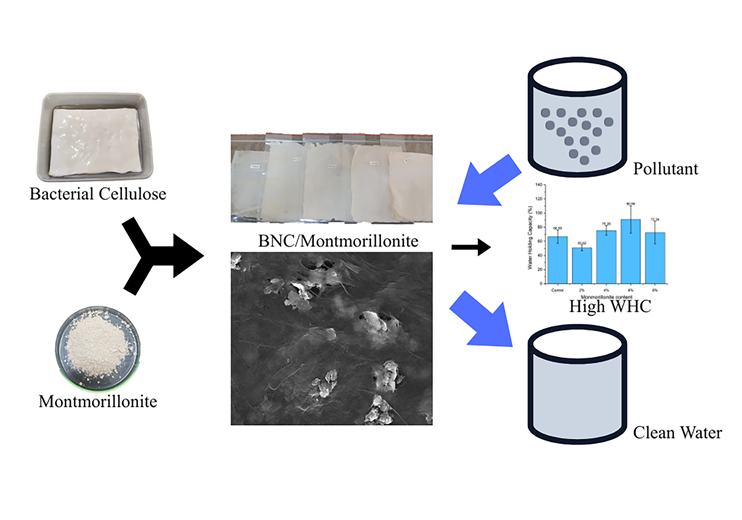
This study aims to investigate the effect of montmorillonite on the surface characteristics and porosity of bacterial nanocellulose (BNC) membranes derived from pineapple peel waste. The bacterial cellulose was synthesized using Acetobacter xylinum using pineapple peel extract as medium component. Bacterial nanocellulose membrane (BNC) was obtained by crushing and homogenizing bacterial cellulose in a high-pressure homogenizer. BNC membrane was reinforced with montmorillonite content of 2 wt% to 8 wt%. The membrane was characterized for its properties using SEM, FTIR, surface roughness tester, tensile tester, water holding capacity test, and BET analysis. The results showed that montmorillonite was well-dispersed within BNC matrix but exhibited agglomeration at higher concentrations. When the samples were analyzed using FTIR spectroscopy, observed changes in functional groups and molecular interactions at 2845 cm‒1 Alkane C‒H bond, confirming that components were successfully integrated. The surface roughness increased significantly from 28.33 ± 3.35 μm (control) to 82.23 ± 1.82 μm (8 wt% montmorillonite), confirming morphological change. The addition of montmorillonite has reduced the crystalline index and the mechanical properties of BNC membrane. BET analysis revealed a transition from microporous (1.6979 nm) to mesoporous structures (up to 2 nm) with enhanced surface area and pore diameter. Pore diameter and volume correlated with enhancing water holding capacity by 36.6% at montmorillonite content of 6 wt%. BC/montmorillonite membranes exhibit adjustable surface characteristics and porosity, thus providing potential for water treatment applications.
Downloads
เอกสารอ้างอิง
M. N. Norizan, S. S. Shazleen, A. H. Alias, F. A. Sabaruddin, M. R. M. Asyraf, E. S. Zainudin, N. Abdullah, M. S. Samsudin, S. H. Kamarudin, and M. N. F. Norrrahim, “Nanocellulose-based nanocomposites for sustainable applications: A review,” Nanomaterials, vol. 12, no. 19, p. 3483, 2022. DOI: https://doi.org/10.3390/nano12193483
R. Raharjo, T. Dwi Widodo, R. Bintarto, and F. A. Alamsyah, “Characterization of bamboo petung fiber reinforced composites with environmentally friendly enzymes,” Journal of Mechanical Engineering Science and Technology, vol. 9, no. 1, pp. 165–176, 2025. DOI: https://doi.org/10.17977/um016v9i1p165
S. S. Jaffar, S. Saallah, M. Misson, S. Siddiquee, J. Roslan, S. Saalah, and W. Lenggoro, “recent development and environmental applications of nanocellulose-based membranes,” Membranes, vol. 12, no. 3, p. 287, 2022. DOI: https://doi.org/10.3390/membranes12030287
Y. Y. Li, B. Wang, M. G. Ma, and B. Wang, “Review of recent development on preparation, properties, and applications of cellulose-based functional materials,” International Journal of Polymer Science, vol. 2018, p. 8973643, 2018. DOI: https://doi.org/10.1155/2018/8973643
H. Rostamabadi, Y. Bist, Y. Kumar, M. Yildirim‐Yalcin, T. Ceyhan, and S. R. Falsafi, “Cellulose nanofibers, nanocrystals, and bacterial nanocellulose: Fabrication, characterization, and their most recent applications,” Future Postharvest and Food, vol. 1, no. 1, pp. 5–33, 2024. DOI: https://doi.org/10.1002/fpf2.12001
P. Cazón, and M. Vázquez, “Bacterial cellulose as a biodegradable food packaging material: A review,” Food Hydrocolloids, vol. 113, p. 106530, 2021. DOI: https://doi.org/10.1016/j.foodhyd.2020.106530
L. Popa, M. V. Ghica, E. E. Tudoroiu, D. G. Ionescu, and C. E. Dinu-Pîrvu, “Bacterial cellulose—A remarkable polymer as a source for biomaterials tailoring,” Materials, vol. 15, no. 3, p. 1054, 2022. DOI: https://doi.org/10.3390/ma15031054
P. Samyn, A. Meftahi, S. A. Geravand, M. E. M. Heravi, H. Najarzadeh, M. S. K. Sabery, and A. Barhoum, “Opportunities for bacterial nanocellulose in biomedical applications: Review on biosynthesis, modification and challenges,” International Journal of Biological Macromolecules, vol. 231, p. 123316, 2023. DOI: https://doi.org/10.1016/j.ijbiomac.2023.123316
A. H. Tayeb, E. Amini, S. Ghasemi, and M. Tajvidi, “Cellulose nanomaterials-binding properties and applications: A review,” Molecules, vol. 23, no. 10, p. 2684, 2018. DOI: https://doi.org/10.3390/molecules23102684
A. F. Alphanoda, E. A. Pane, A. Riyanto, and A. A. Permanasari, “The role of banana peel surface pores through increasing temperature for efficient hydrogen production,” Journal of Mechanical Engineering Science and Technology, vol. 8, no. 2, pp. 421–433, 2024. DOI: https://doi.org/10.17977/um016v8i22024p421
W. Ben Mbarek, L. Escoda, J. Saurina, E. Pineda, F. M. Alminderej, M. Khitouni, and J. J. Suñol, “Nanomaterials as a sustainable choice for treating wastewater: A review,” Materials, vol. 15, no. 23, p. 8576, 2022. DOI: https://doi.org/10.3390/ma15238576
S. Nitodas, M. Skehan, H. Liu, and R. Shah, “Current and potential applications of green membranes with nanocellulose,” Membranes, vol. 13, no. 8, p. 694, 2023. DOI: https://doi.org/10.3390/membranes13080694
U. Yanuhar, H. Suryanto, S. A. Sardjono, I. K. Ningrum, A. Aminnudin, and J. S. Binoj, “Effect of titanium dioxide nano-particle on properties of nanocomposite membrane made of bacterial cellulose,” Journal of Natural Fibers, vol. 19, no. 16, pp. 13914–13927, 2022. DOI: https://doi.org/10.1080/15440478.2022.2112797
M. Fariz Nafiir, Sudirman, E. Yuanita, S. E. Arshad, R. A. Lusiana, and M. Ulfa, “Synthesis and characterization of bacterial cellulose composite with graphite and TiO2-ZnO: Structural and functional analysis,” Acta Chimica Asiana, vol. 7, no. 2, pp. 478–486, 2024. DOI: https://doi.org/10.29303/aca.v7i2.204
P. Nehra, and R. P. Chauhan, “Eco-friendly nanocellulose and its biomedical applications: current status and future prospect,” Journal Biomaterial Science, Polymer Edition, vol. 32, no. 1, pp. 112–149, 2021. DOI: https://doi.org/10.1080/09205063.2020.1817706
L. W. Wong, and J. B. L. Tan, “Halloysite nanotube-polymer nanocomposites: A review on fabrication and biomedical applications,” Journal of Manufacturing Processes, vol. 118, pp. 76–88, 2024. DOI: https://doi.org/10.1016/j.jmapro.2024.03.043
S. P. Bangar, V. Chaudhary, S. Khubber, and W. S. Whiteside, “Kaolinite-based nanocomposites for enhancing starch and other biodegradable polymer applications in food packaging,” International Journal of Biological Macromolecules, vol. 320, p. 145889, 2025. DOI: https://doi.org/10.1016/j.ijbiomac.2025.145889
J. Xu, L. Cheng, Z. Zhang, L. Zhang, C. Xiong, W. Huang, Y. Xie, and L. Yang, “Highly exfoliated montmorillonite clay reinforced thermoplastic polyurethane elastomer: In situ preparation and efficient strengthening,” RSC Advances, vol. 9, no. 15, pp. 8184–8196, 2019. DOI: https://doi.org/10.1039/C8RA10121C
H. Yan, and Z. Zhang, “Effect and mechanism of cation species on the gel properties of montmorillonite,” Colloids and Surfaces A: Physicochemical and Engineering Aspects, vol. 611, p. 125824, 2021. DOI: https://doi.org/10.1016/j.colsurfa.2020.125824
S. Amiri, A. Esfandyari Bayat, and S. Akbari, “Swelling characteristics of various clays in presence of an aqueous environment under different conditions,” Colloids and Surfaces A: Physicochemical and Engineering Aspects, vol. 707, p. 135942, 2025. DOI: https://doi.org/10.1016/j.colsurfa.2024.135942
N. S. Aljohani, Y. N. Kavil, R. K. Al-Farawati, S. Saad Alelyani, M. I Orif, Y. A. Shaban, S. R. Al-Mhyawi, E. H. Aljuhani, and M. Abdel Salam, “The effective adsorption of arsenic from polluted water using modified Halloysite nanoclay,” Arabian Journal of Chemistry, vol. 16, no. 5, p. 104652, 2023. DOI: https://doi.org/10.1016/j.arabjc.2023.104652
M. N. Subramaniam, P. S. Goh, W. J. Lau, and A. F. Ismail, “The roles of nanomaterials in conventional and emerging technologies for heavy metal removal: A state-of-the-art review,” Nanomaterials, vol. 9, no. 4, p. 625, 2019. DOI: https://doi.org/10.3390/nano9040625
M. Ö. Seydibeyoğlu, A. Dogru, J. Wang, M. Rencheck, Y. Han, L. Wang, E. A. Seydibeyoğlu, X. Zhao, K. Ong, J. A. Shatkin, S. Shams Es-haghi, S. Bhandari, S. Ozcan, and D. J. Gardner, “Review on hybrid reinforced polymer matrix composites with nanocellulose, nanomaterials, and other fibers,” Polymers, vol. 15, no. 4, p. 984, 2023. DOI: https://doi.org/10.3390/polym15040984
K. Y. Perera, M. Hopkins, A. K. Jaiswal, and S. Jaiswal, “Nano-clays-containing bio-based packaging materials: Properties, applications, safety, and regulatory issues,” Journal of Nano-structure Chemical, vol. 14, no. 1, pp. 71–93, 2024. DOI: https://doi.org/10.1007/s40097-023-00525-5
C. Sharma, R. Dhiman, N. Rokana, and H. Panwar, “Nano-technology: An untapped resource for food packaging,” Frontiers in Microbiology, vol. 8, p. 1735, 2017. DOI: https://doi.org/10.3389/fmicb.2017.01735
N. R. Amasda, H. Suryanto, U. Yanuhar, F. Nusantara, and Q. Alief Sias, “Surface analysis of bacterial cellulose membrane made from biowaste added with ZnO nanopowder,” Journal of Mechanical Engineering Science and Technology, vol. 9, no. 1, pp. 281–290, 2025. DOI: https://doi.org/10.17977/um016v9i12025p281
L. Segal, J. J. Creely, A. E. Martin, and C. M. Conrad, “An empirical method for estimating the degree of crystallinity of native cellulose using the X-ray diffractometer,” Textile Research Journal, vol. 29, no. 10, pp. 786–794, 1959. DOI: https://doi.org/10.1177/004051755902901003
B. N. Jung, H. W. Jung, D. Kang, G. H. Kim, and J. K. Shim, “Synergistic effect of cellulose nanofiber and nanoclay as distributed phase in a polypropylene based nanocomposite system,” Polymers, vol. 12, no. 10, pp. 1–15, 2020. DOI: https://doi.org/10.3390/polym12102399
I. A. Borojeni, A. Jenab, M. Sanjari, C. Boudreault, M. Klinck, S. Strong, and A. R. Riahi, “Effect of nanoclay addition on the morphology, fiber size distribution and pore size of electrospun polyvinylpyrrolidone (Pvp) composite fibers for air filter applications,” Fibers, vol. 9, no. 8, p. 48, 2021. DOI: https://doi.org/10.3390/fib9080048
H. Suryanto, S. Sukarni, Y. Rohmat, A. Pradana, U. Yanuhar, and K. Witono, “Effect of mercerization on properties of mendong (Fimbristylis globulosa) fiber,” Songklanakarin Journal of Science and Technology, vol. 41, no. 3, pp. 624–630, 2019.
S. B. Y. Abeywardena, S. Perera, K. M. Nalin de Silva, and N. P. Tissera, “A facile method to modify bentonite nanoclay with silane,” International Nano Letter, vol. 7, no. 3, pp. 237–241, 2017. DOI: https://doi.org/10.1007/s40089-017-0214-2
P. Wongsa, P. Phatikulrungsun, and S. Prathumthong, “FT-IR characteristics, phenolic profiles and inhibitory potential against digestive enzymes of 25 herbal infusions,” Scientific Reports, vol. 12, no. 1, p. 6631, 2022. DOI: https://doi.org/10.1038/s41598-022-10669-z
A. B. D. Nandiyanto, R. Oktiani, and R. Ragadhita, “How to read and interpret ftir spectroscope of organic material,” Indonesian Journal of Science and Technology, vol. 4, no. 1, pp. 97–118, 2019. DOI: https://doi.org/10.17509/ijost.v4i1.15806
C. Cojocaru, P. Pascariu, A. C. Enache, A. Bargan, and P. Samoila, “Application of surface-modified nanoclay in a hybrid adsorption-ultrafiltration process for enhanced nitrite ions removal: Chemometric approach vs. machine learning,” Nanomaterials, vol. 13, no. 4, p. 697, 2023. DOI: https://doi.org/10.3390/nano13040697
T. Rosén, H. He, R. Wang, C. Zhan, S. Chodankar, A. Fall, C. Aulin, P. T. Larsson, T. Lindström, and B. S. Hsiao, “Cross-sections of nanocellulose from wood analyzed by quantized polydispersity of elementary microfibrils,” ACS Nano, vol. 14, no. 12, pp. 16743–16754, 2020. DOI: https://doi.org/10.1021/acsnano.0c04570
A. Olszewski, A. Ławniczak, P. Kosmela, M. Strąkowski, A.
Mielewczyk-Gryń, A. Hejna, and Ł. Piszczyk, “Influence of surface-modified montmorillonite clays on the properties of elastomeric thin layer nanocomposites,” Materials, vol. 16, no. 4, p. 1703, 2023. DOI: https://doi.org/10.3390/ma16041703
K. Muralishwara, Y. N. Sudhakar, U. A. Kini, S. Sharma, and B. M. Gurumurthy, “Moisture absorption and spectroscopic studies of epoxy clay nanocomposite,” Polymer Bulletin, vol. 79, no. 7, pp. 5587–5611, 2022. DOI: https://doi.org/10.1007/s00289-022-04200-7
C. Li, Q. Li, X. Ni, G. Liu, W. Cheng, and G. Han, “Coaxial electrospinning and characterization of core-shell structured cellulose nanocrystal reinforced PMMA/PAN composite fibers,” Materials, vol. 10, no. 6, p. 572, 2017. DOI: https://doi.org/10.3390/ma10060572
V. Sorkin, Q. X. Pei, P. Liu, W. Thitsartarn, C. B. He, and Y. W. Zhang, “Atomistic-scale analysis of the deformation and failure of polypropylene composites reinforced by functionalized silica nanoparticles,” Scientific Reports, vol. 11, no. 1, p. 23108, 2021. DOI: https://doi.org/10.1038/s41598-021-02460-3
Z. F. Merzah, S. Fakhry, T. G. Allami, N. Y. Yuhana, and A. Alamiery, “Enhancement of the properties of hybridizing epoxy and nanoclay for mechanical, industrial, and biomedical applications,” Polymers, vol. 14, no. 3, p. 526, 2022. DOI: https://doi.org/10.3390/polym14030526
M. C. Gowrishankar, M. Shettar, P. Somdee, N. Rangaswamy, and G. R. Chate, “A review on mechanical, water-soaking, thermal, and wear properties of nanoclay-polyester nano-composites,” Discover Materials, vol. 5, no. 1, p. 105, 2025. DOI: https://doi.org/10.1007/s43939-025-00304-9
Y. Ibrahim, and N. Hilal, “A critical assessment of surface-patterned membranes and their role in advancing membrane technologies,” ACS ES&T Water, vol. 3, no. 12, pp. 3807–3834, 2023. DOI: https://doi.org/10.1021/acsestwater.3c00564
L. S. Azmi, N. ‘Ain Jabit, S. Ismail, K. E. H. Ku Ishak, and T. K. Abdullah, “Membrane filtration technologies for sustainable industrial wastewater treatment: A review of heavy metal removal,” Desalination Water Treatment, vol. 323, p. 101321, 2025. DOI: https://doi.org/10.1016/j.dwt.2025.101321
Y. Zare, “Effects of imperfect interfacial adhesion between polymer and nanoparticles on the tensile modulus of clay/ polymer nanocomposites,” Applied Clay Science, vol. 129, pp. 65–70, 2016. DOI: https://doi.org/10.1016/j.clay.2016.05.002
M. N. Uddin, M. T. Hossain, N. Mahmud, S. Alam, M. Jobaer, S. I. Mahedi, and A. Ali, “Research and applications of nanoclays: A review,” SPE Polymers, vol. 5, no. 4, pp. 507–535, 2024. DOI: https://doi.org/10.1002/pls2.10146
N. L. C. A. Sari, A. Aminnudin, H. Suryanto, J. S. Binoj, B. M. Bright, G. Jatisukamto, H. W. Wijaya, A. F. Osman, and U. Yanuhar, “Characteristics of membranes derived from pineapple biowaste: the effect of nanoclay addition,” Applied Science and Engineering Progress, vol. 19, no. 1, pp. 1–13, 2025.
A. Kondor, A. Santmarti, A. Mautner, D. Williams, A. Bismarck, and K. Y. Lee, “On the BET surface area of nanocellulose determined using volumetric, gravimetric and chromatographic adsorption methods,” Frontiers in Chemical Engineering, vol. 3, p. 738995, 2021. DOI: https://doi.org/10.3389/fceng.2021.738995
L. Wu, Y. Li, Z. Fu, and B. L. Su, “Hierarchically structured porous materials: Synthesis strategies and applications in energy storage,” National Science Review, vol. 7, no. 11, pp. 1667–1701, 2020. DOI: https://doi.org/10.1093/nsr/nwaa183
J. Zhu, R. Zhang, Y. Zhang, and F. He, “The fractal characteristics of pore size distribution in cement-based materials and its effect on gas permeability,” Scientific Reports, vol. 9, no. 1, p. 17191, 2019. DOI: https://doi.org/10.1038/s41598-019-53828-5
L. Solhi, V. Guccini, K. Heise, I. Solala, E. Niinivaara, W. Xu, K. Mihhels, M. Kröger, Z. Meng, J. Wohlert, H. Tao, E. D. Cranston, and E. Kontturi, “Understanding nanocellulose-water interactions: Turning a detriment into an asset,” Chemical Reviews, vol. 123, no. 5, pp. 1925–2015, 2023. DOI: https://doi.org/10.1021/acs.chemrev.2c00611
N. A. Burger, B. Loppinet, A. Clarke, and G. Petekidis, “How preparation protocols control the rheology of organoclay gels,” Industrial and Engineering Chemistry Research, vol. 64, no. 13, pp. 6980–6991, 2025. DOI: https://doi.org/10.1021/acs.iecr.4c04467
L. Xing, L. Huang, Y. Yang, J. Xu, W. Zhang, G. Chi, and X. Hou, “The blocking effect of clay in groundwater systems: A case study in an Inland plain area,” International Journal of Environmental Research and Public Health, vol. 15, no. 9, p. 1816, 2018. DOI: https://doi.org/10.3390/ijerph15091816
ดาวน์โหลด
เผยแพร่แล้ว
วิธีการอ้างอิง
การอนุญาต
ลิขสิทธิ์ (c) 2026 วารสารโลหะ, วัสดุ และแร่

This work is licensed under a Creative Commons Attribution-NonCommercial-NoDerivatives 4.0 International License.
Authors who publish in this journal agree to the following terms:
- Authors retain copyright and grant the journal right of first publication with the work simultaneously licensed under a Creative Commons Attribution License that allows others to share the work with an acknowledgment of the work's authorship and initial publication in this journal.
- Authors are able to enter into separate, additional contractual arrangements for the non-exclusive distribution of the journal's published version of the work (e.g., post it to an institutional repository or publish it in a book), with an acknowledgment of its initial publication in this journal.