Sustainable biochar production from pine needle waste by retort heating for value-added functional carbon materials
DOI:
https://doi.org/10.55713/jmmm.v37i1.2639คำสำคัญ:
Pine needles, Biomass, Carbonization, Biochar, Graphitizationบทคัดย่อ
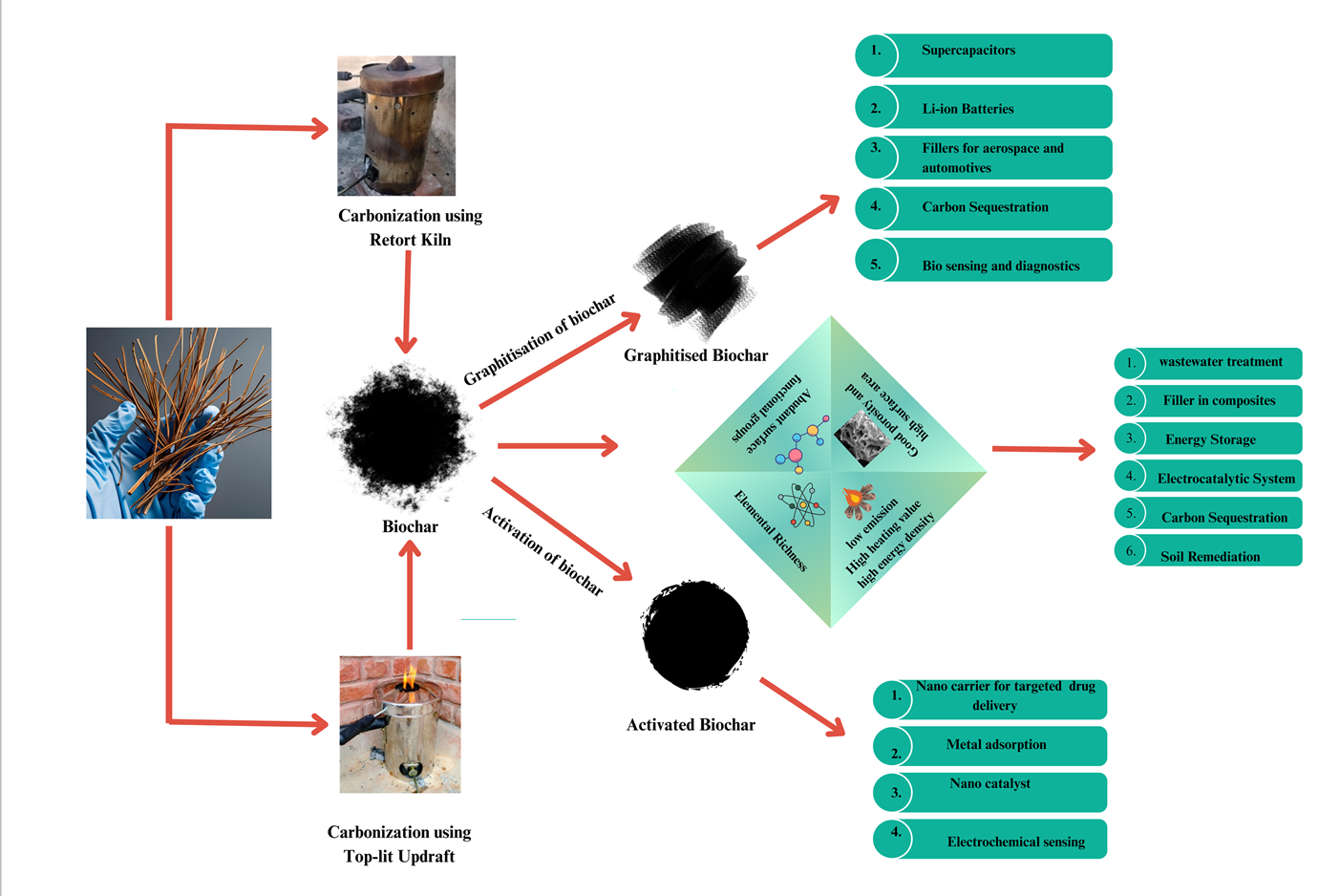
Sustainable management of pine needles, as a major forest waste product, is a critical challenge due to their high flammability, potential to create fire and ability to restrict growth of other vegetations. One of the possible solutions to this challenge is to utilize pine needles to produce value added products following the concept of circular economy. The present work focuses on utilizing pine needle waste to produce biochar and biochar derived functional carbon materials. The attempt has been made to carbonize pine needles into biochar through pyrolysis at different temperatures of 300℃, 400℃, 550℃ and 700℃. Top Lit Updraft and Retort kiln method has also been explored to achieve large-scale conversion rate. The produced biochar is characterized for morphological and structural characteristics through CHNSO elemental analysis, SEM, TEM, FTIR, Raman, XRD, EDAX and XPS. The characterization results show that pine needle biochar produced through retort heating method provides good degree of carbonization and aromatisation with significant polarity index widening the versatile applications of the material. The biochar thus produced can be activated or functionalised into a range of significant functional carbon materials such as activated biochar, nano biochar, graphitized biochar etc. Further, an attempt has been made to graphitize the biochar through chemical activation using Fe(NO3)3 followed by thermal treatment. The result shows that biochar has been successfully converted into graphitized biochar at quite low temperature i.e. <1000℃. Graphitized biochar produced exhibits crystalline aromatic structure with well-organized layers as evident by SEM, FTIR, XRD and Raman studies, and can serve as a source to derive costly graphene-based materials. This adopted pathway of making biochar, thus exhibits the potential to solve the problem associated with accumulation of pine needle waste, that can serve as an alternative precursor for the synthesis of value-added synthetic functional carbon materials applicable to wide range of specific applications including adsorbent or catalysts for water remediation, CO2 sequestration, filler for polymer composites, electrode materials, energy storage, etc.
Downloads
เอกสารอ้างอิง
R. Lesch, E. D. Visser, N. S. Seroka, and L. Khotseng, “Biomass-derived carbon-based nanomaterials: Current research, trends, and challenges,” Journal of Renewable Materials, vol. 13, no. 10, pp. 1935–1977, 2025. DOI: https://doi.org/10.32604/jrm.2025.02025-0026
J. Jiang, D. Deng, Y. Wang, Y. Chen, Y. Bai, M. Wang, X. Xiong, and Y. Lei, “Hydroxyl combined with nitrogen on biomass carbon promotes the electrocatalytic H2O2 selectivity,” Journal of Metals, Materials and Minerals, vol. 35, no. 1, p. e2216, 2025. DOI: https://doi.org/10.55713/jmmm.v35i1.2216
Q. Lin, R. Zhang, C. Yan, Q, Hu, S. Sang, Q. Wu, K. Liu, and H. Liu, “Regulating CoPx/Co heterostructures for enhanced electrocatalytic activity toward hydrazine oxidation reaction,” Journal of Metals, Materials and Minerals, vol. 35, no. 2, p. e2348, 2025. DOI: https://doi.org/10.55713/jmmm.v35i2.2348
K. Chaturvedi, A. Singhwane, M. Dhangar, M. Mill, N. Gorhae, A. Naik, P. Nair, A. K. Srivastava, and S. Verma, “Bamboo for producing charcoal and biochar for versatile applications,” Biomass Conversion and Biorefinery, vol. 14, no. 14, pp. 15159–15185, 2024. DOI: https://doi.org/10.1007/s13399-022-03715-3
R. Saidur, E. A. Abdelaziz, A. Demirbas, M. S. Hossain, and S. Mekhilef, “A review on biomass as a fuel for boilers,” Renewable and Sustainable Energy Reviews, vol. 15, no. 5, pp. 2262–2289, 2011. DOI: https://doi.org/10.1016/j.rser.2011.02.015
D. MP, M. Misra, and A. K. Mohanty, “Recent advances on value-added biocarbon preparation by the pyrolysis of renewable and waste biomass, their structure and properties: A move toward an ecofriendly alternative to carbon black,” Environmental Science: Advances, vol. 2, no. 10, pp. 1282–1301, 2023. DOI: https://doi.org/10.1039/D3VA00107E
M. Bartoli, R. Arrigo, G. Malucelli, A. Tagliaferro, and D. Duraccio, “Recent advances in biochar polymer composites,” Polymers (Basel), vol. 14, no. 12, p. 2506, 2022. DOI: https://doi.org/10.3390/polym14122506
T. A. T. Yasim-Anuar, L. Ng, A. A. Lawal, M. A. A. Farid, M. Yusuf, M. A. Hassan, and H. Ariffin, “Emerging application of biochar as a renewable and superior filler in polymer composites,” RSC Advances, vol. 12, no. 22, pp. 13938–13949, 2022. DOI: https://doi.org/10.1039/D2RA01897G
M. Aboughaly, A. Babaei-Ghazvini, P. Dhar, R. Patel, and B. Acharya, “Enhancing the potential of polymer composites using biochar as a filler: A review,” Polymers (Basel), vol. 15, no. 19, p. 3981, 2023. DOI: https://doi.org/10.3390/polym15193981
A. Babich, and D. Senk, “Coal use in iron and steel metallurgy,” in The Coal Handbook: Towards Cleaner Production, Elsevier, 2013, pp. 267–311. DOI: https://doi.org/10.1533/9781782421177.3.267
A. Lu, and J. Qin “A review on biomass-derived hard carbon anodes for sodium-ion batteries: From carbon precursors to storage mechanisms,” Journal of Metals, Materials and Minerals, vol. 36, no. 1, p. e2555, 2026. DOI: https://doi.org/10.55713/jmmm.v36i1.2555
Z. Sun, D. Yao, C. Cao, Z. Zhang, L. Zhang, H. Zhu, Q. Yuan, and B. Yi, “Preparation and formation mechanism of biomass-based graphite carbon catalyzed by iron nitrate under a low-temperature condition,” Journal of Environmental Management, vol. 318, p. 115555, 2022.
K. Plenča, S. Cvetnić, H. Prskalo, M. Kovacic, M. Cventnic, H. Kusic, Z. Matusinović, M. K. Rokovic, B. Genorio, U. L. Štangar, and A. L. Bozic, “Biomass pyrolysis-derived biochar: A versatile precursor for graphene synthesis,” Materials, vol. 16, no. 24, p. 7658, 2023. DOI: https://doi.org/10.3390/ma16247658
H. You, J. Hui, Y. Zhou, K. Vittore, J. Zhang, L. E. Chaney, S. Chinta, Y. Zhao, G. Lim, D. Lee, E. A. Ainsworth, J. B. Dunn, V. P. Dravid, M. C. Hersam, and S. J. Rowan, “Sustainable production of biomass‐derived graphite and graphene conductive inks from biochar,” Small, vol. 20, no. 52, 2024. DOI: https://doi.org/10.1002/smll.202406669
B. P. Chang, A. Rodriguez-Uribe, A. K. Mohanty, and M. Misra, “A comprehensive review of renewable and sustainable biosourced carbon through pyrolysis in biocomposites uses: Current development and future opportunity,” Renewable and Sustainable Energy Reviews, vol. 152, p. 111666, .2021. DOI: https://doi.org/10.1016/j.rser.2021.111666
Y. Li, R. Gupta, Q. Zhang, and S. You, “Review of biochar production via crop residue pyrolysis: Development and perspectives,” Bioresource Technology, vol. 369, p. 128423, 2023. DOI: https://doi.org/10.1016/j.biortech.2022.128423
A. M. Zubairu, E. Micheli, C. M. Ocensey, N. Boros, G. Rethati, E. Lehoczky, and M. Gulyas, “Biochar improves soil fertility and crop performance: A case study of Nigeria,” Soil Systems, vol. 7, no. 4, p. 105, 2023, DOI: https://doi.org/10.3390/soilsystems7040105
M. Obonukut, S. Alabi, and A. Jock, “Biochar from cassava waste: A paradigm shift from waste to wealth,” in Biochar- Productive Technologies, Properties and Applications, Intech Open, 2023. DOI: https://doi.org/10.5772/intechopen.105965
W. Buss, C. Wurzer, D. A. C. Manning, E. J. Rohling, J. Borevitz, and O. Mašek, “Mineral-enriched biochar delivers enhanced nutrient recovery and carbon dioxide removal,” Communications Earth & Environment, vol. 3, no. 1, p. 67, 2022. DOI: https://doi.org/10.1038/s43247-022-00394-w
D. A. E. L. André Brunnberg, “Catalytic graphitization of biomass,” Kth Royal Institute of Technology School of Industrial Engineering And Management, 2021.
M. Fayazi, “Synthesis of ZnO nanostructures with different morphologies on biochar support for photocatalytic degradation of organic dye,” Journal of Water and Environmental Nano-technology, 2024.
L. Rodrigues, A. Budai, L. Elsgaard, B. Hardy, S. G. Keel, C. Mondini, C. Plaza, and J. Leifeld, “The importance of biochar quality and pyrolysis yield for soil carbon sequestration in practice,” European Journal of Soil Science, vol. 74, no. 4, 2023, DOI: https://doi.org/10.1111/ejss.13396
M. I. Awad, Y. Makkawi, and N. M. Hassan, “Yield and energy modeling for biochar and bio-oil using pyrolysis temperature and biomass constituents,” ACS Omega, vol. 9, no. 16, pp. 18654–18667, 2024. DOI: https://doi.org/10.1021/acsomega.4c01646
G. Stella Mary, P. Sugumaran, S. Niveditha, B. Ramalakshmi, P. Ravichandran, and S. Seshadri, “Production, characterization and evaluation of biochar from pod (Pisum sativum), leaf (Brassica oleracea) and peel (Citrus sinensis) wastes,” International Journal of Recycling of Organic Waste in Agriculture, vol. 5, no. 1, pp. 43–53, 2016. DOI: https://doi.org/10.1007/s40093-016-0116-8
R. Wood, O. Mašek, and V. Erastova, “Developing realistic molecular models of biochars,” Cell Reports Physical Science, vol. 5, no. 7, p. 102037, 2024. DOI: https://doi.org/10.1016/j.xcrp.2024.102037
K. A. Spokas, “Review of the stability of biochar in soils: predictability of O:C molar ratios,” Carbon Manag., vol. 1, no. 2, pp. 289–303, 2010. DOI: https://doi.org/10.4155/cmt.10.32
D. Krügerm, and Ö. Ç. Mutlu, “Demonstration of a top-lit updraft based pyrolytic burner with low emission operation and automatic process control,” Energies (Basel)., vol. 14, no. 13, p. 3913, 2021. DOI: https://doi.org/10.3390/en14133913
J. Sánchez-Pólito, V. Berrueta; V. Ruiz-García; A. Beltrán; E. Herrera-Medina; M. Cazarez-Barboza; L. lvarez-Icaza; and O. Masera “Development and evaluation performance of top-lit updraft biomass micro-gasifiers for energy-intensive household cooking tasks in Mexico,” Sustainable Energy Technologies and Assessments, vol. 67, p. 103813, 2024, DOI: https://doi.org/10.1016/j.seta.2024.103813
J. O. Ighalo, O. A. A. Eletta, and A. G. Adeniyi, “Biomass carbonisation in retort kilns: Process techniques, product quality and future perspectives,” Bioresource Technology Reports, vol. 17, p. 100934, 2022. DOI: https://doi.org/10.1016/j.biteb.2021.100934
A. Chandrasekaran, S. Subbiah, S. Ramachandran, S. Narayanasamy, P. Bartocci, and F. Fantozzi, “Natural draft-improved carbonization retort system for biocarbon production from prosopis juliflora biomass,” Energy & Fuels, vol. 33, no. 11, pp. 11113–11124, 2019. DOI: https://doi.org/10.1021/acs.energyfuels.9b02639
T. Namaswa, D. F. R. P. Burslem, and J. Smith, “Emerging trends in appropriate kiln designs for small-scale biochar production in low to middle income countries,” Bioresource Technology Reports, vol. 24, p. 101641, 2023. DOI: https://doi.org/10.1016/j.biteb.2023.101641
T. J. Bandosz, “Surface chemistry of carbon materials,” in Carbon Materials for Catalysis, Wiley, 2008, pp. 45–92. DOI: https://doi.org/10.1002/9780470403709.ch2
B.-T. T. Dao, D. T. Nguyen, N. H. Le, and C.-N. Ha-Thuc, “Synergistic adsorption–photocatalysis of activated carbon/ titanium dioxide composite derived from rice husk ash under ultraviolet-C irradiation,” Journal of Metals, Materials and Minerals, vol. 36, no. 3, p. e2597, 2026. DOI: https://doi.org/10.55713/jmmm.v36i3.2597
J. Wang, Z. Li, Y. Li, Z. Wang, X. Liu, Z. Liu, and J. Ma, “Evolution and correlation of the physiochemical properties of bamboo char under successive pyrolysis process,” Biochar, vol. 6, no. 1, p. 33, 2024. DOI: https://doi.org/10.1007/s42773-024-00321-6
G. Loebsack, K. K.-C. Yeung, F. Berruti, and N. B. Klinghoffer, “Impact of biochar physical properties on adsorption mechanisms for removal of aromatic aqueous contaminants in water,” Biomass Bioenergy, vol. 194, p. 107617, 2025. DOI: https://doi.org/10.1016/j.biombioe.2025.107617
R. Kumar, P. K. Rakesh, and D. Sreehari, “Investigation on physico-chemical, mechanical and thermal properties of extracted novel pinus roxburghii fiber,” Journal of Natural Fibers, vol. 20, no. 1, 2023. DOI: https://doi.org/10.1080/15440478.2022.2157924
I. Pavkov, M. Radojcin, Z. Stamenkovic, S. Bikic, M. Tomic, M. Bukurov, and B. Despotovic, “Hydrothermal carbonization of agricultural biomass: characterization of hydrochar for energy production,” Solid Fuel Chemistry, vol. 56, no. 3, pp. 225–235, 2022. DOI: https://doi.org/10.3103/S0361521922030077
S. Shyam, M. Daimary, M. Narayan, and H. Sarma, “Biochar-based electroanalytical materials: Towards sustainable, high-performance electrocatalysts and sensors,” Next Materials, vol. 8, p. 100873, 2025. DOI: https://doi.org/10.1016/j.nxmate.2025.100873
I. Cakin, S. Pap, P. P. J. Gaffney, and M. A. Taggart, “Designing a biochar-based pretreatment method for distillery effluents entering constructed wetlands,” The Journal of Cleaner Production, vol. 476, p. 143790, 2024. DOI: https://doi.org/10.1016/j.jclepro.2024.143790
P. Bulak, K. Proc-Pietrycha, M. Kaczor, K. Zlotko, C. Polakowski, D. Wiacek, H. Waniak-Nawicka, E. Zieba, A. Wasko, P. Oleszczuk, and A. Bieganowski, “A novel type of biochar from chitinous Hermetia illucens waste with a built-in stimulating effect on plants and soil arthropods,” Scientific Reports., vol. 13, no. 1, p. 8306, 2023, DOI: https://doi.org/10.1038/s41598-023-35460-6
M. A. Islam, M. I. Parvin, T. K. Dada, R. Kumar, and E. Antunes, “Silver adsorption on biochar produced from spent coffee grounds: validation by kinetic and isothermal modelling,” Biomass Conversion and Biorefinery, vol. 14, no. 22, pp. 28007–28021, 2024. DOI: https://doi.org/10.1007/s13399-022-03491-0
R. Breen, C. Goggin, J. D. Holmes, and G. Collins, “A collaborative cocurricular undergraduate research experience on sustainable materials: Analysis of biochar using the boehm titration and spectroscopic techniques,” Journal of Chemical Education, vol. 102, no. 3, pp. 1323–1332, 2025. DOI: https://doi.org/10.1021/acs.jchemed.4c01110
C. Wang, D. Ma, and X. Bao, “Transformation of biomass into porous graphitic carbon nanostructures by microwave irradiation,” The Journal of Physical Chemistry C, vol. 112, no. 45, pp. 17596–17602, 2008. DOI: https://doi.org/10.1021/jp805113y
X. Yang, H. Pan, S. M. Shaheen, H. Wang, and J. Rinklebe, “Immobilization of cadmium and lead using phosphorus-rich animal-derived and iron-modified plant-derived biochars under dynamic redox conditions in a paddy soil,” Environment International, vol. 156, p. 106628, 2021. DOI: https://doi.org/10.1016/j.envint.2021.106628
A. Kumar, S. D. Joseph, E. R. Graber, S. Tahery, D. R. G. Mitchell, P. Munroe, L. Tsechansky, O. lerdahl, W. Aker, and M. Saebo, “Fertilizing behavior of extract of organomineral-activated biochar: Low-dose foliar application for promoting lettuce growth,” Chemical and Biological Technologies in Agriculture, vol. 8, no. 1, p. 21, 2021. DOI: https://doi.org/10.1186/s40538-021-00222-x
R. Chatterjee, B. Sajjadi, W.-Y. Chen, D. Mattern, N. Hammer, V. Raman, and A. L. Dorris, “Effect of pyrolysis temperature on physicochemical properties and acoustic-based amination of biochar for efficient CO2 adsorption,” Frontiers in Energy Research, vol. 8, 2020. DOI: https://doi.org/10.3389/fenrg.2020.00085
Y. Cui, X. Chen, C. Pitakrattanawong, X. Du, L. Qiu, H. Xu, J. Chen, M. Shunlong, L. Fan, and S. Chao, “Adsorption efficiency of biochar produced by aquaculture by-products for removing geosmin in aquaculture environment,” Water Reuse, vol. 14, no. 1, pp. 65–79, 2024. DOI: https://doi.org/10.2166/wrd.2023.129
S. S. Sahoo, V. K. Vijay, R. Chandra, and H. Kumar, “Production and characterization of biochar produced from slow pyrolysis of pigeon pea stalk and bamboo,” Cleaner Engineering and Technology, vol. 3, p. 100101, 2021. DOI: https://doi.org/10.1016/j.clet.2021.100101
R. Liu, G. Liu, B. Yousaf, Z. Niu, and Q. Abbas, “Novel investigation of pyrolysis mechanisms and kinetics for functional groups in biomass matrix,” Renewable and Sustainable Energy Reviews, vol. 153, p. 111761, 2022. DOI: https://doi.org/10.1016/j.rser.2021.111761
E. M. El-Fawal, A. M. A. El-Naggar, A. A. El-Zahhar, M. M. Alghandi, A. Morshedy, H. A. El-Sayed, an A. E. M. Mohammed, “Biofuel production from waste residuals: comprehensive insights into biomass conversion technologies and engineered biochar applications,” RSC Advances, vol. 15, no. 15, pp. 11942–11974, 2025. DOI: https://doi.org/10.1039/D5RA00857C
W. Suliman, J. B. Harsh, N. I. Abu-Lail, A.-M. Fortuna, I. Dallmeyer, and M. Garcia-Pérez, “The role of biochar porosity and surface functionality in augmenting hydrologic properties of a sandy soil,” Science of The Total Environment, vol. 574, pp. 139–147, 2017. DOI: https://doi.org/10.1016/j.scitotenv.2016.09.025
S. V. Vongsetskul, W. Thepthong, S. Kanyawilas, N. Chanlek, R. Charoenwattanasatien, W. Busayaporn, T. Vongsetskul, “Zinc oxide functionalized biochar from rambutan wood as a novel material to utilize an agricultural waste in Thailand,” Journal of Metals, Materials and Minerals, vol. 36, no. 2, p. e2410, 2026. DOI: https://doi.org/10.55713/jmmm.v36i2.2410
Q. Luo, Y. Deng, Y. Li, Q. He, H. Wu, and X. Fang, “Effects of pyrolysis temperatures on the structural properties of straw biochar and its adsorption of tris-(1-chloro-2-propyl) phosphate,” Scientific Reports., vol. 14, no. 1, p. 25711, 2024. DOI: https://doi.org/10.1038/s41598-024-77299-5
A. K. Varma, and P. Mondal, “Physicochemical characterization and kinetic study of pine needle for pyrolysis process,” Journal of Thermal Analysis and Calorimetry, vol. 124, no. 1, pp. 487–497, 2016. DOI: https://doi.org/10.1007/s10973-015-5126-7
A. K. Varma, and P. Mondal, “Pyrolysis of pine needles: effects of process parameters on products yield and analysis of products,” Journal of Thermal Analysis and Calorimetry, vol. 131, no. 3, pp. 2057–2072, 2018. DOI: https://doi.org/10.1007/s10973-017-6727-0
A. Tomczyk, Z. Sokołowska, and P. Boguta, “Biochar physico-chemical properties: pyrolysis temperature and feedstock kind effects,” Reviews in Environmental Science and Bio/Technology, vol. 19, no. 1, pp. 191–215, 2020. DOI: https://doi.org/10.1007/s11157-020-09523-3
M. Ahmad, S. S. Lee, A. U. Rajapaksha, M. Vithanage, M. Zhang, J. S. Cho, S. E. Lee, and Y. S. Ok, “Trichloroethylene adsorption by pine needle biochars produced at various pyrolysis temperatures,” Bioresource Technology, vol. 143, pp. 615–622, 2013. DOI: https://doi.org/10.1016/j.biortech.2013.06.033
C. Zhang, N. Zhang, Z. Xiao, Z. Li, and D. Zhang, “Characterization of biochars derived from different materials and their effects on microbial dechlorination of pentachlorophenol in a consortium,” RSC Advances, vol. 9, no. 2, pp. 917–923, 2019. DOI: https://doi.org/10.1039/C8RA09410A
M. Keiluweit, P. S. Nico, M. G. Johnson, and M. Kleber, “Dynamic molecular structure of plant biomass-derived black carbon (biochar),” Environmental Science & Technology, vol. 44, no. 4, pp. 1247–1253, 2010. DOI: https://doi.org/10.1021/es9031419
S. Malik, and J. S. Laura, “Evaluating biochar properties derived from various agro-residues via pyrolysis: A comparative study,” Oriental Journal of Chemistry, vol. 41, no. 1, pp. 120–126, 2025. DOI: https://doi.org/10.13005/ojc/410113
S. Jha, R. Gaur, S. Shahabuddin, I. Tyagi, J. Giri, and M. Kanan, “Utilizing low-cost mausambi peel-derived adsorbents for the effective treatment of complex industrial dye mixture in waste-water: Unravelling the adsorption mechanism,” Cleaner Engineering and Technology, vol. 26, p. 100951, 2025. DOI: https://doi.org/10.1016/j.clet.2025.100951
H. Darmstadt, D. Pantea, L. Sümmchen, U. Roland, S. Kaliaguine, and C. Roy, “Surface and bulk chemistry of charcoal obtained by vacuum pyrolysis of bark: influence of feedstock moisture content,” Journal of Analytical and Applied Pyrolysis, vol. 53, no. 1, pp. 1–17, 2000. DOI: https://doi.org/10.1016/S0165-2370(99)00051-0
C. Schneider, S. Walker, A. Phounglamcheik, K. Umeki, and T. Kolb, “Effect of calcium dispersion and graphitization during high-temperature pyrolysis of beech wood char on the gasification rate with CO2,” Fuel, vol. 283, p. 118826, 2021. DOI: https://doi.org/10.1016/j.fuel.2020.118826
N. Kumari, T. Chhabra, S. Kumar, and V. Krishnan, “Nano-architectonics of sulfonated biochar from pine needles as catalyst for conversion of biomass derived chemicals to value added products,” Catalysis Communications, vol. 168, p. 106467, 2022. DOI: https://doi.org/10.1016/j.catcom.2022.106467
R. K. Gond, M. K. Gupta, H. Singh, S. Mavinkere Rangappa, and S. Siengchin, “Extraction and properties of cellulose for polymer composites,” in Biodegradable Polymers, Blends and Composites, Elsevier, 2022, pp. 59–86. DOI: https://doi.org/10.1016/B978-0-12-823791-5.00011-9
S. Yoo, S. S. Kelley, D. C. Tilotta, and S. Park, “Structural characterization of loblolly pine derived biochar by X-ray diffraction and electron energy loss spectroscopy,” ACS Sustainable Chemistry & Engineering, vol. 6, no. 2, pp. 2621–2629, 2018. DOI: https://doi.org/10.1021/acssuschemeng.7b04119
S. Biswas, H. Siddiqi, B. C. Meikap, T. K. Sen, and M. Khiadani, “Preparation and characterization of raw and inorganic acid-activated pine cone biochar and its application in the removal of aqueous-phase Pb2+ metal ions by adsorption,” Water, Air, & Soil Pollution, vol. 231, no. 1, p. 3, 2020. DOI: https://doi.org/10.1007/s11270-019-4375-7
O. Paris, C. Zollfrank, and G. A. Zickler, “Decomposition and carbonisation of wood biopolymers—a microstructural study of softwood pyrolysis,” Carbon N. Y., vol. 43, no. 1, pp. 53–66, 2005. DOI: https://doi.org/10.1016/j.carbon.2004.08.034
P. Nain, “Characterization of pine needle and pine needle biochar: A potential soil amendment for sustainable forest waste management,” Annals of Plant and Soil Research, vol. 25, no. 2, pp. 211–220, 2023. DOI: https://doi.org/10.47815/apsr.2023.10259
T. Yang, and A. C. Lua, “Characteristics of activated carbons prepared from pistachio-nut shells by physical activation,” Journal of Colloid and Interface Science, vol. 267, no. 2, pp. 408–417, 2003. DOI: https://doi.org/10.1016/S0021-9797(03)00689-1
J. Zhang, B. Huang, L. Chen, J. Du, W. Li, and Z. Luo, “Pyrolysis kinetics of hulless barley straw using the distributed activation energy model (daem) by the TG/DTA technique and sem/xrd characterizations for hulless barley straw derived biochar,” Brazilian Journal of Chemical Engineering, vol. 35, no. 3, pp. 1039–1050, 2018. DOI: https://doi.org/10.1590/0104-6632.20180353s20170382
J. Dias, A. Conceição, F. M. Delatorre, and P. Siqueira, “Production, characterization physical, chemical, and structural analysis of biochar fines for bio-reinforcement in composite materials,” Processes, vol. 13, no. 2, p. 504, 2025. DOI: https://doi.org/10.3390/pr13020504
L. Xu, Q. Yao, J. Deng, Z. Han, Y. Zhang, Y. Fu, G. W. Huber, and Q. Guo, “Renewable N-heterocycles production by thermo-catalytic conversion and ammonization of biomass over ZSM-5,” ACS Sustainable Chemistry & Engineering, vol. 3, no. 11, pp. 2890–2899, 2015. DOI: https://doi.org/10.1021/acssuschemeng.5b00841
A. Rachmat, Y. E. Wahyu, P. L. Hariani, F. Riyanti, and F. Fatma, “Pyrolysis and modification of coconut shell into sulfonated biochar and its catalytic activity on cellobiose conversion,” Journal of Metals, Materials and Minerals, vol. 35, no. 3, p. e2271, 2025. DOI: https://doi.org/10.55713/jmmm.v35i3.2271
N. T. Abdel-Ghani, G. A. El-Chaghaby, and E. M. Zahran, “Cost effective adsorption of aluminium and iron from synthetic and real wastewater by rice hull activated carbon (RHAC),” American Journal of Analytical Chemistry, vol. 06, no. 01, pp. 71–83, 2015. DOI: https://doi.org/10.4236/ajac.2015.61007
S. O. Amusat, T. G. Kebede, E. N. Nxumalo, S. Dube, and M. M. Nindi, “Green synthesis of surface modified biochar for simultaneous removal of steroidal hormones and heavy metals from wastewater: Optimisation by central composite design,” Water (Basel), vol. 15, no. 20, p. 3703, 2023. DOI: https://doi.org/10.3390/w15203703
B. Armynah, Atika, Z. Djafar, W. H. Piarah, and D. Tahir, “Analysis of chemical and physical properties of biochar from rice husk biomass,” Journal of Physics: Conference Series, vol. 979, p. 012038, 2018. DOI: https://doi.org/10.1088/1742-6596/979/1/012038
A. Illankoon, C. Milanese, A. Karunarathna, Y. Alanhakoon, P. G. Rathnasiri, M. Medina-Llamas, M. C. Collivignarelli, and S. Sorlini, “Development of a dual-chamber pyrolizer for biochar production from agricultural waste in sri lanka,” Energies (Basel), vol. 16, no. 4, p. 1819, 2023. DOI: https://doi.org/10.3390/en16041819
M. Keiluweit, and M. Kleber, “Molecular-level interactions in soils and sediments: The role of aromatic π-systems,” Environmental Science & Technology vol. 43, no. 10, pp. 3421–3429, 2009. DOI: https://doi.org/10.1021/es8033044
V. Choudhary, M. Patel, C. U. Pittman, and D. Mohan, “Batch and continuous fixed-bed lead removal using himalayan pine needle biochar: Isotherm and kinetic studies,” ACS Omega, vol. 5, no. 27, pp. 16366–16378, 2020. DOI: https://doi.org/10.1021/acsomega.0c00216
R. A. Mensah, V. Shanmugam, E. Kaynak, D. Sokol, J. Wahl, K. C. Le, Y. Zhang, L. Jiang, R. E. Neisiany, E. A. Turhan, and O. Das, “The facile conversion of waste biomass into few-layer graphene oxide,” Scientific Reports, vol. 15, no. 1, p. 9166, 2025. DOI: https://doi.org/10.1038/s41598-025-93037-x
D. Mohan, A. Sarswat, V. K. Singh, M. Alexandre-Franco, and C. U. Pittman, “Development of magnetic activated carbon from almond shells for trinitrophenol removal from water,” Chemical Engineering Journal, vol. 172, no. 2–3, pp. 1111–1125, 2011. DOI: https://doi.org/10.1016/j.cej.2011.06.054
A. Ngambia, O. Mašek, and V. Erastova, “Development of biochar molecular models with controlled porosity,” Biomass Bioenergy, vol. 184, p. 107199, 2024. DOI: https://doi.org/10.1016/j.biombioe.2024.107199
M. Bin Mobarak, N. S. Pinky, S. Mustafi, F. Chowdhury, A. Nahar, U. S. Akhtar, Md. S. Quddus, S. Yasmin, and Md. A. Alam “Unveiling the reactor effect: a comprehensive characterization of biochar derived from rubber seed shell via pyrolysis and in-house reactor,” RSC Advances, vol. 14, no. 41, pp. 29848–29859, 2024. DOI: https://doi.org/10.1039/D4RA05562D
S. Ekman, G. S. dos Reis, E. Laisne, J. Thivet, A. Grimm, E. C. Lima, Mu. Naushad, and G. Dotto, “Synthesis, characterization, and adsorption properties of nitrogen-doped nanoporous biochar: efficient removal of reactive orange 16 dye and colorful effluents,” Nanomaterials, vol. 13, no. 14, p. 2045, 2023. DOI: https://doi.org/10.3390/nano13142045
Q. Lin, J. Zhang, L. Yin, H. Liu, W. Zuo, and Y. Tian, “Relationship between heavy metal consolidation and H2S removal by biochar from microwave pyrolysis of municipal sludge: Effect and mechanism,” Environmental Science and Pollution Research, vol. 28, no. 22, pp. 27694–27702, 2021. DOI: https://doi.org/10.1007/s11356-021-12631-4
Z. Yao, X. Chen, Y. Sun, and W. Qi, “Simultaneous regulation of nitrogen, sulfur and carbon using biochar during sewage sludge pyrolysis,” ReNew Energy Global, vol. 236, p. 121413, 2024. DOI: https://doi.org/10.1016/j.renene.2024.121413
Z. Chen, W. Chen, D. Jia, Y. Liu, A. Zhang, T. Wen, J. Liu, Y. Ai, W. Song, and X. Wang, “N, P, and S codoped graphene‐like carbon nanosheets for ultrafast uranium (VI) capture with high capacity,” Advanced Science, vol. 5, no. 10, 2018. DOI: https://doi.org/10.1002/advs.201800235
S. Oswald, M. V. Gorbunov, and D. Mikhailova, “Electron spectroscopy investigations of potassium and potassium-intercalated graphite with battery background,” Applied Surface Science vol. 655, p. 159614, 2024. DOI: https://doi.org/10.1016/j.apsusc.2024.159614
L. Cizaire, J. M. Martin, T. Le Mogne, and E. Gresser, “Chemical analysis of overbased calcium sulfonate detergents by coupling XPS, ToF-SIMS, XANES, and EFTEM,” Colloids and Surfaces A: Physicochemical and Engineering Aspects, vol. 238, no. 1–3, pp. 151–158, 2004. DOI: https://doi.org/10.1016/j.colsurfa.2004.02.015
S. Li, X. Liu, R. Mao, Z. Huang, and R. Xie, “Red-emission enhancement of the CaAlSiN3 :Eu2+ phosphor by partial substitution for Ca3N2 by CaCO3 and excess calcium source addition,” RSC Advances, vol. 5, no. 93, pp. 76507–76515, 2015. DOI: https://doi.org/10.1039/C5RA14320A
T. K. Mandal, Y. Hou, Z. Gao, H. Ning, W. Yang, and M. Gao, “Graphene oxide‐based sensor for ultrasensitive visual detection of fluoride,” Advanced Science, vol. 3, no. 12, 2016. DOI: https://doi.org/10.1002/advs.201600217
K. Suzuki, Y. Saito, N. Okazaki, and T. Suzuki, “Graphite-shell-chains selectively and efficiently produced from biomass rich in cellulose and chitin,” Scientific Reports, vol. 10, no. 1, p. 12131, 2020. DOI: https://doi.org/10.1038/s41598-020-69156-y
S. J. Goldie, and K. S. Coleman, “Graphitization by metal particles,” ACS Omega, vol. 8, no. 3, pp. 3278–3285, 2023. DOI: https://doi.org/10.1021/acsomega.2c06848
S. G. Krishnan, C. E. White, K. Zeng, N. Kalarikkal, Y. S. Ok, C. B. Arnold, S. Thomas, and A. Nzihou “Recent developments on multi- versus single-metallic catalytic graphitisation of biocarbon: A review,” Fuel, vol. 396, p. 135330, 2025. DOI: https://doi.org/10.1016/j.fuel.2025.135330
Z. Sun, D. Yao, C. Cao, Z. Zhang, L. Zhang, H. Zhu, Q. Yuan, and B. Yi “Preparation and formation mechanism of biomass-based graphite carbon catalyzed by iron nitrate under a low-temperature condition,” Journal of Environmental Management, vol. 318, p. 115555, 2022. DOI: https://doi.org/10.1016/j.jenvman.2022.115555
A. Gomez-Martin, Z. Schnepp, and J. Ramirez-Rico, “Structural evolution in iron-catalyzed graphitization of hard carbons,” Chemistry of Materials, vol. 33, no. 9, pp. 3087–3097, 2021. DOI: https://doi.org/10.1021/acs.chemmater.0c04385
S. M. Alluqmani, H. Albuqawi, M. A. Hakami, N. M. Alabdallah, H. M. Almarri, A. A. Al-Zahrani, and A. Alshahrie, “Preparation and characterisation of graphitic biochar materials derived from rose oil industry waste via different pyrolysis durations and ball milling for advanced composites,” Materials Research Express, vol. 11, no. 3, p. 035005, 2024. DOI: https://doi.org/10.1088/2053-1591/ad3523
C. Yang, Z. Liu, W. Liu, Y. Qiu, S. Zhang, X. Zhang, M. Wang, H. Wu, L. Hongyi, J. Huang, J. Liu, Y. Wang, S. He, D. Gu, G. Xiaohui, X. Yang, T. Xie, H. Chen, and Y. Yao, “Graphitized biochar derived from agricultural wastes enhances methanogenesis via conductivity‐driven direct interspecies electron transfer,” Advanced Science, vol. 12, no. 41, 2025. DOI: https://doi.org/10.1002/advs.202508739
I. Major, J.-M. Pin, E. Behazin, A. Rodriguez-Uribe, M. Misra, and A. Mohanty, “Graphitization of Miscanthus grass biocarbon enhanced by in situ generated FeCo nanoparticles,” Green Chemistry, vol. 20, no. 10, pp. 2269–2278, 2018. DOI: https://doi.org/10.1039/C7GC03457A
T. Mazon, B. A. Bregadiolli, J. V. Paulin, W. A. Bizzo, L. T. Kubota, and S. Deng, “Application of graphitized sugarcane biochar and derivative composites as electrodes in super-capacitors,” SSRN Electronic Journal, 2022. DOI: https://doi.org/10.2139/ssrn.4164495
T. Kim, J. Lee, and K.-H. Lee, “Full graphitization of amorphous carbon by microwave heating,” RSC Advances, vol. 6, no. 29, pp. 24667–24674, 2016. DOI: https://doi.org/10.1039/C6RA01989G
H. Li, Y. Xiao, X. Tian, X. Xing, M. Cao, and Y. Wang, “A crystalline/amorphous FeCo alloy/FeCoNi-Pi bifunctional electrocatalyst for efficient overall water splitting,” Inorganic Chemistry Frontiers, vol. 11, no. 12, pp. 3585–3595, 2024. DOI: https://doi.org/10.1039/D4QI00574K
S. Khoshk Rish, A. Tahmasebi, R. Wang, J. Dou, and J. Yu, “Formation mechanism of nano graphitic structures during microwave catalytic graphitization of activated carbon,” Diamond and Related Materials, vol. 120, p. 108699, 2021. DOI: https://doi.org/10.1016/j.diamond.2021.108699
T. Li, R. Ma, X. Xu, S. Sun, and J. Lin, “Microwave-induced preparation of porous graphene nanosheets derived from biomass for supercapacitors,” Microporous and Mesoporous Materials, vol. 324, p. 111277, 2021. DOI: https://doi.org/10.1016/j.micromeso.2021.111277
N. C. Silva de Souza, G. A. Puiatti, G. do C. Dias, R. M. Silva, R. P. Lopes Moreira, and T. A. Silva, “Development of sustainable electrodes based on cobalt ferrite-decorated biochar for the voltammetric determination of paracetamol in biological fluids,” Analytical Methods, vol. 17, no. 17, pp. 3509–3516, 2025. DOI: https://doi.org/10.1039/D5AY00089K
Md. M. Rahman, A. Al Mamun, H. Minami, Md. M. Rahman, S. M. Hoque, and H. Ahmad, “Biochar/poly(aniline-pyrrole) modified graphite electrode and electrochemical behavior for application in low-cost supercapacitor,” Arabian Journal of Chemistry, vol. 17, no. 9, p. 105938, 2024. DOI: https://doi.org/10.1016/j.arabjc.2024.105938
H. Jing, D. Zheng, H. Du, H. Zhu, M. Chen, and Y. Zhou, “Cage-like ulva biochar confined synthesis of Fe3O4/ZnO hetero-junction nanoparticles for synergistic adsorption and photo-catalytic degradation of PFOA,” Biochar, vol. 8, no. 1, p. 11, 2026. DOI: https://doi.org/10.1007/s42773-025-00525-4
C. Mabrouk, J. Wannassi, P. A. Salazar-Carballo, S. Carinelli, A. J. Gross, H. Kahri, N. Jaffrezic-Renault, and H. Barhoumi “ZnO nanoparticles coated with EDTA and Ag nanoparticles (ZnO@EDTA-Ag NPs) for enhanced electrochemical detection of Cu2+ ions in food and environmental samples,” Microchemical Journal, vol. 212, p. 113562, 2025. DOI: https://doi.org/10.1016/j.microc.2025.113562
ดาวน์โหลด
เผยแพร่แล้ว
วิธีการอ้างอิง
ฉบับ
บท
การอนุญาต
ลิขสิทธิ์ (c) 2026 วารสารโลหะ, วัสดุ และแร่

This work is licensed under a Creative Commons Attribution-NonCommercial-NoDerivatives 4.0 International License.
Authors who publish in this journal agree to the following terms:
- Authors retain copyright and grant the journal right of first publication with the work simultaneously licensed under a Creative Commons Attribution License that allows others to share the work with an acknowledgment of the work's authorship and initial publication in this journal.
- Authors are able to enter into separate, additional contractual arrangements for the non-exclusive distribution of the journal's published version of the work (e.g., post it to an institutional repository or publish it in a book), with an acknowledgment of its initial publication in this journal.