Effect of MgO on crawling and physical properties in ceramic glazes
DOI:
https://doi.org/10.55713/jmmm.v36i3.2537Keywords:
Crawling, Defect, Phase formation, Ceramic glazeAbstract
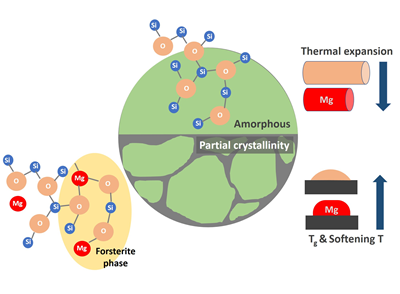
This study attempted to seek and verify the scientific aspects responsible for crawling in ceramic glazes. The selected additive was magnesium oxide (MgO). The glazes were applied on porcelain biscuits and fired between 1100℃ and 1300℃. The degree of crawling was enhanced with increasing amount of MgO, which was accompanied by formation of forsterite (Mg2SiO4) as a major phase. Complete island separation was achieved with 10 wt% MgO with good wettability and shiny surface. The morphology of the glaze demonstrated this phase as small crystals within the glaze layer. Addition of MgO resulted in a continuous decrease in the thermal expansion coefficient (as low as 11.76 ´ 10‒6 1∙℃‒1) likely due to crystallization of different phases. On the contrary, both glass-transition and softening temperatures (Tg and Ts) showed an initial decrease when adding 5 wt% MgO. However, the trend was reversed beyond the amount of 10 wt%. The in-depth study of the glass structure could not be carried out as the crystalline phase generating Raman peaks that interfered the deconvolution of the non-bridging oxygen (NBO) characteristics. The melting behavior displayed a similar trend to both Tg and Ts, signifying the complicated role of Mg cations in the glaze structure. Addition of MgO (5 wt%) could reduce the softening temperature from 1082℃ to 987℃ suggested that a small amount of MgO could likely behave as a network modifier. A higher amount modified the glaze structure to be closer to a glass-creamic. This change in phasic nature was likely to yield the glazes with high rigidity, high surface tension via melting difficulty which were closely reflected by the increase in the thermal expansion coefficient as well as Tg and Ts. Formation of crystalline phases due to MgO addition was believed to mainly cause crawling as evidenced by various, relevant characterization techniques.
Downloads
References
E. Youssef, N. Mostafa, J. E. Khoury, T. Merhej and R. Lteif, "Glaze surface defects causes and prevention controls," Journal of Ceramic Science and Technology, vol. 14, no. 1, pp. 1‒10, 2023.
D. Wattanasiriwech, and S. Wattanasiriwech, "Effect of particle size of glaze powder and thickness of glaze layer on glaze crawling for dolomite wares," Chiang Mai Journal of Science, vol. 33, no. 1, pp. 35‒44, 2006.
S. Junta, S. Mulinta, A. Saitan, and K. Ruammaitree, "Effect of Al2O3, CaCO3 and MgCO3 on physical properties of crawling Shino glaze in reduction atmosphere," Key Engineering Materials, vol. 608, pp. 258‒363, 2014. DOI: https://doi.org/10.4028/www.scientific.net/KEM.608.358
J. Li, J. Liang, and L. Wang, "Effect of particle-size distribution on the surface appearance of glazed surface," Journal of Thermal analysis Calorimetry, vol. 115, pp. 1127‒1131, 2014. DOI: https://doi.org/10.1007/s10973-013-3397-4
S. Wang, Z. Bao, and L. Mian, "Effect of MgO on crystallization and properties of anorthite glass-ceramic glaze," Journal of Ceramics, vol. 44, no. 5, pp. 1024‒1030, 2023.
M. G. Rasteiro, T. Gassman, R. Santos, and E. Antunes, "Crystalline phase characterization of glass-ceramic glazes," Ceramics International, vol. 33, pp. 345‒354, 2007. DOI: https://doi.org/10.1016/j.ceramint.2005.10.002
T. Mouri, and M. Enami, "Raman spectroscopic study of olivine-group minerals," Journal of Mineralogical and Petrologgical Sciences, vol. 103, pp. 100‒104, 2008. DOI: https://doi.org/10.2465/jmps.071015
R. L. Dumitrache, and I. Teoreanu, "Melting behavior of feldspar porcelain glazes," Scientific Bulletin-University Politehnica of Bucharest, vol. 68, no. 1, pp. 3‒16, 2006.
N. Yongvanich, T. Sirijan, P. Larptaweechai, and L. Chatchawong, "Reduction of maturation point in crystalline glaze through frit addition," Monatshefte für Chemie/Chemical Monthly, vol. 148, pp. 1329‒1335, 2017. DOI: https://doi.org/10.1007/s00706-017-1991-z
N. Yongvanich, C. Chanthanan, N. Ruennarong, and N. Suwanna, "Stability of malayaite pigments in high-ZnO ceramic glazes," Key Engineering Materials, vol. 772, pp. 90‒94, 2018. DOI: https://doi.org/10.4028/www.scientific.net/KEM.772.90
N. Yongvanich, P. Soysom, and W. Ratkasemsak, "Synthesis of zircon pigments from rice husk ash and their performance in ceramic glaze," Journal of Metals, Materials and Minerals, vol. 33, no. 1, pp. 47‒55, 2023. DOI: https://doi.org/10.55713/jmmm.v33i1.1593
Downloads
Published
How to Cite
License
Copyright (c) 2026 Journal of Metals, Materials and Minerals

This work is licensed under a Creative Commons Attribution-NonCommercial-NoDerivatives 4.0 International License.
Authors who publish in this journal agree to the following terms:
- Authors retain copyright and grant the journal right of first publication with the work simultaneously licensed under a Creative Commons Attribution License that allows others to share the work with an acknowledgment of the work's authorship and initial publication in this journal.
- Authors are able to enter into separate, additional contractual arrangements for the non-exclusive distribution of the journal's published version of the work (e.g., post it to an institutional repository or publish it in a book), with an acknowledgment of its initial publication in this journal.