Salt resistance of metakaolin and asphalt waste dust-based geopolymer
DOI:
https://doi.org/10.55713/jmmm.v36i4.2547Keywords:
Geopolymer, Metakaolin, Asphalt Waste Dust, Portland CementAbstract
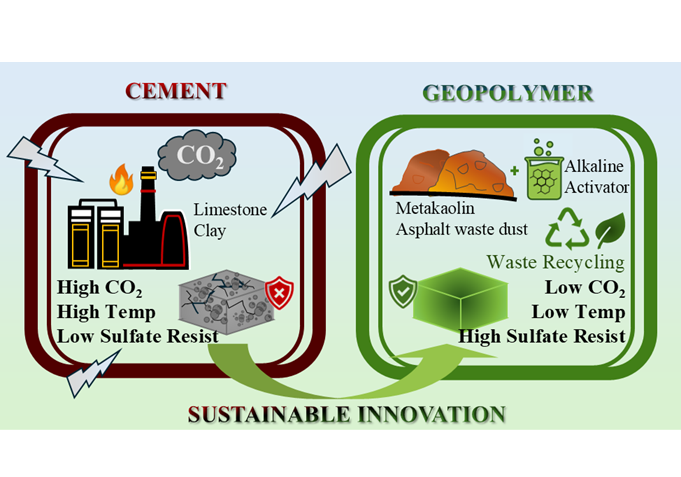
Conventional Portland cement concrete is prone to durability issues in environments with salt contamination, where corrosion, expansion, and cracking are common. Dissolved salts are particularly aggressive and act as direct agents of concrete deterioration. The study focuses on synthesizing geo-polymer materials made of metakaolin (MK) and asphalt waste dust (AD) to evaluate their influence on salt resistance performance, aiming to develop a new type of construction material similar to cement-free concrete. Physical and chemical properties were examined using XRD, XRF, ICP, and FESEM techniques. In addition, compressive strength and weight loss after salt exposure were measured to evaluate the mechanical and durability performance of the geopolymer samples. Geopolymer samples were prepared with 10 wt%, 30 wt%, 50 wt%, and 70 wt% AD replacing MK. Specimens were cured for 2 day, 7 day, and 28 day, followed by immersion in salt solutions for 90 day. Results showed that up to 30 wt% AD and at least 70 wt% MK were appropriate ratios for geopolymer synthesis. Cement samples lost compressive strength and weight, whereas the compressive strength of the geopolymer increased after 90 day of salt immersion. Geopolymer with 10 wt% AD showed the best corrosion resistance, compressive strength, and maintained weight after 28 day of curing.
Downloads
References
O. O. Metalssi, R. R. Touhami, F. Barberon, J.-B. d’Espinose de Lacaillerie, N. Rossel, L. Divet, and J.-M. Torrenti, "Understanding the degradation mechanisms of cement-based systems in combined chloride-sulfate attack," Cement and Concrete Research, vol. 164, p. 107065, 2023. DOI: https://doi.org/10.1016/j.cemconres.2022.107065
H. Zhao, Y. Hu, Z. Tang, K. Wang, Y. Li, and W. Li, "Deterioration of concrete under coupled aggressive actions associated with load, temperature and chemical attacks: A comprehensive review," Construction and Building Materials, vol. 322, p. 126466, 2022. DOI: https://doi.org/10.1016/j.conbuildmat.2022.126466
F. El Inaty, M. Marchetti, M. Quiertant, and O. O. Metalssi, "Chemical mechanisms involved in the coupled attack of sulfate and chloride ions on low-carbon cementitious materials: An in-depth study," Applied Sciences, vol. 13, no. 21, p. 11729, 2023. DOI: https://doi.org/10.3390/app132111729
K. In, Y. R. Jiang, S. Jung, M. Lee, S.-W. Yoo, and B. Oh, "Durability of concrete under combined exposure conditions of chlorides and sulfates," Key Engineering Materials, vol. 711, pp. 319–326, 2016. DOI: https://doi.org/10.4028/www.scientific.net/KEM.711.319
N. Klein, E. D. Gómez, G. S. Duffó, and S. B. Farina, "Effect of sulphate on the corrosion of reinforcing steel in concrete," Construction and Building Materials, vol. 354, p. 129214, 2022. DOI: https://doi.org/10.1016/j.conbuildmat.2022.129214
H. Sun, C. Jiang, K. Cao, D. Yu, W. Liu, X. Zhang, F. Xing, and D. Zhao, "Monitoring of steel corrosion and cracking in cement paste exposed to combined sulfate–chloride attack with X-ray microtomography," Construction and Building Materials, vol. 302, p. 124345, 2021. DOI: https://doi.org/10.1016/j.conbuildmat.2021.124345
D. Chen, W. Guo, D. Chen, L. Guo, B. Cai, and T. Ye, "Mechanistic modeling for coupled chloride-sulfate attack in cement-based materials," Construction and Building Materials, vol. 455, p. 139231, 2024. DOI: https://doi.org/10.1016/j.conbuildmat.2024.139231
M. Santhanam, M. D. Cohen, and J. Olek, "Sulfate attack research — whither now?," Cement and Concrete Research, vol. 31, no. 6, pp. 845–851, 2001. DOI: https://doi.org/10.1016/S0008-8846(01)00510-5
B. Tian, and M. D. Cohen, "Does gypsum formation during sulfate attack on concrete lead to expansion?," Cement and Concrete Research, vol. 30, no. 1, pp. 117–123, 2000. DOI: https://doi.org/10.1016/S0008-8846(99)00211-2
B. Leporace-Guimil, A. Conforti, R. Zerbino, and G. A. Plizzari, "Chloride-induced corrosion in reinforced concrete and fiber reinforced concrete elements under tensile service loads," Cement and Concrete Composites, vol. 124, p. 104245, 2021. DOI: https://doi.org/10.1016/j.cemconcomp.2021.104245
S. J. Jaffer, and C. M. Hansson, "Chloride-induced corrosion products of steel in cracked-concrete subjected to different loading conditions," Cement and Concrete Research, vol. 39, no. 2, pp. 116–125, 2009. DOI: https://doi.org/10.1016/j.cemconres.2008.11.001
P. Zhao, Z. Si, L. Huang, Y. He, X. Liu, and Y. Zhang, "A review of the repair measures for reinforced concrete affected by chloride ion corrosion," Journal of Building Engineering, vol. 102, p. 112028, 2025. DOI: https://doi.org/10.1016/j.jobe.2025.112028
M. Z. Y. Ting, and Y. Yi, "Durability of cementitious materials in seawater environment: A review on chemical interactions, hardened-state properties and environmental factors," Construction and Building Materials, vol. 367, p. 130224, 2023. DOI: https://doi.org/10.1016/j.conbuildmat.2022.130224
M. Tamoor, and C. Zhang, " Sustainable geopolymer concrete: A comprehensive lifecycle and performance assessment," Next Research, vol. 2, p. 100956, 2025. DOI: https://doi.org/10.1016/j.nexres.2025.100956
M. M. Madirisha, O. R. Dada, and B. D. Ikotun, "Chemical fundamentals of geopolymers in sustainable construction," Materials Today Sustainability, vol. 27, p. 100842, 2024. DOI: https://doi.org/10.1016/j.mtsust.2024.100842
S. Zaland, J. Wang, K. Li, S. I. Sadat, and K. Akhunzada, "Geo-polymers as a sustainable alternative to Portland cement: Synthesis, durability, applications, environmental impacts, and cost analysis," Renewable and Sustainable Energy Reviews, vol. 225, p. 116157, 2026. DOI: https://doi.org/10.1016/j.rser.2025.116157
N. Shehata, O. A. Mohamed, E. T. Sayed, M. A. Abdelkareem, and A. G. Olabi, "Geopolymer concrete as green building materials: Recent applications, sustainable development and circular economy potentials," Science of the Total Environment, vol. 836, p. 155577, 2022. DOI: https://doi.org/10.1016/j.scitotenv.2022.155577
L. Ricciotti, C. Frettoloso, R. Franchino, N. Pisacane, and R. Aversa, "Geopolymer materials: cutting-edge solutions for sustainable design building," Sustainability, vol. 17, p. 7483, 2025. DOI: https://doi.org/10.3390/su17167483
V. Ramesh, B. Muthramu, and D. Rebekhal, "A review of sustainability assessment of geopolymer concrete through AI-based life cycle analysis," AI in Civil Engineering, vol. 4, p. 3, 2025. DOI: https://doi.org/10.1007/s43503-024-00045-3
R. Firdous, D. Stephan, and J. N. Y. Djobo, "Natural pozzolan based geopolymers: A review on mechanical, microstructural and durability characteristics," Construction and Building Materials, vol. 190, pp. 1251–1263, 2018. DOI: https://doi.org/10.1016/j.conbuildmat.2018.09.191
H. Xu, and J. S. J. Van Deventer, "The geopolymerisation of alumino-silicate minerals," International Journal of Mineral Processing, vol. 59, no. 3, pp. 247–266, 2000. DOI: https://doi.org/10.1016/S0301-7516(99)00074-5
J. L. Provis, and J. S. J. van Deventer, "Introduction to geo-polymers," in Geopolymers, J. L. Provis and J. S. J. van Deventer, Eds.: Woodhead Publishing, 2009, pp. 1–11. DOI: https://doi.org/10.1533/9781845696382.1
P. Cong, and Y. Cheng, "Advances in geopolymer materials: A comprehensive review," Journal of Traffic and Transportation Engineering (English Edition), vol. 8, no. 3, pp. 283–314, 2021. DOI: https://doi.org/10.1016/j.jtte.2021.03.004
N. Marandi, and S. Shirzad, "Sustainable cement and concrete technologies: A review of materials and processes for carbon reduction," Innovative Infrastructure Solutions, vol. 10, no. 9, p. 408, 2025. DOI: https://doi.org/10.1007/s41062-025-02213-5
S. Sbahieh, G. McKay, and S. G. Al-Ghamdi, " Comprehensive analysis of geopolymer materials: properties, environmental impacts, and applications," Materials, vol. 16, no. 23, p. 7363, 2023. DOI: https://doi.org/10.3390/ma16237363
A. S. Kolade, B. D. Ikotun, and D. O. Oyejobi, "A review of the chemistry, waste utilization, mix design and performance evaluation of geopolymer concrete," Iranian Journal of Science and Technology, Transactions of Civil Engineering, vol. 49, no. 4, pp. 1771–1795, 2025. DOI: https://doi.org/10.1007/s40996-025-01801-w
S. Tangaramvong, P. Nuaklong, M. T. Khine, and P. Jongvivatsakul, “The influences of granite industry waste on concrete properties with different strength grades,” Case Studies in Construction Materials, vol. 15, p. e00669, 2021. DOI: https://doi.org/10.1016/j.cscm.2021.e00669
M. Adamu, P. Trabanpruek, P. Jongvivatsakul, S. Likitlersuang, and M. Iwanami, “Mechanical performance and optimization of high-volume fly ash concrete containing plastic wastes and graphene nanoplatelets using response surface methodology,” Construction and Building Materials, vol. 308, p. 125085, 2021. DOI: https://doi.org/10.1016/j.conbuildmat.2021.125085
A. M. Harrisson, "Constitution and specification of portland cement," in Lea's Chemistry of Cement and Concrete, 5th ed., P. C. Hewlett and M. Liska, Eds. Butterworth-Heinemann, 2019. DOI: https://doi.org/10.1016/B978-0-08-100773-0.00004-6
S. Chakraborty, B. W. Jo, and M. A. Sikandar, "Hydration mechanism of the hydrogen-rich water based cement paste," The Journal of Physical Chemistry C, vol. 120, no. 15, pp. 8198–8209, 2016. DOI: https://doi.org/10.1021/acs.jpcc.6b01444
A. A. Bahraq, M. A. Al-Osta, O. S. Baghabra Al-Amoudi, I. B. Obot, M. Maslehuddin, H.-u.-R. Ahmed, and T. A. Saleh, "Molecular simulation of cement-based materials and their properties," Engineering, vol. 15, pp. 165–178, 2022. DOI: https://doi.org/10.1016/j.eng.2021.06.023
M. Schmücker, and K. J. D. MacKenzie, "Microstructure of sodium polysialate siloxo geopolymer, " Ceramics International, vol. 31, no. 3, pp. 433–437, 2005. DOI: https://doi.org/10.1016/j.ceramint.2004.06.006
S. Dadsetan, H. Siad, M. Lachemi, O. Mahmoodi, and M. Sahmaran, "Optimization and characterization of geopolymer binders from ceramic waste, glass waste and sodium glass liquid," Journal of Cleaner Production, vol. 342, p. 130931, 2022. DOI: https://doi.org/10.1016/j.jclepro.2022.130931
Adnan, and M. Anas, "Geopolymer concrete as a sustainable alternative to OPC," Journal of Umm Al-Qura University for Engineering and Architecture, vol. 16, pp. 1223–1245, 2025. DOI: https://doi.org/10.1007/s43995-025-00155-8
D. Bondar, C. J. Lynsdale, N. B. Milestone, and N. Hassani, "Sulfate resistance of alkali activated pozzolans," International Journal of Concrete Structures and Materials, vol. 9, no. 2, pp. 145–158, 2015. DOI: https://doi.org/10.1007/s40069-014-0093-0
H. Zhu, G. Liang, H. Li, Q. Wu, C. Zhang, Z. Yin, and S. Hua, "Insights to the sulfate resistance and microstructures of alkali-activated metakaolin/slag pastes," Applied Clay Science, vol. 202, p. 105968, 2021. DOI: https://doi.org/10.1016/j.clay.2020.105968
L. K. M, and V. Revathi, "Durability studies in alkaline activated systems (metakaolin – bottom ash): A prospective study," Boletín de la Sociedad Española de Cerámica y Vidrio, vol. 62, no. 1, pp. 40–55, 2023. DOI: https://doi.org/10.1016/j.bsecv.2021.09.004
P. Duxson, A. Fernández-Jiménez, J. Provis, G. Lukey, A. Palomo, and J. van Deventer, " Geopolymer technology: the current state of the art," Journal of Materials Science, vol. 42, pp. 2917–2933, 2007. DOI: https://doi.org/10.1007/s10853-006-0637-z
J. M. Inocente, F. Elyseu, L. J. Jaramillo Nieves, J. Jiusti, M. Cargnin, and M. Peterson, "Production and characterization of high-reactivity metakaolins calcined in flash reactor," Applied Clay Science, vol. 213, p. 106247, 2021. DOI: https://doi.org/10.1016/j.clay.2021.106247
C. R. Kaze, A. Adesina, T. Alomayri, H. Assaedi, E. Kamseu, U. C. Melo, and C. Leonelli, "Characterization, reactivity and rheological behaviour of metakaolin and Meta-halloysite based geopolymer binders," Cleaner Materials, vol. 2, p. 100025, 2021. DOI: https://doi.org/10.1016/j.clema.2021.100025
J. Ayawanna, T. Suksawat, P. Sertsoongnern, and S. Chaiyaput, "The use of asphalt waste dust for stabilization of sustainable pavement recycling," Construction and Building Materials, vol. 446, p. 137936, 2024. DOI: https://doi.org/10.1016/j.conbuildmat.2024.137936
S. Chaiyaput, P. Sertsoongnern, and J. Ayawanna, "Utilization of waste dust from asphalt concrete manufacturing as a sustainable subbase course material in pavement structures," Sustainability, vol. 14, no. 16, p. 9804, 2022. DOI: https://doi.org/10.3390/su14169804
N. Phachan, S. Chokkha, and A. Poowancum, “A sustainable cement replacement material from a coal-fired power plant waste,” in The Asian Conference on Sustainability, Energy & the Environment 2017: Official Conference Proceedings, 2017.
ASTM International, ASTM C1012/C1012M-18b: Standard test method for length change of hydraulic-cement mortars exposed to a sulfate solution, West Conshohocken, PA, USA: ASTM International, 2018.
P. Phanpong, “Effect of concentration of sulfate solution on expansion and weight loss of mortar,” M.Eng. thesis, Rajamangala University of Technology Thanyaburi, Pathum Thani, Thailand, 2014. [Online]. Available: http://www.repository.rmutt.ac.th/ handle/123456789/2382.
ASTM International, ASTM C109/C109M-20, Standard test method for compressive strength of hydraulic cement mortars (using 2-in. or [50-mm] cube specimens), West Conshohocken, PA, USA: ASTM International, 2020.
J. Li, S. Mailhiot, A. M. Kantola, H. Niu, H. Sreenivasan, V.-V. Telkki, and P. Kinnunen, "Longitudinal single-sided NMR study: Silica-to-alumina ratio changes the reaction mechanism of geo-polymer," Cement and Concrete Research, vol. 160, p. 106921, 2022. DOI: https://doi.org/10.1016/j.cemconres.2022.106921
H. L. Dinh, J. Liu, J.-H. Doh, and D. E. L. Ong, "Influence of Si/Al molar ratio and Ca content on the performance of fly ash-based geopolymer incorporating waste glass and GGBFS," Construction and Building Materials, vol. 411, p. 134741, 2024. DOI: https://doi.org/10.1016/j.conbuildmat.2023.134741
ASTM International, ASTM C150/C150M-22: Standard specification for Portland cement, West Conshohocken, PA, USA: ASTM International, 2022.
O. S. Al-Amoudi, "Mechanisms of sulfate attack in plain and blended cements: A review," in Extending Performance of Concrete Structures: Proceedings of the International Seminar held at the University of Dundee, Scotland, UK on 7 September 1999, R. K. Dhir and P. A. J. Tittle, Eds. Emerald Publishing Limited, 1999. DOI: https://doi.org/10.1680/epocs.28203.0025
S. S. Zhang, S. Wang, and X. Chen, "Understanding the role of magnesium ions on setting of metakaolin-based geopolymer," Cement and Concrete Research, vol. 177, p. 107430, 2024. DOI: https://doi.org/10.1016/j.cemconres.2024.107430
Downloads
Published
How to Cite
Issue
Section
Categories
License
Copyright (c) 2026 Journal of Metals, Materials and Minerals

This work is licensed under a Creative Commons Attribution-NonCommercial-NoDerivatives 4.0 International License.
Authors who publish in this journal agree to the following terms:
- Authors retain copyright and grant the journal right of first publication with the work simultaneously licensed under a Creative Commons Attribution License that allows others to share the work with an acknowledgment of the work's authorship and initial publication in this journal.
- Authors are able to enter into separate, additional contractual arrangements for the non-exclusive distribution of the journal's published version of the work (e.g., post it to an institutional repository or publish it in a book), with an acknowledgment of its initial publication in this journal.