Enhanced red emission of Gd\(_{2}\)MoO\(_{6}\):Eu\(^{3+}\) phosphor-in-glass embedded in SiO\(_{2}\)-TeO\(_{2}\)-Na\(_{2}\)O-BaO matrix for solid-state lighting
DOI:
https://doi.org/10.55713/jmmm.v36i3.2595Keywords:
Phosphor-in-glass, Photoluminescence, EuropiumAbstract
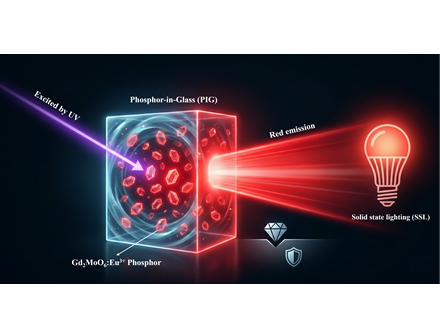
Gd2MoO6:Eu3+ phosphor-in-glass (PIG) composites were synthesized by a microwave-assisted melting technique using a 50SiO2:20TeO2:15Na2O:15BaO glass matrix containing 0.00 wt% to 10.00 wt% phosphor. Their structural, optical, and luminescent properties were systematically investigated. X-ray diffraction confirmed the formation of crystalline Gd2MoO6 phases, which became prominent at 5.00 wt% and 10.00 wt%, indicating partial crystallization within the glass network. The density and refractive index increased from 3.621 g∙cm‒3 to 3.774 g∙cm‒3 and 1.535 to 1.692 with higher phosphor loading, suggesting a more compact structure. Absorption spectra showed four characteristic Eu3+ bands at 464 nm, 534 nm, 2088 nm, and 2203 nm, while excitation monitored at 613 nm exhibited the strongest band at 394 nm (7F0→5L6). Emission spectra revealed intense red emissions at 590 nm, 613 nm, 653 nm, and 702 nm, corresponding to the 5D0→7F1–7F5 transitions, with chromaticity coordinates of (x, y) = (0.65, 0.34). The photoluminescence lifetime, measured under 394 nm excitation and monitored at 613 nm emission, decreased slightly from 1.719 ms to 1.585 ms. Vickers hardness values measured under a 0.2 kgf load ranged from 1601.7 HV0.2 to 1606.1 HV0.2, indicating high mechanical durability. Overall, the obtained PIG composites show strong red emission and robust structural properties, demonstrating their potential for solid-state lighting applications.
Downloads
References
X. Pang, H. Zhang, L. Xie, T. Xuan, Y. Sun, S. Shuaichen, B. Jiang, W. Chen, J. Zhuang, C. Hu, Y. L. Liu, B. Lei, and X. Zhang, “Precipitating CsPbBr3 quantum dots in boro-germanate glass with a dense structure and inert environment toward highly stable and efficient narrow-band green emitters for wide-color-gamut liquid crystal displays,” Journal of Materials Chemistry C, vol. 7, no. 42, pp. 13139–13148, 2019. DOI: https://doi.org/10.1039/C9TC04732H
S. Selvi, K. Marimuthu, and G. Muralidharan, “Effect of PbO on the B2O3–TeO2–P2O5–BaO–CdO–Sm2O3 glasses - Structural and optical investigations,” Journal of Non-Crystalline Solids, vol. 461, pp. 35–46, 2017. DOI: https://doi.org/10.1016/j.jnoncrysol.2017.01.028
P. Zheng, S. Li, L. Wang, T-L. Zhou, S. You, T. Takeda, N. Hirosaki, and R-J. Xie, “Unique color converter architecture enabling phosphor-in-glass (PiG) films suitable for high-power and high-luminance laser-driven white lighting,” ACS Applied Materials & Interfaces, vol. 10, no. 17, pp. 14930–14940, 2018, DOI: https://doi.org/10.1021/acsami.8b03168
Y. Peng, R. Li, S. Wang, Z. Chen, L. Nie, and M. Chen, “Luminous Properties and thermal reliability of screen-printed phosphor-in-glass-based white light-emitting diodes,” IEEE Transactions on Electron Devices, vol. 64, no. 3, pp. 1114–1119, 2017. DOI: https://doi.org/10.1109/TED.2016.2645285
P. Yasaka, R. Rajaramakrishna, W. Wongwan, P. Yamchumporn, H. J. Kim, and J. Kaewkhao, “Development of ZnO–BaO–B2O3–TeO2 glass doped with Sm3+ for orange emitting material,” Solid State Sciences, vol. 98, 2019. DOI: https://doi.org/10.1016/j.solidstatesciences.2019.106041
W. Thanyaphirak, P. Yasaka, K. Boonin, N. Sangwaranatee, and J. Kaewkhao, “Dy3+ ion - doped zinc barium niobium boro-tellurite glasses: Structural, optical, and luminescence insights for white light applications,” Suranaree Journal of Science and Technology, vol. 31, no. 3, pp. 1–9, 2024. DOI: https://doi.org/10.55766/sujst-2024-03-e06013
W. Wongwan, P. Yasaka, K. Boonin, A. Angnanon, N. Intachai, and S. Kothan, “Optimization of energy transfer in Tb3+/Sm3+ ions doped silicoborotellurite scintillation glass for X-ray imaging application,” Radiation Physics and Chemistry, vol. 237, no. June, p. 113124, 2025. DOI: https://doi.org/10.1016/j.radphyschem.2025.113124
P. Krongkitsiri, P. Yasaka, K. Boonin, W. Wongwan, and J. Kaewkhao, “Synthesis and luminescence properties of Sr2ZnMoO6:Eu2O3 phosphors,” Journal of Physics: Conference Series, vol. 2602, no. 1, pp. 2–8, 2023. DOI: https://doi.org/10.1088/1742-6596/2602/1/012004
I. I. Kindrat, and B. V. Padlyak, “Luminescence properties and quantum efficiency of the Eu-doped borate glasses,” Optical Materials (Amst)., vol. 77, pp. 93–103, 2018. DOI: https://doi.org/10.1016/j.optmat.2018.01.019
F. Lei, B. Yan, H. H. Chen, and J. T. Zhao, “Molten salt synthesis, characterization, and luminescence properties of Gd2MO6:Eu3+ (M=W, Mo) phosphors,” Journal of the American Ceramic Society, vol. 92, no. 6, pp. 1262–1267, 2009. DOI: https://doi.org/10.1111/j.1551-2916.2009.03006.x
P. Yasaka, W. Wongwan, K. Boonin, N. Intachai, S. Kothan, and A. Angnanon, “Microwave synthesis of Eu3+ ion doped phosphor in glass : A novel scintillation material with luminescence enhancement,” Radiation Physics and Chemistry, vol. 237, no. June, p. 113106, 2025. DOI: https://doi.org/10.1016/j.radphyschem.2025.113106
G. Li, Z. Wang, Z. Quan, X. Liu, M. Yu, R. Wang, and J. Lin, “Sol-gel growth of Gd2MoO6:Eu3+ nanocrystalline layers on SiO2 spheres (SiO2@Gd2MoO6:Eu3+) and their luminescent properties,” Surface Science, vol. 600, no. 16, pp. 3321–3326, 2006, DOI: https://doi.org/10.1016/j.susc.2006.06.018
M. Pang, X. Liu, and J. Lin, “Luminescence properties of R2MoO6:Eu3+ (R = Gd, Y, La) phosphors prepared by Pechini sol-gel process,” Journal of Materials Research, vol. 20, no. 10, pp. 2676–2681, 2005. DOI: https://doi.org/10.1557/JMR.2005.0356
W. Wongwan, P. Yasaka, K. Boonin, H. J. Kim, N. Discharoen, S. Kothan, and J. Kaewkhao, “Microwave-assisted fabrication of Sr2ZnMoO6:Sm2O3 phosphors in TeO2:ZnO:B2O3 glass matrix for high-efficiency solid-state lighting applications,” Optik (Stuttg)., vol. 297, p. 171532, 2023. DOI: https://doi.org/10.1016/j.ijleo.2023.171532
W. Wongwan, P. Yasaka, K. Boonin, S. Khondara, H. J. Kim, S. Kothan, N. Chanlek, P. Kanjanaboos, N. Phuphathanaphong, T. Sareein, N. Sangwaranatee, and J. Kaewkhao, “A comparative study of microwave assisted and conventional melting techniques to glass properties,” Radiation Physics and Chemistry, vol. 224, p. 112011, 2024, DOI: https://doi.org/10.1016/j.radphyschem.2024.112011
J. M. de Carvalho, C. C. S. Pedroso, M. S. de N. Saula, M. C. F. C. Felinto, and H. F. de Brito, “Microwave-assisted preparation of luminescent inorganic materials: A fast route to light conversion and storage phosphors,” Molecules, vol. 26, no. 10, 2021. DOI: https://doi.org/10.3390/molecules26102882
N. Jarucha, and P. Meejitpaisan, “Tb3+ concentration effect on the photo - and radioluminescence result of lanthanum borate glass for yellowish green laser application,” Suranaree J. Sci. Technol., vol. 30, no. 6, pp. 1–7, 2024. DOI: https://doi.org/10.55766/sujst-2023-06-e01658
E. S. Sazali, M. R. Sahar, and S. K. Ghoshal, “Influence of europium ion on structural, mechanical and luminescence behavior of tellurite nanoglass,” Journal of Physics: Conference Series, vol. 431, no. 1, 2013. DOI: https://doi.org/10.1088/1742-6596/431/1/012008
P. Yasaka, Y. Ruangthaweep, P. Mangthong, and J. Kaewkhao, “Physical and optical investigation of ZnO-BaO-TeO2 glass systems,” Materials Today: Proceedings, vol. 5, no. 6, pp. 14199–14203, 2018. DOI: https://doi.org/10.1016/j.matpr.2018.02.090
T. Watanabe, Y. Benino, and T. Komatsu, “Change in vickers hardness at the glass transition region for fragile and strong glasses,” vol. 286, pp. 141–145, 2001. DOI: https://doi.org/10.1016/S0022-3093(01)00521-X
W. M. Cheong, M. H. M. Zaid, K. A. Matori, Y. W. Fen, T. S. Tee, Z. W. Loh, M. Z. H. Mayzan, and S. Schmid, “Influence of Eu3+ Ions on elastic moduli and microhardness of zinc ‑ boro ‑ soda ‑ lime ‑ silica glass system,” Silicon, vol. 16, pp. 3173–3180, 2024. DOI: https://doi.org/10.1007/s12633-024-02918-9
P. R. Rani, M. Venkateswarlu, K. Swapna, S. Mahamuda, M. V. V. K. S. Prasad, and A. S. Rao, “Spectroscopic and luminescence properties of Ho3+ ions doped barium lead alumino fluoro borate glasses for green laser applications,” Solid State Sciences, vol. 102, p. 106175, 2020. DOI: https://doi.org/10.1016/j.solidstatesciences.2020.106175
E. M. A. Hussein, “Characterization of some radiation shielding, optical, and physical properties of fluorophosphate glasses modified by Sm3+,” Journal of Materials Science: Materials in Electronics., vol. 32, no. 21, pp. 25933–25951, 2021. DOI: https://doi.org/10.1007/s10854-021-05368-w
W. T. Carnall, P. R. Fields, and K. Rajnak, “Electronic energy levels of the trivalent lanthanide aquo ions. IV. Eu8+,” Journal of Chemical Physics., vol. 49, no. 10, pp. 4424–4442, 1968. DOI: https://doi.org/10.1063/1.1669896
K. A. Kumar, S. Babu, V. R. Prasad, S. Damodaraiah, and Y. C. Ratnakaram, “Optical response and luminescence characteristics of Sm3+ and Tb3+/sm3+ co-doped potassium-fluoro-phosphate glasses for reddish-orange lighting applications,” Materials Research Bulletin, vol. 90, pp. 31–40, 2017. DOI: https://doi.org/10.1016/j.materresbull.2017.01.046
Downloads
Published
How to Cite
License
Copyright (c) 2026 Journal of Metals, Materials and Minerals

This work is licensed under a Creative Commons Attribution-NonCommercial-NoDerivatives 4.0 International License.
Authors who publish in this journal agree to the following terms:
- Authors retain copyright and grant the journal right of first publication with the work simultaneously licensed under a Creative Commons Attribution License that allows others to share the work with an acknowledgment of the work's authorship and initial publication in this journal.
- Authors are able to enter into separate, additional contractual arrangements for the non-exclusive distribution of the journal's published version of the work (e.g., post it to an institutional repository or publish it in a book), with an acknowledgment of its initial publication in this journal.