Controlled release of holy basil essential oil nanoemulsion encapsulated in gelatin/ carboxymethyl cellulose hydrogel for wound care
DOI:
https://doi.org/10.55713/jmmm.v36i2.2620Keywords:
Essential oil, Hydrogel, Gelatin, Carboxymethyl cellulose, Drug delivery systemAbstract
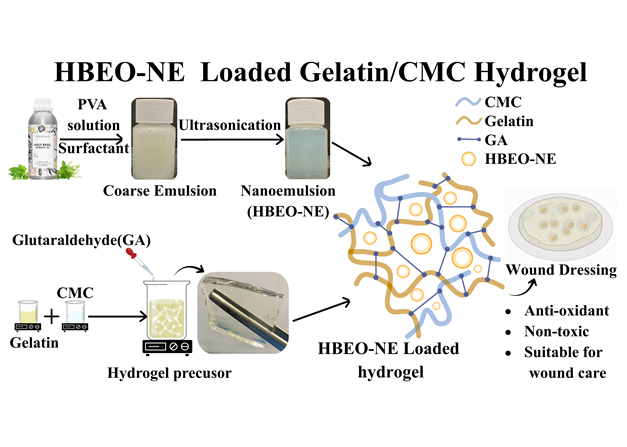
Holy basil essential oil (HBEO) is a therapeutic agent recognized for its antioxidant, anti-inflammatory, and wound-healing properties. However, its clinical use is limited by poor aqueous solubility, volatility, and instability. Nanoemulsion (NE) is an effective strategy to overcome these limitations. In this study, 1% HBEO in 0.5% polyvinyl alcohol (PVA) aqueous solution formulation yielded nanosized droplets (182±3 nm, PDI = 0.286) and showed sustained release, with 92% drug release over 30 h, compared to the rapid release for 1% HBEO in pure water. To further enhance stability and biocompatibility, the HBEO nanoemulsion (HBEONE) was incorporated into a glutaraldehyde (GA) crosslinked gelatin/ carboxymethyl cellulose (CMC) hydrogel matrix. The resulting hydrogel exhibited a swelling ratio of 8 (g∙g‒1) and HBEO loading capacity of 67.5%. The cytotoxicity of HBEO/gelatin/CMC hydrogel was observed with less cytotoxicity compared to the natural release of HBEONE without a hydrogel matrix. These results demonstrate the HBEONE-loaded gelatin/CMC hydrogel as a robust platform for controlled release in drug delivery systems.
Downloads
References
D. Braatz, M. Cherri, M. Tully, M. Dimde, G. Ma, E. Mohammadifar, F. Reisbeck, V. Ahmadi, M. Schirner, and R. Haag, “Chemical approaches to synthetic drug delivery systems for systemic applications,” Angewandte Chemie International Edition, vol. no. 49, p. e202203942, 2022. DOI: https://doi.org/10.1002/anie.202203942
R. Langer, “Drug delivery and targeting,” Nature, vol. 30. no. 392, pp. 5–10, 1998.
D. P. de Sousa, R. O. S. Damasceno, R. Amorati, H. A. Elshabrawy, R. D. de Castro, D. P. Bezerra, V. R. V. Nunes, R.C. Gomes, and T. C. Lima, “Essential oils: Chemistry and pharmacological activities,” Biomolecules, vol. 13, no. 7, p. 1144, 2023. DOI: https://doi.org/10.3390/biom13071144
A. Bhatnagar, and R. Pimoli, “Chemical composition of the essential oil of Ocimum sanctum L. growing in Garhwal region of Uttarakhand, India,” International Journal of Herbal Medicine, vol. 13, no. 2, pp. 43–46, 2025. DOI: https://doi.org/10.22271/flora.2025.v13.i2a.977
P. Singh, B. B. Basak, V. J. Patel, R. Sarkar, K. C. Patel, G. N. Motaka, “Integration of biochar with chemical fertilizers improves the economic yield, quality of holy basil (Ocimum sanctum L.) and soil health,” Journal of Soil Science and Plant Nutrition, vol. 24, pp. 6404–6417, 2024. DOI: https://doi.org/10.1007/s42729-024-01977-6
M. W. Imam, and S. Luqman, “Unveiling the mechanism of essential oil action against skin pathogens: from ancient wisdom to modern science,” Archives of Microbiology, vol. 206, no. 8, p. 347, 2024. DOI: https://doi.org/10.1007/s00203-024-03986-6
R. J. Wilson, Y. Li, G. Yang, and C.-X. Zhao, “Nanoemulsions for drug delivery,” Particuology, vol. 64, pp. 85–97, 2022. DOI: https://doi.org/10.1016/j.partic.2021.05.009
Z. Yang, Q. He, B. B. Ismail, Y. Hu, and M. Guo, Ultrasonication induced nano-emulsification of thyme essential oil: Optimization and antibacterial mechanism against Escherichia coli,” Food Control, vol. 133, p. 108609, 2022. DOI: https://doi.org/10.1016/j.foodcont.2021.108609
Y. Shi, M. Zhang, K. Chen, and M. Wang, “Nano-emulsion prepared by high pressure homogenization method as a good carrier for Sichuan pepper essential oil: Preparation, stability, and bioactivity, LWT, vol. 154, p. 112779, 2022. DOI: https://doi.org/10.1016/j.lwt.2021.112779
Z. Xing, Y. Xu, X. Feng, C. Gao, D. Wu, W. Cheng, L. Meng, Z. Wang, T. Xu, and X. Tang, “Fabrication of cinnamon essential oil nanoemulsions with high antibacterial activities via micro-fluidization,” Food Chemistry, vol. 456, p. 139969, 2024. DOI: https://doi.org/10.1016/j.foodchem.2024.139969
L. Zhou, W. Zhang, J. Wang, R. Zhang, and J. Zhang, “Comparison of oil-in-water emulsions prepared by ultrasound, high-pressure homogenization and high-speed homogenization,” Ultrasonics Sonochemistry, vol. 82, p. 105885, 2022. DOI: https://doi.org/10.1016/j.ultsonch.2021.105885
R. Song, Y. Lin, and Z. Li, “Ultrasonic-assisted preparation of eucalyptus oil nanoemulsion: Process optimization, in vitro digestive stability, and anti-Escherichia coli activity,” Ultrasonics Sonochemistry, vol. 82, p. 105904, 2022. DOI: https://doi.org/10.1016/j.ultsonch.2021.105904
C. Laosinwattana, N. Somala, J. Dimak, M. Teerarak, and N. Chotsaeng, “Ultrasonic emulsification of Cananga odorata nano-emulsion formulation for enhancement of herbicidal potential,” Scientific Reports, vol. 15, p. 3263, 2025. DOI: https://doi.org/10.1038/s41598-025-87810-1
P. Pongsumpun, S. Iwamoto, and U. Siripatrawan, “Response surface methodology for optimization of cinnamon essential oil nanoemulsion with improved stability and antifungal activity, “Ultrasonics Sonochemistry, vol. 60, p. 104604, 2020. DOI: https://doi.org/10.1016/j.ultsonch.2019.05.021
Y. Weerapol, S. Manmuan, N. Chaothanaphat, S. Okonogi, C. Limmatvapirat, S. Limmatvapirat, and S. Tubtimsri, “Impact of fixed oil on ostwald ripening of anti-oral cancer nanoemulsions loaded with amomum kravanh essential oil,” Pharmaceutics, vol. 14, p. 938, 2022. DOI: https://doi.org/10.3390/pharmaceutics14050938
N. M. Deghiedy, N. M. Elkenawy, and H. A. Abd El-Rehim, “Gamma radiation-assisted fabrication of bioactive-coated thyme nanoemulsion: A novel approach to improve stability, antimicrobial and antibiofilm efficacy,” Journal of Food Engineering, vol. 304, p. 110600, 2021. DOI: https://doi.org/10.1016/j.jfoodeng.2021.110600
V. S. Ghorpade, R. J. Dias, K. K. Mali, and S. I. Mulla, “Citric acid crosslinked carboxymethylcellulose-polyvinyl alcohol hydrogel films for extended release of water soluble basic drugs,” Journal of Drug Delivery Science and Technology, vol. 52, p. 421–430, 2019. DOI: https://doi.org/10.1016/j.jddst.2019.05.013
M. S. Manga, L. Higgins, A. A. Kumar, B. T. Lobel, D. W. York, and O. J. Cayre, “Exploring effects of polymeric stabiliser molecular weight and concentration on emulsion production via stirred cell membrane emulsification,” Polymer Chemistry, vol. 14, pp. 5049–5059, 2023. DOI: https://doi.org/10.1039/D3PY00948C
E. J. Delgado-Pujol, G. Martínez, D. Casado-Jurado, J. Vázquez, J. León-Barberena, D. Rodríguez-Lucena, Y. Torres, A. Alcudia, and B. Begines, “Hydrogels and nanogels: Pioneering the future of advanced drug delivery systems,” Pharmaceutics, vol. 17, p. 215, 2025. DOI: https://doi.org/10.3390/pharmaceutics17020215
R. Andreazza, A. Morales, S. Pieniz, and J. Labidi, “Gelatin-based hydrogels: Potential biomaterials for remediation,” Polymers (Basel), vol. 15, p. 1026, 2023. DOI: https://doi.org/10.3390/polym15041026
W. Zhang, Y. Liu, Y. Xuan, and S. Zhang, “Synthesis and applications of carboxymethyl cellulose hydrogels,” Gels, vol. 8, p. 529, 2022. DOI: https://doi.org/10.3390/gels8090529
N. Kreua-Ongarjnukool, S. T. Niyomthai, K. Sarodom, T. Lothong, and N. Soomherun, “Hybrid gelatin/carboxymethyl cellulose hydrogel loaded copper(II) ion for medical applications, Materials Science Forum, vol. 1009, pp. 3–8. 2020. DOI: https://doi.org/10.4028/www.scientific.net/MSF.1009.3
F. Sahar, A. Riaz, N. S. Malik, N. Gohar, A. Rasheed, U. R. Tulain, A. Erum, K. Barkat, S. F. Badshah, and S. I. Shah, “Design, characterization and evaluation of gelatin/carboxy-methyl cellulose hydrogels for effective delivery of ciprofloxacin, Polymer Bulletin, vol. 80, no. 11, pp. 12271–12299, 2022. DOI: https://doi.org/10.1007/s00289-022-04657-6
B. He, Y. Wang, Z. Jiang, S. Liu, and J. Zhu, “Physical properties and antibacterial activity of the composited films based on carboxymethyl cellulose and gelatin functionalized with ε-polylysine,” International Journal of Biological Macromolecules, vol. 191, pp. 1126–1136, 2021. DOI: https://doi.org/10.1016/j.ijbiomac.2021.09.181
A. Hivechi, M. T. Joghataei, S. H. Bahrami, P. B. Milan, M. Amoupour, N. Latifi, S. M. A. Haramshahi, S. Naderi Gharah- gheshlagh, and S. Nezari, “Oxidized carboxymethyl cellulose/ gelatin in situ gelling hydrogel for accelerated diabetic wound healing: Synthesis, characterization, and in vivo investigations,” International Journal of Biological Macromolecules, vol. 242, p. 125127, 2023. DOI: https://doi.org/10.1016/j.ijbiomac.2023.125127
A. Bigi, G. Cojazzi, S. Panzavolta, K. Rubini, and N. Roveri, “Mechanical and thermal properties of gelatin films at different degrees of glutaraldehyde crosslinking,” Biomaterials, vol. 22, pp. 763–768, 2001. DOI: https://doi.org/10.1016/S0142-9612(00)00236-2
R. Parveen, S. Baboota, J. Ali, A. Ahuja, and S. Ahmad, “Stability studies of silymarin nanoemulsion containing Tween 80 as a surfactant,” Journal of Pharmacy and Bioallied Sciences, vol. 7, p. 321, 2015. DOI: https://doi.org/10.4103/0975-7406.168037
K. Flekka, V. D. Dimaki, E. Mourelatou, K. Avgoustakis, F. N. Lamari, and S. Hatziantoniou, “Stability and retention of nanoemulsion formulations incorporating lavender essential oil, Cosmetics, vol. 11, no. 3, p. 65, 2024. DOI: https://doi.org/10.3390/cosmetics11030065
A. Kaolaor, K. Kiti, P. Pankongadisak, and O. Suwantong, “Camellia Oleifera oil-loaded chitosan nanoparticles embedded in hydrogels as cosmeceutical products with improved biological properties and sustained drug release,” International Journal of Biological Macromolecules, vol. 275, p. 133560, 2024. DOI: https://doi.org/10.1016/j.ijbiomac.2024.133560
T. M. Tran Vo, P. Potiyaraj, P. del Val, and T. Kobayashi, “Ultrasound-triggered amoxicillin release from chitosan/ethylene glycol diglycidyl ether/amoxicillin hydrogels having a covalently bonded network,” ACS Omega, vol. 9, p. 585, 2023. DOI: https://doi.org/10.1021/acsomega.3c06213
F.N. Sorasitthiyanukarn, P. Rojsitthisak, and P. Rojsitthisak, “Kinetic study of chitosan-alginate biopolymeric nanoparticles for the controlled release of curcumin diethyl disuccinate,” Journal of Metals, Materials and Minerals, vol. 27, no. 2, pp. 17-22, 2017.
T. M. Tran Vo, P. Sanghong, A. Pongwisuthiruchte, C. Aonbangkhen, X. Chen, and P. Potiyaraj, “Self-oxygenating, autonomous self-healing dual-physical crosslinked PVA/chitosan/ hydrolysed collagen hydrogels for advanced wound management,” Journal of Materials Chemistry B, vol. 13, pp. 11020–11031, 2025. DOI: https://doi.org/10.1039/D5TB00919G
Y. Qin, W. Li, D. Liu, M. Yuan, and L. Li, “Development of active packaging film made from poly (lactic acid) incorporated essential oil,” Progress in Organic Coatings , vol. 103. pp. 76–82, 2017. DOI: https://doi.org/10.1016/j.porgcoat.2016.10.017
G. Mugnaini, R. Gelli, L. Mori, and M. Bonini, “How to cross-link gelatin: the effect of glutaraldehyde and glyceraldehyde on the hydrogel properties,” ACS Applied Polymer Materials, vol. 5, pp. 9192–9202, 2023. DOI: https://doi.org/10.1021/acsapm.3c01676
Downloads
Published
How to Cite
License
Copyright (c) 2026 Journal of Metals, Materials and Minerals

This work is licensed under a Creative Commons Attribution-NonCommercial-NoDerivatives 4.0 International License.
Authors who publish in this journal agree to the following terms:
- Authors retain copyright and grant the journal right of first publication with the work simultaneously licensed under a Creative Commons Attribution License that allows others to share the work with an acknowledgment of the work's authorship and initial publication in this journal.
- Authors are able to enter into separate, additional contractual arrangements for the non-exclusive distribution of the journal's published version of the work (e.g., post it to an institutional repository or publish it in a book), with an acknowledgment of its initial publication in this journal.