Antibacterial characterization of ciprofloxacin-doped electrospun of low molecular weight polyethylene oxide (PEO) and sodium alginate (NaAlg) nanofibers
DOI:
https://doi.org/10.55713/jmmm.v36i2.2399คำสำคัญ:
Electrospinning, Low molecular weight polyethylene oxide, Sodium alginate, Crosslinking technique, Ciprofloxacinบทคัดย่อ
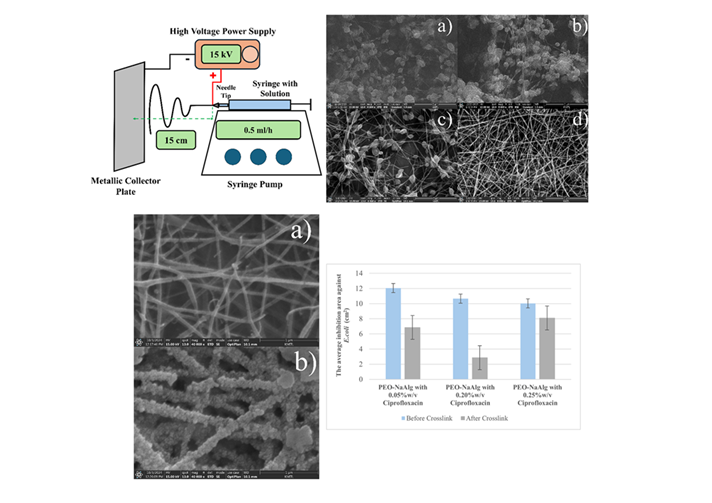
Producing nanofibers using the electrospinning technique is a developed method that is widely used and of significant interest nowadays. This technique can be applied using various types of polymers. This research aimed to investigate the antibacterial PEO-NaAlg nanofiber fabrication. The fiber fabrication was examined under various viscosities of electrospinning solution. The electrospun nanofiber fabrication focuses on blending polyethylene oxide (PEO) with a molecular weight of 200-300 kDa, mixed with sodium alginate (NaAlg) of three different viscosities: 150 cP, 300 cP, and 730 cP to study how the viscosity of the solution affects the morphology of electrospun nanofibers. The PEO-NaAlg electrospun nanofiber was enhanced for water insolubility by crosslinking with calcium chloride (CaCl2). The additional antibacterial property of the nanofiber by loading an antibacterial agent potentially against the growth of bacteria, was investigated. Antibacterial drug, ciprofloxacin at varying amounts of 0.05%w/v, 0.20%w/v, and up to 0.25%w/v was loaded to PEO-NaAlg solution and conducted electro-spinning. The effectiveness of the antibacterial electrospun nanofiber was evaluated by testing its ability to inhibit the growth of Escherichia coli (E. coli) and Staphylococcus aureus (S. aureus). The inhibition area before and after crosslinking was observed. The results showed that the acquired nanofiber formation required 7%w/v of 200 kDa to 300 kDa of PEO, and blending 1%w/v NaAlg of 150 cP can certainly retain fiber morphology after crosslinking. Moreover, nanofibers loaded with ciprofloxacin effectively inhibit the growth of E. coli.
Downloads
เอกสารอ้างอิง
G. C. Rutledge, and V. S. Fridrikh, "Formation of fibers by electrospinning," Advanced Drug Delivery Reviews, vol. 59, no. 14, pp. 1384‒1391, 2007. DOI: https://doi.org/10.1016/j.addr.2007.04.020
D. Li, and Y. Xia, "Electrospinning of nanofibers: Reinventing the wheel?," Advanced Materials, vol. 16, no. 4, pp. 1151‒1170, 2004. DOI: https://doi.org/10.1002/adma.200400719
J. Xue, T. Wu, Y. Dai, and Y. Xia, "Electrospinning and electrospun nanofibers: Methods, materials, and applications," Chemical Review, vol. 119, pp. 5298‒5415, 2019. DOI: https://doi.org/10.1021/acs.chemrev.8b00593
V. Jacobs, R. D. Anandjiwala, and M. Maaza, "The influence of electrospinning parameters on the structural morphology and diameter of electrospun nanofibers," Journal of Applied Polymer Science, vol. 115, no. 5, pp. 3130‒3136, 2009.
J. Doshi, and D. H. Reneker, "Electrospinning process and applications of electrospun fibers," Journal of Electrostatics, vol. 35, no. 2‒3, pp. 151‒160, 1995. DOI: https://doi.org/10.1016/0304-3886(95)00041-8
Z.-M. Huang, Y.-Z. Zhang, M. Kotaki, and S. Ramakrishna, "A review on polymer nanofibers by electrospinning and their applications in nanocomposites," Composites Science and Technology, vol. 63, no. 15, pp. 2223‒2253, 2003. DOI: https://doi.org/10.1016/S0266-3538(03)00178-7
S. Gu, Z. Wang, J. Ren, and C. Zhange, "Electrospinning of gelatin and gelatin/poly(l-lactide) blend and its characteristics for wound dressing," Materials Science and Engineering: C, vol. 29, no. 6, pp. 1822‒1828, 2009. DOI: https://doi.org/10.1016/j.msec.2009.02.010
O. Urbanek, A. Wysocka, P. Nakielski, F. Pierini, E. Jagielska, and I. Sabala, "Staphylococcus aureus specific electrospun wound dressings: Influence of immobilization technique on antibacterial efficiency of novel enzybiotic," Pharmaceutics(MDPI), pp. 1‒17, 2021. DOI: https://doi.org/10.3390/pharmaceutics13050711
N. Weber, Y.-S. Lee, S. Shanmugasundaram, M. Jaffe, and T. Arinzeh, "Characterization and in vitro cytocompatibility of piezoelectric electrospun scaffolds," Acta Biomaterialia, vol. 6, no. 9, pp. 3550‒3556, 2010. DOI: https://doi.org/10.1016/j.actbio.2010.03.035
A. Subramanian, U. M. Krishnan, and S. Sethuraman, "Fabrication of uniaxially aligned 3D electrospun scaffolds for neural regeneration," Biomedical Materials, pp. 1‒10, 2011. DOI: https://doi.org/10.1088/1748-6041/6/2/025004
R. S. Ambekar, and B. Kandasubramanian, "Advancements in naofibers for wound dressing: A review," European Polymer Journal, vol. 117, pp. 304‒336, 2019. DOI: https://doi.org/10.1016/j.eurpolymj.2019.05.020
X. Liu, H. Xu, M. Zhang, and D.-G. Yu, "Electrospun medicated nanofibers for wound healing: Review," Membranes (Basel), vol. 11, no. 10, p. 770, 2021. DOI: https://doi.org/10.3390/membranes11100770
X. Zhang, Y. Wang, Z. Gao, X. Mao, J. Cheng, L. Huang and J. Tang, "Advances in wound dressing based on electrospinning nanofibers," Journal of Applied Polymer Science, vol. 141, no. 1, p. 54746, 2023. DOI: https://doi.org/10.1002/app.54746
A. Kyziol, J. Michna, I. Moreno, E. Gamez, and S. Irusta, "Preparation and Characterization of electrospun alginate nano-fibers loaded with ciprofloxacin hydrochloride," European Polymer Journal, vol. 96, pp. 350‒360, 2017. DOI: https://doi.org/10.1016/j.eurpolymj.2017.09.020
M. F. Hossain, and M. Rahman, "Preparation and characterization of the electrospun alginate nanofibers," Scientfic Research Publishing, vol. 7, pp. 91‒100, 2021. DOI: https://doi.org/10.4236/jtst.2021.72008
C. D. Saquing, C. Tang, B. Monian, and C. Bonino, "Alginate–polyethylene oxide blend nanofibers and the role of the carrier polymer in electrospinning," Industrial & Engineering Chemistry Research, vol. 52, no. 26, pp. 8692‒8704, 2013. DOI: https://doi.org/10.1021/ie302385b
Y.-Q. Wan, J.-H. He, J.-Y. Yu, and Y. Wu, "Electrospinning of high-molecule PEO solution," Journal of Applied Polymer Science, vol. 103, no. 6, pp. 3840‒3843, 2006. DOI: https://doi.org/10.1002/app.25472
H. Hecht, and S. Srebnik, "Structural characterization of sodium alginate and calcium alginate," Biomacromolecules, vol. 17, no. 6, pp. 2160‒2167, 2016. DOI: https://doi.org/10.1021/acs.biomac.6b00378
S. Safi, M. Morshed, S. H. Ravandi, and M. Ghiaci, "Study of electrospinning of sodium alginate, blended solutions of sodium alginate/poly(vinyl alcohol) and sodium alginate/poly(ethylene oxide)," Journal of Applied Polymer Science, vol. 104, no. 5, pp. 3245‒3255, 2007. DOI: https://doi.org/10.1002/app.25696
T. Caykara, S. Demirci, M. S. Eroglu, and O. Guven, "Poly (ethylene oxide) and its blends with sodium alginate," Polymer, vol. 46, no. 24, pp. 10750‒10757, 2005. DOI: https://doi.org/10.1016/j.polymer.2005.09.041
D. Fang, Y. Liu, S. Jiang, J. Nie, and G. Ma, "Effect of inter-molecular interaction on electrospinning of sodium alginate," Carbohydrate Polymer, vol. 85, no. 1, pp. 276‒279, 2011. DOI: https://doi.org/10.1016/j.carbpol.2011.01.054
A. Saarai, V. Kasparkova, T. Sedlacker, and P. Saha, "A comparative study of crosslinked sodium alginate/gelatin hydrogels for wound dressing," World Scientific and Engineering Academy and Society (WSEAS), pp. 384‒389, 2011.
A. G. S. de Laia, E. de Souza Costa Júnior, and H. de Souza Costa, "A study of sodium alginate and calcium chloride interaction through films for intervertebral disc regeneration uses," Materials Science, Medicine, Engineering, pp. 7341‒7348, 2014.
I. Choi, Y. Lee, J. S. Lyu, J.-s. Lee, and J. Han, "Characterization of ionically crosslinked alginate films: Effect of different anion-based metal cations on the improvement of water-resistant properties," Food Hydrocolloids, vol. 131, p. 107785, 2022. DOI: https://doi.org/10.1016/j.foodhyd.2022.107785
H. Nie, A. He, W. Wu, J. Zheng, S. Xu, J. Li, and C. C. Han, "Effect of poly(ethylene oxide) with different molecular weights on the electrospinnability of sodium alginate," Polymer, vol. 50, no. 20, pp. 4926‒4934, 2009. DOI: https://doi.org/10.1016/j.polymer.2009.07.043
V. Jacobs, R. D. Anandjiwala, and M. Maaza, "The influence of electrospinning parameters on the structural morphology and diameter of electrospun nanofibers," Journal of Applied Polymer Science, vol. 115, no. 5, pp. 3130‒3136, 2009. DOI: https://doi.org/10.1002/app.31396
M. Abrigo, S. L. McArthur, and P. Kingshott, "Electrospun nano-fibers as dressings for chronic wound care: Advances, challenges, and future prospects," Macromolecular Bioscience, vol. 14, no. 6, pp. 772‒792, 2014. DOI: https://doi.org/10.1002/mabi.201300561
A. Pakolpakçıl, B. Osman, G. Göktalay, E. T. Özer, Y. Şahan, B. Becerir, and E. Karaca, "Design and in vivo evaluation of alginate-based pH-sensing electrospun wound dressing containing anthocyanins," Journal of Polymer Research, vol. 28, no. 2, 2021. DOI: https://doi.org/10.1007/s10965-020-02400-1
X.-Z. Sun, G. R. Williams, X.-X. Hou, and L.-M. Zhu, "Electro-spun curcumin-loaded fibers with potential biomedical applications," Carbohydrate Polymers, vol. 94, no. 1, pp. 147‒153, 2013. DOI: https://doi.org/10.1016/j.carbpol.2012.12.064
I. A. Isoglu, and N. Koc, "Centella asiatica extract containing bilayered electrospun wound dressing," Fibers and Polymers, vol. 21, pp. 1453‒1465, 2020. DOI: https://doi.org/10.1007/s12221-020-9956-y
A. Cerci, E. S. Demir, E. Karaca, C. B. Guzel, and B. Osman, "Preparation and characterization of amoxicillin-loaded polyvinyl alcohol/sodium alginate nanofibrous mat: Drug release properties, antibacterial activity, and cytotoxicity," Arabian Journal for Science and Engineering, vol. 50, pp. 77‒91, 2024. DOI: https://doi.org/10.1007/s13369-024-09075-6
K. Zhao, S.-X. Kang, Y.-Y. Yang, and D.-G. Yu, "Electrospun Functional nanofiber membrane for antibiotic removal in water: Review," Polymer, vol. 13, no. 2, p. 226, 2021. DOI: https://doi.org/10.3390/polym13020226
M. Contardi, J. A. Heredia-Guerrero, G. Perotto, P. Valentini, P. P. Pompa, R. Spanò, L. Goldoni, R. Bertorelli, A. Athanassiou, and I. S. Bayer, "Transparent ciprofloxacin-povidone antibiotic films and nanofiber mats as potential skin and wound care dressings," European Journal of Pharmaceutical Sciences, vol. 105, pp. 133‒144, 2017. DOI: https://doi.org/10.1016/j.ejps.2017.03.044
D. Mehrabani, M. Farjam, B. Geramizadeh, N. Tanideh, M. Amini, and M. R. Panjehshahin, "The healing effect of curcumin on burn wounds in rat," World Journal of Plastic Surgery, vol. 4, no. 1, pp. 29‒35, 2015.
D. Leaper, O. Assadian, and C. E. Edmiston, "Approach to chronic wound infections," British Journal of Dermatology, vol. 173, no. 2, pp. 351‒358, 2014. DOI: https://doi.org/10.1111/bjd.13677
P. C. Sharma, A. Jain, S. Jain, R. Pahwa, and M. S. Yar, "Ciprofloxacin: Review on developments in synthetic, analytical, and medicinal aspects," Journal of Enzyme Inhibition and Medicinal Chemistry, vol 25, no. 4, pp. 577‒589, 2010. DOI: https://doi.org/10.3109/14756360903373350
C. A. Bonino, M. D. Krebs, C. D. Saquing, S. I. Jeong, K. L. Shearer, E. Alsberg, and S. A. Khan, "Electrospinning alginate-based nanofibers: From blends to crosslinked low molecular weight alginate-only system," Carbohydrate Polymers, vol. 85, pp. 111‒119, 2011. DOI: https://doi.org/10.1016/j.carbpol.2011.02.002
C. A. Schneidar, W. S. Rasband, and W. K. Eliceiri, "NIH image to ImageJ: 25 years of image analysis," Nature Methods, vol. 9, pp. 671‒675, 2012. DOI: https://doi.org/10.1038/nmeth.2089
A. R. Polu, D. Kim, and H.-W. Rhee, "Poly(ethylene oxide)-lithium difluoro(oxalato)borate new solid polymer electrolytes: Ion–polymer interaction, structural, thermal, and ionic conductivity studies," Ionics, vol. 21, pp. 2771‒2780, 2015. DOI: https://doi.org/10.1007/s11581-015-1474-3
H. Fong, I. Chun, and D. Reneker, "Beaded nanofibers formed during electrospinning," Polymer, vol. 40, no. 16, pp. 4585‒4592, 1999. DOI: https://doi.org/10.1016/S0032-3861(99)00068-3
Y. Zhao, H. Chen, Y. Wang, and Q. Li, "Effect of sodium alginate and its guluronic acid/mannuronic acid ratio on the physicochemical properties of high-amylose cornstarch," Starch, vol. 68, no. 11‒12, pp. 1215‒1223, 2016. DOI: https://doi.org/10.1002/star.201500346
N. Bhardwaj, and S. C. Kundu, "Electrospinning: A fascinating fiber fabrication technique," Biotechnology Advances, pp. 325‒347, 2010. DOI: https://doi.org/10.1016/j.biotechadv.2010.01.004
A. Dodero, S. Vicini, M. Alloisio, and M. Castellano, "Sodium alginate solutions: correlation between rheological properties and spinnability," Journal of Materials Science, vol. 54, pp. 8034‒8046, 2019. DOI: https://doi.org/10.1007/s10853-019-03446-3
S. A. Park, K. E. Park, and W. Kim, "Preparation of sodium alginate/poly(ethylene oxide) blend nanofibers with lecithin," Macromolecular Research, vol. 18, pp. 891‒896, 2010. DOI: https://doi.org/10.1007/s13233-010-0909-y
S. Bekin, S. Sarmad, K. Gurkan, G. Yenici, G. Keceli, and G. Gurdag, "Dielectric, thermal, and swelling properties of calcium ion-crosslinked sodium alginate film," Polymer Engineering & Science, vol. 54, no. 6, pp. 1372‒1382, 2013. DOI: https://doi.org/10.1002/pen.23678
M. Ghani, B. Rezaei, A. G. Aghaji, and M. Arami, "Novel cross-linked superfine alginate-based nanofibers: Fabrication, characterization, and their use in the adsorption of cationic and anionic dyes," Advances in Polymer Technology, vol. 35, no. 4, pp. 428-438, 2016. DOI: https://doi.org/10.1002/adv.21569
W. Wang, T. Peigs, and A. H. Barber, "Indentation induced solid state ordering of electrospun polyethylene oxide fibres," Nanotechnology, vol. 21, no. 3, p. 035705, 2010. DOI: https://doi.org/10.1088/0957-4484/21/3/035705
D. Matuka, B. Binta, H. Carman, and T. Singh, "Staphylococcus aureus and Escherichia coli levels on the hands of theatre staff in three hospitals in Johannesburg, South Africa, before and after handwashing," SAMJ Research, vol. 108, pp. 474‒476, 2018. DOI: https://doi.org/10.7196/SAMJ.2018.v108i6.12485
T. Thairin, and P. Wutticharoenmongkol, "Ciprofloxacin-loaded alginate/poly (vinyl alcohol)/gelatin electrospun nanofiber mats as antibacterial wound dressing," Journal of Industrial Textiles, pp. 1‒27, 2021. DOI: https://doi.org/10.1177/1528083721997466
T. C. Mokhena, and A. S. Luyt, "Development of multifunctional nano/ultrafiltration membrane based on a chitosan thin film on alginate electrospun nanofibres," Journal of Cleaner Production, vol. 156, pp. 470‒479, 2017. DOI: https://doi.org/10.1016/j.jclepro.2017.04.073
S. R. Shah, A. M. Henslee, P. P. Spicer, S. Yokota, S. Petrichenko, S. Allahabadi, G. N. Bennett, M. E. Wong, F. K. Kasper, and A. G. Mikos, "Effects of antibiotic physicochemical properties on their release kinetics from biodegradable polymer micro-particles," Pharmaceutical research, vol. 31, no. 12, pp. 3379–3389, 2014. DOI: https://doi.org/10.1007/s11095-014-1427-y
K. E. Penton, Z. Kinler, A. Davis, J. A. Spiva, and S. K. Hamilton, "Electrospinning drug-loaded alginate-based nanofibers towards developing a drug release rate catalog," Polymers, vol. 14, no. 14, p. 2773, 2022. DOI: https://doi.org/10.3390/polym14142773
J. AL. Mustafa, and Z. A. Taha, "Thermodynamics of the complexation of ciprofloxacin with calcium and magnesium perchlorate," Thermochinica Acta, vol. 521, pp. 9‒13, 2011. DOI: https://doi.org/10.1016/j.tca.2011.03.033
Amiruddin, A.S. Rijal, and D. M. Hariyadi, "Effect of CaCl2 crosslinker concentration on the characteristics, release and stability of ciprofloxacin HCl-alginate-carrageenan microspheres," Pharmacy and Pharmaceutical Sciences Journal, vol.10, no. 3, 2023. DOI: https://doi.org/10.20473/jfiki.v10i32023.312-323
S. Khalili, N. Ghane, S. N. Khorasani, F. Heydari, A. Atwal, and P. Davoodi, "Cytocompatibility and antibacterial properties of coaxial electrospun nanofibers containing ciprofloxacin and indomethacin drugs," Polymers, vol. 14, no. 13, p. 2565, 2022. DOI: https://doi.org/10.3390/polym14132565
S. Khoshnood, M. Heidary, A. Hashemi, F. Shahi, M. Saki, E. Kouhsari, G. Eslami, and H. Goudarzi, "Involvement of the AcrAB Efflux Pump in ciprofloxacin resistance in clinical klebsiella pneumoniae isolates," Infect Disord Drug Targets, vol. 21, no. 4, pp. 564‒571, 2021. DOI: https://doi.org/10.2174/1871526520999200905121220
T. J. Foster, "Antibiotic resistance in Staphylococcus aureus," FEMS Microbiology Reviews, vol. 41, pp. 30‒49, 2017. DOI: https://doi.org/10.1093/femsre/fux007
D. C. Hooper, and G. A. Jacoby, "Mechanisms of drug resistance: quinolone resistance," Annals of the New York Academy of Sciences, vol. 1354, pp. 12‒31, 2015. DOI: https://doi.org/10.1111/nyas.12830
R. DS, B. MJ, and W. LO, "In-vitro studies with ciprofloxacin, a new 4-quinolone compound," Journal of antimicrobial chemotherapy, vol. 13, no. 4, pp. 333‒346, 1984. DOI: https://doi.org/10.1093/jac/13.4.333
C.-R. DM, M. JP, P. A, B. P, T. PA, and A. Ward, "Ciprofloxacin. A review of its antibacterial activity, pharmacokinetic properties and therapeutic use," Drugs, vol. 35, pp. 373‒447, 1988. DOI: https://doi.org/10.2165/00003495-198835040-00003
J.-W. Lu, Y.-L. Zhu, Z.-X. Guo, P. Hu, and J. Yu, "Electro-spinning of sodium alginate with poly(ethylene oxide)," Polymer, vol. 47, no. 23, pp. 8026‒8031, 2006. DOI: https://doi.org/10.1016/j.polymer.2006.09.027
S. Tripathi, B. N. Singh, D. Singh, G. Kumar, and P. Srivastava, "Optimization and evaluation of ciprofloxacin-loaded collagen/ chitosan scaffolds for skin tissue engineering," 3Biotech, vol. 11, no. 4, p. 160, 2021. DOI: https://doi.org/10.1007/s13205-020-02567-w
L. Zhang, L. Li, L. Wang, J. Nie, and G.Ma, "Multilayer electro-spun nanofibrous membranes with antibacterial property for air filtration," Applied Surface Science, vol. 515, p. 145962, 2020. DOI: https://doi.org/10.1016/j.apsusc.2020.145962
ดาวน์โหลด
เผยแพร่แล้ว
วิธีการอ้างอิง
ฉบับ
บท
การอนุญาต
ลิขสิทธิ์ (c) 2026 วารสารโลหะ, วัสดุ และแร่

This work is licensed under a Creative Commons Attribution-NonCommercial-NoDerivatives 4.0 International License.
Authors who publish in this journal agree to the following terms:
- Authors retain copyright and grant the journal right of first publication with the work simultaneously licensed under a Creative Commons Attribution License that allows others to share the work with an acknowledgment of the work's authorship and initial publication in this journal.
- Authors are able to enter into separate, additional contractual arrangements for the non-exclusive distribution of the journal's published version of the work (e.g., post it to an institutional repository or publish it in a book), with an acknowledgment of its initial publication in this journal.