Zinc oxide functionalized biochar from rambutan wood as a novel material to utilize an agricultural waste in Thailand
DOI:
https://doi.org/10.55713/jmmm.v36i2.2410คำสำคัญ:
Agricultural waste, Biochar, Composite, Rambutan wood, Zinc oxideบทคัดย่อ
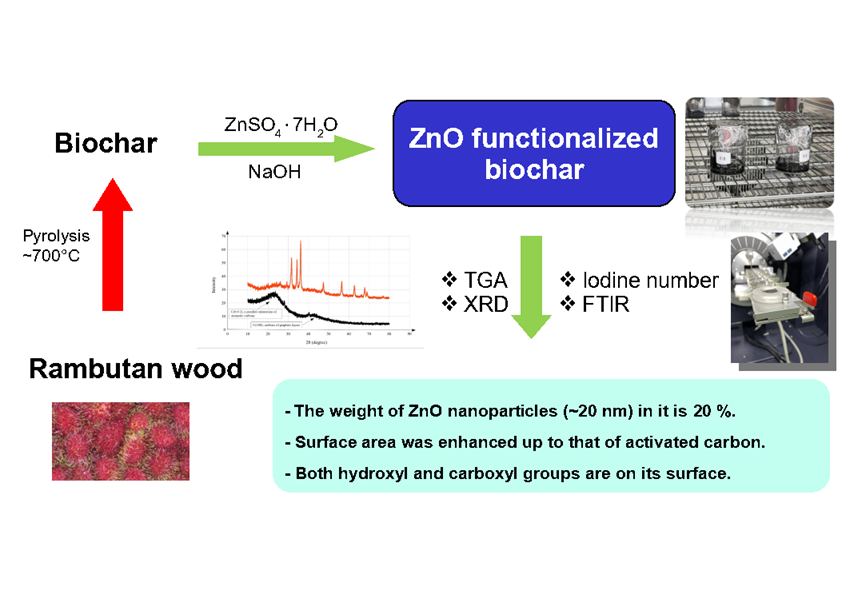
Zinc oxide-functionalized biochar (biochar-ZnO) from rambutan wood, an agricultural waste, was prepared to increase a value of biochar from rambutan, an important economic fruit crop in Thailand, for the first time. Biochar-ZnO was synthesized by a sol-gel process. X-ray diffraction (XRD) spectra suggest that the biochar consists of amorphous carbon mainly and confirm the success of zinc oxide functionalization on the biochar surface. The crystal structure of zinc oxide is hexagonal Wurtzite. The diameter of zinc oxide particles is ~20 nm. Thermogravimetric (TGA) thermograms indicate the success of biochar-ZnO preparation. A weight percentage of zinc oxide in the composite is ~20. Their Fourier transform infrared (FTIR) spectra confirm, again, the success of ZnO functionalization on the biochar surface and indicate both carboxylic and hydroxyl groups on the biochar and biochar-ZnO surface. The iodine numbers of the biochar and biochar-ZnO are 570 and 555 mg∙g‒1, respectively. These numbers suggest that the biochar without an activation has a surface area that is comparable to that of activated carbon. Also, a decrease in the iodine numbers after the sol-gel process suggest a coverage of zinc oxide particles on the biochar surface. Lastly, biochar-ZnO is a promising material to be used for further applications such as a filler in rubber industry, an important industry in Thailand.
Downloads
เอกสารอ้างอิง
Thailand Department of Agricultural Extension, Ministry of Agriculture and Cooperastives, www.doae.go.th https://gisblog. doae.go.th/?p=629 (accessed May 17, 2025).
D. C. B. D. Santos, R. B. W. Evaristo, R. C. Dutra, P. A. Z. Suarez, E. A. Silveira, and G. F. Ghesti, “Advancing biochar applications: A review of production processes, analytical methods, decision criteria, and pathways for scalability and certification,” Sustainability, vol. 17, p. 2685, 2025. DOI: https://doi.org/10.3390/su17062685
P. R. Yaashikaa, P. S. Kumar, S. Varjani, and A. Saravanan, “Advancing biochar applications: A review of production processes, analytical methods, decision criteria, and pathways for scalability and certification,” Biotechnology Reports, vol. 28, p. 2685, 2020. DOI: https://doi.org/10.1016/j.btre.2020.e00570
H. E. Brown, “Zinc oxide rediscovered,” New York: The New Jersey Zinc Company, pp. 1–99, 1957.
S. Sahoo, M. Maiti, A. Ganguly, G. Jacob, B. Jinu, and K. Anil, “Effect of zinc oxide nanoparticles as cure activator on the properties of natural rubber and nitrile rubber,” Journal of Applied Polymer Science, vol. 105, no. 4, pp. 2407–2415, 2007. DOI: https://doi.org/10.1002/app.26296
G. K. Prashanth, M. S. Dileep, M. Gadewar, M. K. Ghosh, S. Rao, A. S. Giresha, P. A. Prashanth, M. M. Swamy, K. V. Yatish, and M. Mutthuraju, “Zinc oxide nanostructures: illuminating the potential in biomedical applications: a brief overview,” BioNanoScience, vol. 14, no. 2, pp. 1876–1896, 2024. DOI: https://doi.org/10.1007/s12668-024-01366-4
F. N. Archibong, L. C. Orakwe, O. A. Ogah, S. O. Mbam, S. A. Ajah, M. E. Okechukwu, C. O. Igberi, K. J. Okafor, M. O. Chima, and I. I. Ikelle, “Emerging progress in montmorillonite rubber/polymer nanocomposites: a review,” Journal of Materials Science, vol. 58, no. 6, pp. 2396–2429, 2023. DOI: https://doi.org/10.1007/s10853-023-08173-4
S. Wannapop, T. Phancharoen, K. Benphad, and A. Somdee, “CuWO4 decorated ZnO corn kernels-like nanostructure for enhanced photocatalytic activity,” Digest Journal of Nano-materials and Biostructures, vol. 20, no. 1, pp. 201–211, 2025. DOI: https://doi.org/10.15251/DJNB.2025.201.201
P. Sonthongphithak, C. Muangnapoh, C. Ratanatawanate, T. E-kobon, A. Piyasaengthong, P. Hongsachart, M. Sriuttha, N. Sengkhamparn, A. C. T. A. Dhanapal, and K. Wittayanarakul, “Biosynthesis of zinc oxide nanoparticles using water hyacinth extracts: characterization, evaluation of antimicrobial and dye removal,” Journal of Metals, Materials and Minerals, vol. 34, no. 2, p.1979, 2024. DOI: https://doi.org/10.55713/jmmm.v34i2.1979
A. Kamal, U. Haroon, H. Manghwar, K. H. Alamer, I. M. Alsudays, A. T. Althobaiti, A. Iqbal, M. Akbar, Farhana, M. Anar, M. Nazish, H. J. Chaudhary, and M. F. H. Munis, “Bio-
logical applications of ball-milled synthesized biochar-zinc oxide nanocomposite using Zea mays L.,” Molecules, vol. 27, no. 16, Art. no. 5333, 2022. DOI: https://doi.org/10.3390/molecules27165333
A. Nakarmi, S. E. Bourdo, L. Ruhl, S. Kanel, M. Nadagouda, P. K. Alla, I. Pavel, and T. Viswanathan, “Benign zinc oxide betaine-modified biochar nanocomposites for phosphate removal from aqueous solutions,” Journal of Environmental Management, vol. 272, Art. no. 111048, 2020. DOI: https://doi.org/10.1016/j.jenvman.2020.111048
M. A. O. Lourenço, J. Zeng, P. Jagdale, M. Castellino, A. Sacco, M. A. Farkhondehfal, and C. F. Pirri, “Biochar/zinc oxide composites as effective catalysts for electrochemical CO2 reduction,” ACS Sustainable Chemistry & Engineering, vol. 9, no. 15, pp. 5445‒5453, 2021. DOI: https://doi.org/10.1021/acssuschemeng.1c00837
M. Li, X. Zhao, Y. Cheng, M. Wu, C. Dong, H. Xiang, Y. Li, Y. Cai, Z. Zhang, and B. Yu, “Zinc oxide nanoparticles coupled biochar-based slow-release fertilizer for enhanced nutrient efficiency and sustainable agriculture,” Industrial Crops and Products, vol. 232, p. 121265, 2025. DOI: https://doi.org/10.1016/j.indcrop.2025.121265
Y. Yan, S. Manicka, E. Lester, T. Wu, and C.-H. Pang, “Synthesis of graphene oxide and graphene quantum dots from miscanthus via ultrasound-assisted mechano-chemical cracking method,” Ultrasonics Sonochemistry, vol. 73, Art. no. 105519, 2021. DOI: https://doi.org/10.1016/j.ultsonch.2021.105519
I. Mansuri, R. Farzana, R. Rajarao, and V. Sahajwalla, “Carbon dissolution using waste biomass - A sustainable approach for ironarbon alloy production,” Metals, vol. 8, Art. no. 290, 2018. DOI: https://doi.org/10.3390/met8040290
S. Sakulpaisan, T. Vongsetskul, S. Reamouppaturm, J. Luangkachao, J. Tantirungrotechai, and P. Tangboriboonrat, “Titania-functionalized graphene oxide for an efficient adsorptive removal of phosphate ions,” Journal of Environmental Management, vol. 167, pp. 99‒104, 2016. DOI: https://doi.org/10.1016/j.jenvman.2015.11.028
ดาวน์โหลด
เผยแพร่แล้ว
วิธีการอ้างอิง
การอนุญาต
ลิขสิทธิ์ (c) 2026 วารสารโลหะ, วัสดุ และแร่

This work is licensed under a Creative Commons Attribution-NonCommercial-NoDerivatives 4.0 International License.
Authors who publish in this journal agree to the following terms:
- Authors retain copyright and grant the journal right of first publication with the work simultaneously licensed under a Creative Commons Attribution License that allows others to share the work with an acknowledgment of the work's authorship and initial publication in this journal.
- Authors are able to enter into separate, additional contractual arrangements for the non-exclusive distribution of the journal's published version of the work (e.g., post it to an institutional repository or publish it in a book), with an acknowledgment of its initial publication in this journal.