Green synthesis and optimized annealing temperature effects on zinc oxide nanoparticles using mango peel extract
DOI:
https://doi.org/10.55713/jmmm.v36i3.2541คำสำคัญ:
Green Synthesis, Annealing Temperature, Zinc Oxide Nanoparticles, Mango Peel Extractบทคัดย่อ
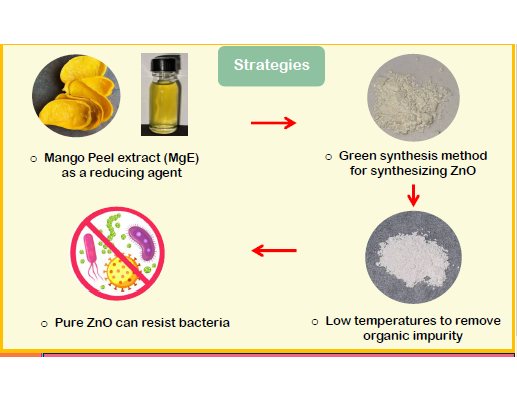
This study presents the green synthesis of zinc oxide nanoparticles (ZnO-NPs) using mango peel extract (MgE) as a natural reducing and stabilizing agent. Phytochemical extraction was performed with deionized water, ethanol, and methanol for 1 h to 5 h, with deionized water at 4 h yielding the highest flavonoid content. Using zinc nitrate as a precursor, 25 mL of MgE successfully facilitated the synthesis of ZnO-NPs (ZnO-25MgE). It was found that annealing temperature at 400℃ for 6 h produced pure ZnO. The obtained nanoparticles were characterized by X-ray diffraction (XRD), Fourier-transform infrared spectroscopy (FT-IR), and field emission scanning electron microscopy (FE-SEM). XRD confirmed the crystalline structure with an average size of 6.67 nm, while FT-IR and FE-SEM analyses revealed Zn–O vibrations, residual organics, and nanoscale morphology. Thermogravimetric analysis (TGA) indicated the appropriate annealing temperature for the removal of organics. For comparison, chemically synthesized ZnO was also characterized, and its antibacterial activity was assessed via disc diffusion against Escherichia coli and Staphylococcus aureus. The results demonstrated notable inhibition, highlighting the potential of biosynthesized ZnO-NPs for antimicrobial applications.
Downloads
เอกสารอ้างอิง
S. Shahzadi, S. Fatima, Q. ul ain, Z. Shafiq, and M. R. S. A. Janjua, “A review on green synthesis of silver nanoparticles (SNPs) using plant extracts: A multifaceted approach in photocatalysis, environmental remediation, and biomedicine,” RSC Advances, vol. 15, pp. 3858–3903, 2025. DOI: https://doi.org/10.1039/D4RA07519F
M. S. Samuel, M. Ravikumar, A. John J., E. Selvarajan, H. Patel, P. S. Chander, J. Soundarya, S. Vuppala, R. Balaji, and N. Chandrasekar, “A review on green synthesis of nanoparticles and their diverse biomedical and environmental applications,” Catalysts, vol. 12, no. 5, p. 459, 2022. DOI: https://doi.org/10.3390/catal12050459
S. Ying, Z. Guan, P. C. Ofoegbu, P. Clubb, C. Rico, F. He, and J. Hong, “Green synthesis of nanoparticles: Current developments and limitations,” Environmental Technology & Innovation, vol. 24, p. 102336, 2022. DOI: https://doi.org/10.1016/j.eti.2022.102336
A. Hussein, and E. E. Al-Abodi, “A review article: Green synthesis by using different plants to preparation oxide nanoparticles,” Ibn AL-Haitham Journal For Pure and Applied Sciences, vol. 36, no. 1, 2025. DOI: https://doi.org/10.30526/36.1.2933
D. Mamand, S. A. Hussen, and S. B. Aziz, “Green approach to synthesis polymer composites based on chitosan with desired linear and non-linear optical characteristics,” Scientific Reports, vol. 15, p. 3130, 2025. DOI: https://doi.org/10.1038/s41598-024-75953-6
W. Xiong, G. Li, and B. Xiao, “An empirical study on green-house gas emission calculations from municipal solid waste disposal methods including landfill, incineration, and composting,” Applied Sciences, vol. 10, no. 5, p. 1673, 2019. DOI: https://doi.org/10.3390/app10051673
S. L. Nordahl, C. V. Proeble, T. W. Kirchstetter, and C. D. Scown, “Greenhouse gas and air pollutant emissions from composting,” Environmental Science & Technology, vol. 15, p.15573‒15574, 2025. DOI: https://doi.org/10.1021/acs.est.5c08656
Y. Zhang, and J. Wang, “Greenhouse gas emissions from landfills: A review and bibliometric analysis,” Sustainability, vol. 11, no. 8, p. 2282, 2019. DOI: https://doi.org/10.3390/su11082282
G. Chataut, B. Bhatta, D. Joshi, K. Subedi and K. Kafle, “Greenhouse gases emission from agricultural soil: A review,” Journal of Agriculture and Food Research, vol. 11, p. 100533, 2023. DOI: https://doi.org/10.1016/j.jafr.2023.100533
E. J. Rifna, N. N. Misra, and M. Dwivedi, “Recent advances in extraction technologies for recovery of bioactive compounds derived from fruit and vegetable waste peels: A review”, Critical reviews in food science and nutrition, vol. 63, no. 6, pp. 719–752, 2023. DOI: https://doi.org/10.1080/10408398.2021.1952923
N. Kučuk, M. Primožič, P. Kotnik, Ž. Knez, and M. Leitgeb, “Mango peels as an industrial by-product: A sustainable source of compounds with antioxidant, enzymatic, and antimicrobial activity,“ Foods, vol. 13, no. 4, p. 553, 2024. DOI: https://doi.org/10.3390/foods13040553
C. Torres-León, and R. Rojas, J. C. Contreras-Esquivel, L. Serna-Cock, R. E. Belmares-Cerda, and C. N. Aguilar, “Mango seed: Functional and nutritional properties,” Trends in Food Science & Technology, vol. 55, pp. 109‒117, 2016. DOI: https://doi.org/10.1016/j.tifs.2016.06.009
L. Espinosa-Espinosa, L. Garduño-Siciliano, M. Rodriguez-Canales, L. B. Hernandez-Portilla, M. M. Canales-Martinez, and M. A. Rodriguez-Monroy, “The wound-healing effect of mango peel extract on incision wounds in a murine model,” Molecules, vol. 27, no. 1, p. 259, 2022. DOI: https://doi.org/10.3390/molecules27010259
S. Maenpuen, P. Mee-Udorn, C. Pinthong, A. Athipornchai, K. Phiwkaow, S. Watchasit, P.Pimviriyakul, T. Rungrotmongkol, R. Tinikul, U. Leartsakulpanich, and P. Chitnumsub, “Mangiferin is a new potential antimalarial and anticancer drug for targeting serine hydroxymethyltransferase,” Archives of biochemistry and biophysics, vol. 745, p. 109712, 2023. DOI: https://doi.org/10.1016/j.abb.2023.109712
R. Ahmad, M. Aldholmi, A. Mostafa, A. Alqathama, A. Aldarwish, A. Abuhassan, L. Alateeq, S. Bubshait, M. Aljaber, and S. Aldossary, “A novel green extraction and analysis technique for the comprehensive characterization of mangiferin in different parts of the fresh mango fruit (Mangifera indica),” LWT, vol. 159, p. 113176, 2022. DOI: https://doi.org/10.1016/j.lwt.2022.113176
R. Malviya, and G. T. Kulkarni, “Extraction and characterization of mango peel pectin as pharmaceutical excipient,” Polymers in Medicine, vol. 42, no. 3–4, pp. 185–190, 2012.
B. E. Richter, B. A. Jones, J. L. Ezzell, N. L. Porter, N. Avdalovic, and C. Pohl, “Accelerated solvent extraction: A technique for sample preparation,” Analytical Chemistry, vol. 68, no. 6, pp. 1033–1039, 1996. DOI: https://doi.org/10.1021/ac9508199
P. Maran, K. Swathi, P. Jeevitha, J. Jayalakshmi, and G. Ashvini, “Multiple response analysis and optimization of microwave-assisted extraction of antioxidant phenolic compounds of waste Mangifera indica L. peel,” Journal of Food Processing and Preservation, vol. 39, no. 6, pp. 2276–2285, 2015. DOI: https://doi.org/10.1111/jfpp.12473
S. S. Patil, U. B. Deshannavar, S. N. Gadekar-Shinde, A. H. Gadagi, and S. A. Kadapure, “Optimization studies on batch extraction of phenolic compounds from Azadirachta indica leaves using genetic algorithm and machine learning techniques,” Heliyon, vol. 9, p. e21991, 2023. DOI: https://doi.org/10.1016/j.heliyon.2023.e21991
B. Kaur, P. S. Panesar, and A. K. Anal, “Standardization of ultrasound-assisted extraction for the recovery of phenolic compounds from mango peels,” Journal of Food Science and Technology, vol. 59, no. 7, pp. 2813–2820, 2021. DOI: https://doi.org/10.1007/s13197-021-05304-0
V. M.Kulkarni, and V. K. Rathod, “Mapping of an ultrasonic bath for ultrasound assisted extraction of mangiferin from Mangifera indica leaves,” Ultrasonics Sonochemistry, vol. 21, no. 2, pp. 606‒611, 2014. DOI: https://doi.org/10.1016/j.ultsonch.2013.08.021
B. R. Khanam, N. C. Prachalith, B. Angadi, B. U. Reddy, and K. Udaykumar, “The effect of reaction and annealing temperatures on physicochemical properties of highly stable ZnO nanoparticles synthesized via a green route using Plumeria obtusa L.,” New Journal of Chemistry, vol. 47, pp. 19122–19137, 2023. DOI: https://doi.org/10.1039/D3NJ02641H
Md. S. Mostafa, S. Yeasmin, Md. M. H. Pranto, S. M. Reza, T. Ur. Rashid, H. Das, M. Rahman, and A. Habib, “Annealing‐induced optimization of green‐synthesized ZnO nanoparticles for improved nanopriming in sustainable agriculture,” Nanoscale Advances, vol. 7, pp. 5589–5600, 2025. DOI: https://doi.org/10.1039/D5NA00354G
S. Azizi, R. Mohamad, A. Bahadoran, S. Bayat, R. A. Rahim, A. Ariff, and W. Z. Saad, “Effect of annealing temperature on antimicrobial and structural properties of bio-synthesized zinc oxide nanoparticles using flower extract of Anchusa italica,” Journal of Photochemistry and Photobiology B: Biology, vol. 161, pp. 441‒449, 2016. DOI: https://doi.org/10.1016/j.jphotobiol.2016.06.007
N. Verm, S. Bhatia, and R. K. Bedi, “Effect of annealing temperature on ZnO nanoparticles and its applications for photocatalytic degradation of DR-31 dye,” International Journal of Pure and Applied Physics, vol. 13, no. 1, pp. 118–122, 2017.
J. C. Moore, L. R. Covington, and R. Stansell, “Affect of film thickness on the blue photoluminescence from ZnO,” Physica Status Solidi (a), vol. 209, no. 4, pp. 741‒745, 2012. DOI: https://doi.org/10.1002/pssa.201127613
A. Kumar, P. Nirmal, M. Kumar, A. Jose, V. Tomer, E. Oz, C. Proestos, M. Zeng, T. Elobeid, K. Sneha, and F. Oz, “Major phytochemicals: Recent advances in health benefits and extraction method,” Molecules, vol. 28, no. 2, p. 887, 2023. DOI: https://doi.org/10.3390/molecules28020887
S. Wirunchit, N. Sakulpeeb, S. Chutipaijit, J. Nukaew, and W. Koetniyom, “Flavonoid extraction from mango peels for nano-particles by green synthesis process,” Current Applied Science and Technology, vol. 25, no. 6, p. e0263933, 2025. DOI: https://doi.org/10.55003/cast.2025.263933
S. Wirunchit, N. sakulpeeb, S. chutipaijit, J. nukaew, and W. koetniyom, “Green synthesis of zinc oxide nanoparticles from lemon peel extract and their antibacterial activity,” Suranaree Journal of Science and Technology, vol. 31, no. 3, p. 030196 2024. DOI: https://doi.org/10.55766/sujst-2024-03-e05665
E. Z, Gomaa, “Microbial mediated synthesis of zinc oxide nanoparticles, characterization and multifaceted applications,” Journal of Inorganic and Organometallic Polymers and Materials, vol. 32, pp. 414‒4132, 2022. DOI: https://doi.org/10.1007/s10904-022-02406-w
M. Murali, N.Kalegowda, H. G. Gowtham, M. A. Ansari, M. N. Alomary, S. Alghamdi, N. Shilpa, S. B. Singh, M. C. Thriveni, M. Aiyaz, N. Angaswamy, N. Lakshmidevi, S. F.Adil, M. R. Hatshan, and K. N. Amruthesh, “Plant-mediated zinc oxide nanoparticles: Advances in the new millennium towards under-standing their therapeutic role in biomedical applications,” Pharmaceutics, vol.13, no. 10, p. 1662, 2021. DOI: https://doi.org/10.3390/pharmaceutics13101662
ดาวน์โหลด
เผยแพร่แล้ว
วิธีการอ้างอิง
การอนุญาต
ลิขสิทธิ์ (c) 2026 วารสารโลหะ, วัสดุ และแร่

This work is licensed under a Creative Commons Attribution-NonCommercial-NoDerivatives 4.0 International License.
Authors who publish in this journal agree to the following terms:
- Authors retain copyright and grant the journal right of first publication with the work simultaneously licensed under a Creative Commons Attribution License that allows others to share the work with an acknowledgment of the work's authorship and initial publication in this journal.
- Authors are able to enter into separate, additional contractual arrangements for the non-exclusive distribution of the journal's published version of the work (e.g., post it to an institutional repository or publish it in a book), with an acknowledgment of its initial publication in this journal.