Enhanced energy-storage performance and electric-field-induced strain in Ta-doped (Bi\(_{0.465}\)Na\(_{0.465}\)Ba\(_{0.07}\))TiO\(_{3}\) lead-free ceramics
DOI:
https://doi.org/10.55713/jmmm.v36i4.2685คำสำคัญ:
Environmentally friendly ceramics, Ta substitution, Energy-storage capability, Relaxor behaviorบทคัดย่อ
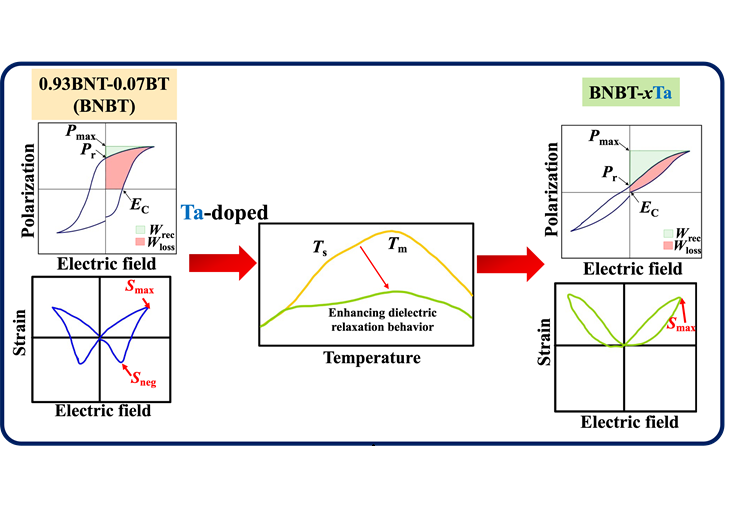
The influence of Ta5+ substitution on lead-free (Bi0.465Na0.465Ba0.07)TaxTi(1–x)O3 (BNBT–xTa, x = 0.0 to 0.03) ceramics was investigated. The samples were prepared using a conventional solid-state route, resulting in a phase-pure perovskite structure with pseudocubic characteristics for all compositions. With increasing Ta content, the electrical response gradually shifted toward relaxor behavior, as indicated by slimmer P–E loops, reduced remanent polarization, and a shift of Ts toward lower temperatures. This transition was also reflected in the strain characteristics, where S–E loops evolved from typical butterfly shapes to sprout-like profiles. The sample with x = 0.01 showed the best strain performance, reaching ~0.23% strain along with a normalized coefficient of ~383 pm·V‒1. Energy-storage performance was significantly improved, with a maximum Wrec of ~0.90 J·cm‒3 for x = 0.02, while efficiency further increased to 68% for x = 0.03. In parallel, electrical resistivity increased by nearly an order of magnitude, accompanied by a rise in activation energy from 1.53 eV to 1.71 eV, suggesting suppressed charge transport due to enhanced energy barriers. Overall, Ta5+ substitution effectively tailors both electrical and electromechanical properties, making BNBT-based ceramics promising candidates for advanced lead-free capacitor applications and actuators.
Downloads
เอกสารอ้างอิง
L. Yang, X. Kong, F. Li, H. Hao, Z. Cheng, H. Liu, J.-F. Li, and S. Zhang, “Perovskite lead-free dielectrics for energy storage applications,” Progress in Materials Science, vol. 102, pp. 72–108, 2019. DOI: https://doi.org/10.1016/j.pmatsci.2018.12.005
D. Damjanovic, and R. Newnham, “Electrostrictive and piezo-electric materials for actuator applications,” Journal of Intellignet Material Systems and Structures, vol. 3, no. 2, pp. 190–208, 1992. DOI: https://doi.org/10.1177/1045389X9200300201
J. Lee, S. Hajra, S. Panda, W. Oh, Y. Oh, H. Shin, Y. K. Mishra, and H. J. Kim, “Accelerate the shift to green energy with PVDF based piezoelectric nanogenerator,” International Journal of Precision Engineering and Manufacturing-Green Technology, vol. 11, no. 1, pp. 233–241, 2024. DOI: https://doi.org/10.1007/s40684-023-00539-y
R. Guo, L. E. Cross, S.-E. Park, B. Noheda, D. E. Cox, and G. Shirane, “Origin of the high piezoelectric response in PbZr1−xTixO3,” Physical Review Letters, vol. 84, no. 23, pp. 5423‒5426, 2000. DOI: https://doi.org/10.1103/PhysRevLett.84.5423
K. J. Puttlitz, and G. T. Galyon, “Impact of the ROHS directive on high-performance electronic systems,” Lead-Free Electronic Solders, Springer, 2006, pp. 347–365. DOI: https://doi.org/10.1007/978-0-387-48433-4_23
T. Takenaka, K-i. Maruyama, and K. Sakata, “(Bi1/2Na1/2)TiO3- BaTiO3 system for lead-free piezoelectric ceramics,” The Japan Society of Applied Physis, vol. 30, no. 9S, p. 2236, 1991.
Y. Saito, H. Takao, T. Tani, T. Nonoyama, K. Takatori, T. Homma, T. Nagaya, and M. Nakamura, “Lead-free piezo-ceramics,” Nature, vol. 432, no. 7013, pp. 84–87, 2004. DOI: https://doi.org/10.1038/nature03028
T. Takenaka, K. M. K. Maruyama, and K. S. K. Sakata, “(Bi1/2Na1/2)TiO3-BaTiO3 system for lead-free piezoelectric ceramics,” Japanese Journal of Applied Physis., vol. 30, no. 9S, p. 2236, 1991.
M. Benyoussef, M. Zannen, J. Belhadi, B. Manoun, J.-L. Dellis, M. El. Marssi, and A. Lahmar, “Dielectric, ferroelectric, and energy storage properties in dysprosium doped sodium bismuth titanate ceramics,” Ceramics International, vol. 44, no. 16, pp. 19451–19460, 2018. DOI: https://doi.org/10.1016/j.ceramint.2018.07.182
Y. Hiruma, H. Nagata, and T. Takenaka, “Thermal depoling process and piezoelectric properties of bismuth sodium titanate ceramics,” Journal of Applied Physics, vol. 105, no. 8, pp. 084112‒084118, 2009. DOI: https://doi.org/10.1063/1.3115409
P. Gonnard, and M. Troccaz, “Dopant distribution between A and B sites in the PZT ceramics of type ABO3,” Journal of Solid State Chemistry, vol. 23, no. 3–4, pp. 321–326, 1978. DOI: https://doi.org/10.1016/0022-4596(78)90080-4
F. Gao, X. Dong, C. Mao, W. Liu, H. Zhang, L. Yang, F. Cao, and G. Wang, “Energy‐storage properties of 0.89Bi0.5Na0.5TiO3– 0.06BaTiO3–0.05K0.5Na0.5NbO3 lead‐free anti‐ferroelectric ceramics,” Journal of the American Ceramic Society, vol. 94, no. 12, pp. 4382–4386, 2011. DOI: https://doi.org/10.1111/j.1551-2916.2011.04731.x
L. Zheng, X. Yi, S. Zhang, W. Jiang, B. Yang, R. Zhang, and W. Cao, “Complete set of material constants of 0.95(Na0.5Bi0.5) TiO3-0.05BaTiO3 lead-free piezoelectric single crystal and the delineation of extrinsic contributions,” Applied Physics Letters, vol. 103, no. 12, p. 122905, 2013. DOI: https://doi.org/10.1063/1.4821853
W. Jo, T. Granzow, E. Aulbach, J.Rodel, and D. Damjanovic, “Origin of the large strain response in (K0.5Na0.5)NbO3-modified (Bi0.5Na0.5)TiO3–BaTiO3 lead-free piezoceramics,” Journal of Applied Physics, vol. 105, no. 9, p. 094102, 2009. DOI: https://doi.org/10.1063/1.3121203
M. R. Bafandeh, H.-S. Han, and J.-S. Lee, “Enhanced electric field induced strain in complex-ion Ga3+ and Ta5+-doped 0.93 BNT-0.07BT piezoceramic,” Journal of Electroceramics, vol. 47, no. 3, pp. 89–99, 2021. DOI: https://doi.org/10.1007/s10832-021-00264-5
Y. Xu, X. Liu, G. Wang, X. Liu, and Y. Feng, “Antiferro-electricity in tantalum doped (Bi0.5Na0.5)0.94Ba0.06TiO3 lead-free ceramics,” Ceramics International, vol. 42, no. 3, pp. 4313–4322, 2016. DOI: https://doi.org/10.1016/j.ceramint.2015.11.109
J. Hao, Z. J. Xu, R. Chu, W. Li, P. Fu, J. Du, and G. Li, “Structure evolution and electrostrictive properties in (Bi0.5Na0.5)0.94Ba0.06 TiO3–M2O5 (M= Nb, Ta, Sb) lead-free piezoceramics,” Journal of the European Ceramic Society, vol. 36, no. 16, pp. 4003–4014, 2016. DOI: https://doi.org/10.1016/j.jeurceramsoc.2016.06.020
R. Zuo, C. Ye, X. Fang, and J. Li, “Tantalum doped 0.94Bi0.5 Na0.5TiO3–0.06BaTiO3 piezoelectric ceramics,” Journal of the European Ceramic Society, vol. 28, no. 4, pp. 871–877, 2008. DOI: https://doi.org/10.1016/j.jeurceramsoc.2007.08.011
R. D. Shannon, “Revised effective ionic radii and systematic studies of interatomic distances in halides and chalcogenides,” Acta Crystallographica Section A, vol. 32, no. 5, pp. 751–767, 1976. DOI: https://doi.org/10.1107/S0567739476001551
R. A. Malik, A. Hussain, A. Maqbool, A. Zaman, T. k. Song, W.-J. kim, and M.-H. Kim, “Giant strain, thermally-stable high energy storage properties and structural evolution of Bi-based lead-free piezoceramics,” Journal of Alloys and Compounds, vol. 682, pp. 302–310, 2016. DOI: https://doi.org/10.1016/j.jallcom.2016.04.297
X. Qiao, F. Zhang, D. Wu, B. Chen, X. Zhao, Z. Peng, X. Ren, P. Liang, X. Chao, and Z. Yang, “Superior comprehensive energy storage properties in Bi0.5Na0.5TiO3-based relaxor ferroelectric ceramics,” Chemical Engineering Journal, vol. 388, p. 124158, 2020. DOI: https://doi.org/10.1016/j.cej.2020.124158
P. Fu, Z. Xu, R. Chu, W. Li, G. Zang, and J. Hao, “Piezoelectric, ferroelectric and dielectric properties of La2O3-doped (Bi0.5 Na0.5)0.94 Ba0.06TiO3 lead-free ceramics,” Materials & Design, vol. 31, no. 2, pp. 796–801, 2010. DOI: https://doi.org/10.1016/j.matdes.2009.07.056
A. Ullah, Z. Yao, H. Liu, H. Hao, A. Manan, A. Ullah, A. Jan, M. Cao, S. Ahmad, and F. Alresheedi, “Improved energy storage properties of La0.33NbO3 modified 0.94Bi0.5Na0.5TiO3-0.06 BaTiO3 ceramic system,” Applied Physics A, vol. 127, pp. 1–12, 2021. DOI: https://doi.org/10.1007/s00339-021-04312-3
P. Premwichit, T. Siritanon, W. Somsri, N. Nuntawong, O. Kosasang, S. Gupta, and S. Prasertpalichat “High energy-storage performance under low electric fields and enhanced electric-field-induced strain in Nb5+ doped BNT− BT lead-free piezo-ceramics,” Journal of Asian Ceramic Societies, vol. 13, no. 1, pp. 154–168, 2025. DOI: https://doi.org/10.1080/21870764.2025.2475587
W. Jo, S. Schaab, E. Sapper, L. A. Schmitt, H.-J. Kleebe, A. J. Bell, and J. Rodel, “On the phase identity and its thermal evolution of lead free (Bi1/2Na1/2)TiO3-6mol% BaTiO3,” Journal of Applied Physics, vol. 110, no. 7, p. 074106, 2011. DOI: https://doi.org/10.1063/1.3645054
P. Zhongbin, D. Hu, Y. Zhang, J. J. Liu, B. Shen, and J. Zhai, “Achieving high discharge energy density and efficiency with NBT-based ceramics for application in capacitors,” Journal of Materials, Chemistry C, vol. 7, no. 14, pp. 4072–4078, 2019. DOI: https://doi.org/10.1039/C9TC00087A
X. Zhou, G. Xue, H. Luo, C. R. Bowen, and D. Zhang, “Phase structure and properties of sodium bismuth titanate lead-free piezoelectric ceramics,” Progress in Materials Science, vol. 122, p. 100836, 2021. DOI: https://doi.org/10.1016/j.pmatsci.2021.100836
J. He, X. Liu, Y. Zhao, H. Du, T. Zhang, and J. Shi, “Dielectric stability and energy-storage performance of BNT-based relaxor ferroelectrics through Nb5+ and its excess modification,” ACS Applied Electronic Materials, vol. 4, no. 2, pp. 735–743, 2022. DOI: https://doi.org/10.1021/acsaelm.1c01129
Y. Yang, Z. Liu, P. Ren, Y. Mao, H. Sun, B. Liang, P. Mao, K. Guo, B. Xie, and L. Shu, “Modulation of phase boundary and domain structures to engineer strain properties in BNT-based ferroelectrics,” Journal of Advanced Ceramics, vol. 13, no. 7, pp. 967–975, 2024. DOI: https://doi.org/10.26599/JAC.2024.9220910
W. Zhou, T. Du, and C. Long, “High-efficiency lead-free bnt-based relaxor ferroelectrics via synergistic A/B-Site substitution for enhanced energy storage and stability,” Materials, vol. 18, no. 23, p. 5259, 2025. DOI: https://doi.org/10.3390/ma18235259
P. Fu, Z. Xu, R. Chu, W. Li, G. Zang, and J. Jao, “Piezoelectric, ferroelectric and dielectric properties of Nd2O3-doped (Bi0.5 Na0.5)0.94Ba0.06TiO3 lead-free ceramics,” Materials Science and Engineering B, vol. 167, no. 3, pp. 161–166, 2010. DOI: https://doi.org/10.1016/j.mseb.2010.01.057
J. Zang, M. Li, D. C. Sinclair, W. Jo, and J. Rodel, “Impedance spectroscopy of (Bi1/2Na1/2)TiO3–BaTiO3 ceramics modified with (K0.5Na0.5)NbO3,” Journal of the American Ceramic Society, vol. 97, no. 5, pp. 1523–1529, 2014.
M. Chandrasekhar, D. K. Khatua, R. Pattanayak, and P. Kumar, “Dielectric relaxation and conduction mechanism studies of BNT-BT-BKT ceramics,” Journal of Physics and Chemistry of Solids, vol. 111, pp. 160–166, 2017. DOI: https://doi.org/10.1016/j.jpcs.2017.07.029
F. Li, J. Zhai, B. Shen, X. Liu, and H. Zeng, “Simultaneously high-energy storage density and responsivity in quasi-hysteresis-free Mn-doped Bi0.5Na0.5TiO3-BaTiO3-(Sr0.7Bi0.2□0.1)TiO3 ergodic relaxor ceramics,” Materials Research Letters, vol. 6, no. 7, pp. 345–352, 2018. DOI: https://doi.org/10.1080/21663831.2018.1457095
B. K. Barick, R. N. P. Choudhary, and D. K. Pradhan, “Dielectric and impedance spectroscopy of zirconium modified (Na0.5Bi0.5) TiO3 ceramics,” Ceramics International, vol. 39, no. 5, pp. 5695–5704, 2013. DOI: https://doi.org/10.1016/j.ceramint.2012.12.087
H. Yanmin, D. Shi, L. Liu, G. Li, S. Zheng, and L. Fang, “High-temperature impedance spectroscopy of BaFe0.5Nb0.5O3 ceramics doped with Bi0.5Na0.5TiO3,” Applied Physics A, vol. 114, no. 3, pp. 891–896, 2014. DOI: https://doi.org/10.1007/s00339-013-7735-y
M. Li, M. J. Poetrowski, R. A. De. Souza, H. Zhang, I. M. Reaney, S. Cook, J. A. Kilner, and D. C. Sinclaie,“ A family of oxide ion conductors based on the ferroelectric perovskite Na0.5Bi0.5TiO3,” Nature Materials, vol. 13, no. 1, pp. 31–35, 2014. DOI: https://doi.org/10.1038/nmat3782
J. Shi, X. Liu, F. Zhu, W. Tian, Y. Xia, T. Li, R. Rao, T. Zhang, and L. Liu, “Oxygen vacancy migration and its lattice structural origin in A-site non-stoichiometric bismuth sodium titanate perovskites,” Journal of Materiomics, vol. 8, no. 3, pp. 719–729, 2022. DOI: https://doi.org/10.1016/j.jmat.2021.09.008
P. Premwichit, O. Kosasang, N. Triamnak, and S. Prasertpalichat, “Effects of Nd3+ donor doping on dielectric, electrical conductivity and ferroelectric properties of (Bi0.5Na0.5)0.93Ba0.07TiO3 lead-free ceramics,” Integrated Ferroelectrics, vol. 223, no. 1, pp. 185–195, 2021. DOI: https://doi.org/10.1080/10584587.2021.1964297
J. Zuo, H. Yang, J. Chen, and C. Li, “Highly-reliable dielectric capacitors with excellent comprehensive energy-storage properties using Bi0.5Na0.5TiO3-based relaxor ferroelectric ceramics,” Journal of the European Ceramic Society, vol. 43, no. 6, pp. 2452–2459, 2023. DOI: https://doi.org/10.1016/j.jeurceramsoc.2023.01.005
W. Jo, R. Dittmer, M. Acosta, J. Zang, C. Groh, E. Sapper, K. Wang, and J. Rodel, “Giant electric-field-induced strains in lead-free ceramics for actuator applications–status and perspective,” Journal of Electroceramics, vol. 29, no. 1, pp. 71–93, 2012. DOI: https://doi.org/10.1007/s10832-012-9742-3
C. L. Freeman, J. A. Dawson, H.-R. Chen, J. H. Harding, L.-B. Ben, and D. C. Sinclair “A new potential model for barium titanate and its implications for rare-earth doping,” Journal of Materials Chemistry, vol. 21, no. 13, pp. 4861–4868, 2011. DOI: https://doi.org/10.1039/c0jm04058d
M. Cernea, L. Trupina, C. Dragoi, B. S. Vasile, and R. Trusca, “Structural and piezoelectric characteristics of BNT–BT0.05 thin films processed by sol–gel technique,” Journal of Alloys and Compounds, vol. 515, pp. 166–170, 2012. DOI: https://doi.org/10.1016/j.jallcom.2011.11.129
M. Cernea, A. C. Galca, M. C. Cioangher, C. Dragoi, and G. Loncea, “Piezoelectric BNT-BT0.11 thin films processed by sol–gel technique,” Journal of Materials Science, vol. 46, no. 17, pp. 5621–5627, 2011. DOI: https://doi.org/10.1007/s10853-011-5512-x
Y. Lan, C. Yuan, X. Liu, B. Zhu, L. Meng, C. Zhou, F. Liu, J. Xu, J. Wang, and G. Rao, “Semiconducting tailoring and electrical properties of A-site Co substituted Bi0·5Na0·5TiO3-δ ferroelectric ceramics,” Materials Chemistry and Physics, vol. 260, p. 124100, 2021. DOI: https://doi.org/10.1016/j.matchemphys.2020.124100
M. Wang, Q. Feng, C. Luo, Y. Ian, C. Yuan, N. Luo, C. Zhou, T. Fujita, J. Xu, G.-h. Chen, and Y. Wei, “Ultrahigh energy storage density and efficiency in Bi0.5Na0.5TiO3-based ceramics via the domain and bandgap engineering,” ACS Applied Materials & Interfaces, vol. 13, no. 43, pp. 51218–51229, 2021. DOI: https://doi.org/10.1021/acsami.1c14151
J. Y. Tsao, S. Chowdhury, M. A. Hollis, D. Jena, N. M. Johnson, K. A. Jones, R. J. Kaplar, S. Rajan, C. G. Van de Walle, E. Bellotti, C. L. Chua, R. Collazo, M. E. Coltrin, J. A. Cooper, K. R. Evans, S. Graham, T. A. Grotjohn, E. R. Heller, M. Higashiwaki, M. S. Islam, P. W. Juodawlkis, M. A. Khan, A. D. Koehler, J. H. Leach, U. K. Mishra, Robert Nemanich, R. C.N. Pilawa-Podgurski, J. B. Shealy, Z. Sitar, M. J. Tadjer, A. F. Witulski, M. Wraback, and J. A. Simmons “Ultrawide‐bandgap semiconductors: research opportunities and challenges,” Advanced Electronic Materials, vol. 4, no. 1, p. 1600501, 2018. DOI: https://doi.org/10.1002/aelm.201600501
V. Palankovski, G. Kaiblinger-Grujin, and S. Selberherr, “Study of dopant-dependent band gap narrowing in compound semi-conductor devices,” Materials Science and Engineering: B, vol. 66, no. 1–3, pp. 46–49, 1999. DOI: https://doi.org/10.1016/S0921-5107(99)00118-X
R. K. Sahu, K. Banerjee, and S. Asthana, “Ergodic-nonergodic relaxor behavior, recoverable energy storage density, and dynamic hysteresis scaling in NKBT ferroelectrics,” Journal of Materials Science: Materials in Electronics, vol. 34, no. 11, p. 972, 2023. DOI: https://doi.org/10.1007/s10854-023-10430-w
A. Ullah, C. W. Ahn, A. Ullah, and I. W. Kim, “Large strain under a low electric field in lead-free bismuth-based piezo-electrics,” Applied Physics Letters, vol. 103, no. 2, 2013. DOI: https://doi.org/10.1063/1.4813420
P. Premwichit, S. Jaila, and S. Prasertpalichat, “Effect of lanthanum doping on phase transition, piezoelectric and energy storage properties of lead-free 0.93(Bi0.5Na0.5)TiO3‒0.07 BaTiO3 ceramics,” Journal of Metals Materials and Minerals, vol. 35, no. 4, p. e2358, 2025. DOI: https://doi.org/10.55713/jmmm.v35i4.2358
J. Tangsritrakul, C. Wichittanankom, and C. Saiyasombat, “Composition-driven phase coexistence and functional properties of the (1-x)BZT-(x)BCT ceramics near the phase convergence region,” Journal of Metals Materials and Minerals, vol. 34, no. 1, pp. 1798–1798, 2024. DOI: https://doi.org/10.55713/jmmm.v34i1.1798
S. Pang, L. Yang, J. Qin, H. Qin, H. Xie, H. Wang, C. Zhou, and J. Xu, “Low electric field-induced strain and large improvement in energy density of (Lu0.5Nb0.5)4+ complex-ions doped BNT–BT ceramics,” Applied Physics A, vol. 125, pp. 1–12, 2019. DOI: https://doi.org/10.1007/s00339-019-2410-6
X. Liu, J. Zhai, B. Shen, F. Li, Y. Zhang, P. Li, and B. liu, “Electric-field-temperature phase diagram and electromechanical properties in lead-free (Na0.5Bi0.5)TiO3-based incipient piezo-electric ceramics,” Journal of the European Ceramic Society, vol. 37, no. 4, pp. 1437–1447, 2017. DOI: https://doi.org/10.1016/j.jeurceramsoc.2016.12.020
R. A. Malik, A. Hussain, A. Zaman, A. Maqbool, J. Ur, Rahman, T. K. Song, W.-J. Kim, and M.-H. Kim, “Structure–property relationship in lead-free A-and B-site co-doped Bi0.5(Na0.84 K0.16)0.5TiO3–SrTiO3 incipient piezoceramics,” RSC Advances, vol. 5, no. 117, pp. 96953–96964, 2015. DOI: https://doi.org/10.1039/C5RA19107F
ดาวน์โหลด
เผยแพร่แล้ว
วิธีการอ้างอิง
ฉบับ
บท
Categories
การอนุญาต
ลิขสิทธิ์ (c) 2026 วารสารโลหะ, วัสดุ และแร่

This work is licensed under a Creative Commons Attribution-NonCommercial-NoDerivatives 4.0 International License.
Authors who publish in this journal agree to the following terms:
- Authors retain copyright and grant the journal right of first publication with the work simultaneously licensed under a Creative Commons Attribution License that allows others to share the work with an acknowledgment of the work's authorship and initial publication in this journal.
- Authors are able to enter into separate, additional contractual arrangements for the non-exclusive distribution of the journal's published version of the work (e.g., post it to an institutional repository or publish it in a book), with an acknowledgment of its initial publication in this journal.