Intelligent control of surface quality in super-finish grinding by utilizing WattPilote
DOI:
https://doi.org/10.55713/jmmm.v37i1.2732คำสำคัญ:
Super-finish grinding, Surface roughness, Power signals, Control limits, WattPiloteบทคัดย่อ
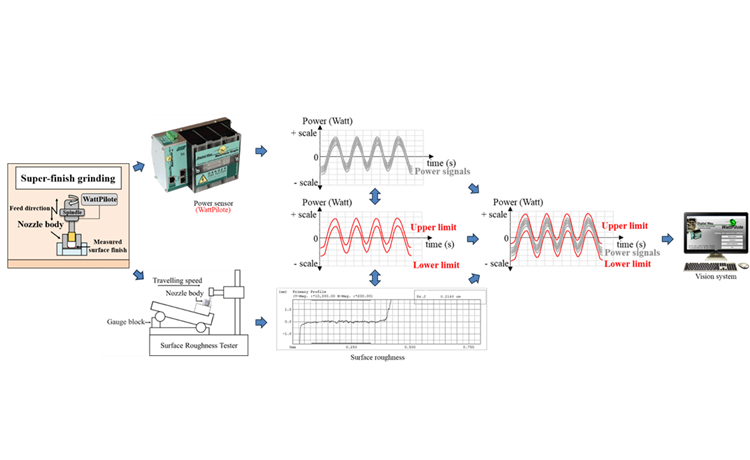
As the intelligent grinding machine is required for high-precision grinding, a monitoring system is developed to control the surface quality of nozzle injector, which is stainless steel (DSUS70DH), for automotive combustion engine in super-finish grinding process by utilizing WattPilote to detect the in-process power signals. The in-process control limits of surface finish are determined referring to the experimentally obtained results by examining the maximum and minimum power signals under various samples. The new algorithm is proposed to identify and compare the obtained power signals by WattPilote during the in-process super-finish grinding. The experimentally obtained upper and lower control limits have been proved and verified with the new super-finish grinding tests. It is confirmed that the developed system can be used to monitor and check the quality of the surface finish of nozzle injectors during the super-finish grinding process with high accuracy regardless of grinding conditions. However, the in-process prediction model of surface finish, which can forecast the surface roughness of nozzle injector during high-precision grinding, will be executed in further research work.
Downloads
เอกสารอ้างอิง
M. C. Shaw, "Principles of Abrasive Processing," Oxford, UK: Clarendon Press, 1996.
M. A. Kamely, S. M. Kamil, and C. W. Chong, "Mathematical modeling of surface roughness in surface grinding operation," in World Academy of Science, Engineering and Technology, 2011, vol. 80, pp. 1048‒1051.
X. Jiang, K. Liu, M. Si, M. Li, and P. Gong, "Grinding force and surface formation mechanisms of 17CrNi2MoVNb alloy when grinding with cbn and alumina wheels," Materials, vol. 16, no. 4, p. 1720, 2023. DOI: https://doi.org/10.3390/ma16041720
W. Huang, Z. Wu, and Y. Gao, "The influence of diesel nozzle structure on internal flow characteristics," in Proceedings of the FISITA 2012 World Automotive Congress, Berlin, Heidelberg: Springer Berlin Heidelberg, 2013, Paper F2012-A02-017.
W. A. Majewski, and H. Jääskeläinen, "Diesel emissions and their control: 2nd Ed," SAE International, 2023, pp. 1085‒1097.
H. Tong, Y. Li, L. Zhang, and J. Qian, "Experimental exploration of wire electro discharge grinding for conical nozzle surfaces," The International Journal of Advanced Manufacturing Technology, vol. 95, no. 1, pp. 1233‒1241, 2018. DOI: https://doi.org/10.1007/s00170-017-1101-8
V. Pandiyan, T. Tjahjowidodo, and M. P. Samy, "In-process surface roughness estimation model for compliant abrasive belt machining process,: Procedia CIRP, vol. 46, pp. 254‒257, 2016. DOI: https://doi.org/10.1016/j.procir.2016.03.126
J.-S. Kwak, S.-B. Sim, and Y.-D. Jeong, "An analysis of grinding power and surface roughness in external cylindrical grinding of hardened SCM440 steel using the response surface method," International Journal of Machine Tools and Manufacture, vol. 46, no. 3‒4), pp. 304‒312. 2006. DOI: https://doi.org/10.1016/j.ijmachtools.2005.05.019
S. Tangjitsitcharoen, and V. Boranintr, "Integration of in-process monitoring and statistical process control of surface roughness on CNC turning process," International Journal of Computer Integrated Manufacturing, vol. 26, no. 3, pp. 227‒236, 2013. DOI: https://doi.org/10.1080/0951192X.2012.731608
F. Klocke, Manufacturing Processes 2: Grinding, Honing, Lapping. RWTHedition. Springer Berlin, Heidelberg. 2009, 433 p. DOI: https://doi.org/10.1007/978-3-540-92259-9
M. Benghersallah, L. Boulanouar, G. L. Coz, A. Devillez, and D. Dudzinski, "Dry high speed milling of cobalt-base hard facing superalloy," Mechanika, vol 18, no. 5, pp. 590‒598, 2012. DOI: https://doi.org/10.5755/j01.mech.18.5.2707
M. Benghersallah, L. Boulanouar, G. Lecoz, and D. Dudzinski, "Dry high speed milling of nickel-based superalloy," Mechanika, vol. 19, no. 2, p. 223‒228, 2013. DOI: https://doi.org/10.5755/j01.mech.19.2.4149
A. Devillez, G. L. Coz, S. Dominiak, and D. Dudzinski, "Dry machining of Inconel 718, workpiece surface integrity," Journal of Materials Processing Technology, vol. 211, no. 10, pp. 1590‒1598, 2011. DOI: https://doi.org/10.1016/j.jmatprotec.2011.04.011
X. Li, X. Liu, C. Yue, S. Y. Liang, and L. Wang, "Systematic review on tool breakage monitoring techniques in machining operations," International Journal of Machine Tools and Manufacture, vol. 176, pp. 1‒39. 2022. DOI: https://doi.org/10.1016/j.ijmachtools.2022.103882
S, Bombiński, J. Kossakowska-Skajster, and K. Jemielniak, "New developments and future prospects in commercial tool condition monitoring systems," Measurement, vol. 255, p. 118037, 2025. DOI: https://doi.org/10.1016/j.measurement.2025.118037
V. Thammasing, and S. Tangjitsitcharoen, "In-process prediction of surface roughness in grinding process by monitoring of cutting force ratio," Applied Mechanics and Materials, vol. 627, pp. 29‒34, 2014. DOI: https://doi.org/10.4028/www.scientific.net/AMM.627.29
S. Tangjitsitcharoen, and A. Senjuntichai, "In-process chatter detection in surface grinding," MATEC Web of Conferences, vol. 28, p. 02001, 2015. DOI: https://doi.org/10.1051/matecconf/20152802001
J. F. G. Oliveira, E. J. Silva, C. Guo, and F. Hashimoto, "Industrial challenges in grinding," CIRP Annals, vol. 58, no. 2, pp. 663‒680, 2009. DOI: https://doi.org/10.1016/j.cirp.2009.09.006
ดาวน์โหลด
เผยแพร่แล้ว
วิธีการอ้างอิง
ฉบับ
บท
Categories
การอนุญาต
ลิขสิทธิ์ (c) 2026 วารสารโลหะ, วัสดุ และแร่

This work is licensed under a Creative Commons Attribution-NonCommercial-NoDerivatives 4.0 International License.
Authors who publish in this journal agree to the following terms:
- Authors retain copyright and grant the journal right of first publication with the work simultaneously licensed under a Creative Commons Attribution License that allows others to share the work with an acknowledgment of the work's authorship and initial publication in this journal.
- Authors are able to enter into separate, additional contractual arrangements for the non-exclusive distribution of the journal's published version of the work (e.g., post it to an institutional repository or publish it in a book), with an acknowledgment of its initial publication in this journal.