Sustainable lightweight foams from hazardous aluminum dross
DOI:
https://doi.org/10.55713/jmmm.v36i3.2549Keywords:
Aluminium dross, Ceramic Foam, Sustainable Materials, Industrial Waste UpcyclingAbstract
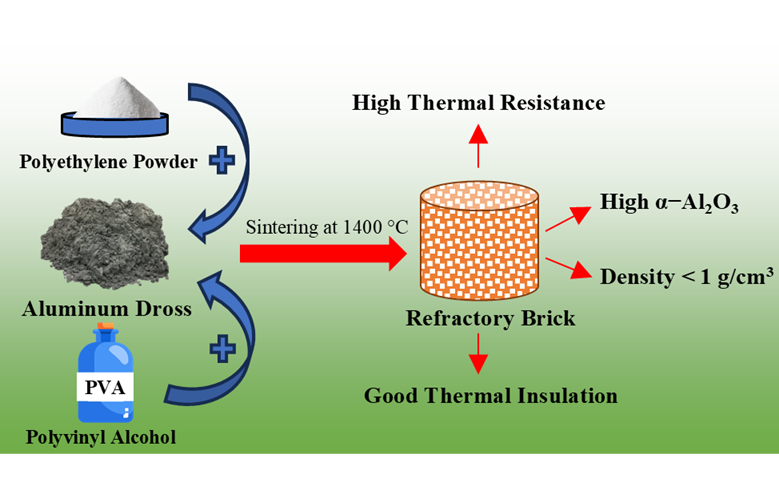
Aluminum dross is a hazardous byproduct from aluminum industry that causes environmental problems and high disposal cost. This work presents a sustainable route to upcycle secondary aluminum dross into lightweight ceramic foams for insulating refractory applications. Secondary aluminum dross powder was blended with polyethylene (PE) pore-forming agents (30 vol% to 70 vol%) and polyvinyl alcohol (PVA) binder added as a 7.5 wt% aqueous solution (binder contents: 1 vol% and 3 vol%), followed by pressing and sintering at 1400℃. Increasing PE systematically reduced bulk density and increased open porosity. At 70 vol% PE, the foams reached a bulk density of 0.94 g∙cm‒3 and open porosity of ~74%, satisfying the Japanese Industrial Standard (JIS) specification for lightweight refractory bricks. The maximum compressive strength was ~2 MPa, sufficient for thermal insulation where load-bearing capacity is secondary. X-ray diffraction confirmed a multiphase matrix of α−Al2O3, MgAl2O4, and CaAl12O19, indicating solid-state reactions between alumina and Mg/Ca-bearing phases. Morphology revealed a well-connected porous network stabilized by reaction-bonded bridges, indicating strong interparticle bonding and limited pore coalescence during sintering. This approach can divert over 1000 kg of hazardous waste per ton of secondary aluminum dross processed and cut CO2 emissions by 65% versus alumina routes. The approach promotes circular economy through waste-derived ceramics.
Downloads
References
O. Manfredi, W. Wuth, and I. Bohlinger, “Characterizing the physical and chemical properties of aluminum dross,” JOM, vol. 49, pp. 48–51, 1997. DOI: https://doi.org/10.1007/s11837-997-0012-9
S. Chokkha, J. Ayawanna, A. Poowancum, T. Singlaem, and P. Mitsomwang, “Fabrication of porous geopolymers utilizing aluminum wastes as foaming agent,” Journal of Metals, Materials and Minerals, vol. 34, no. 2, p. 1966, 2014. DOI: https://doi.org/10.55713/jmmm.v34i2.1966
P. Ramaswamy, S. A. Gomes, and N. P. Ravichander, “Utilization of aluminum dross: Refractories from industrial waste,” IOP Conference Series: Materials Science and Engineering, vol. 577, p. 012101, 2019. DOI: https://doi.org/10.1088/1757-899X/577/1/012101
A. Meshram, and K. K. Singh, “Recovery of valuable products from hazardous aluminum dross: A review,” Resources, Conservation & Recycling, vol. 130, pp. 95–108, 2018. DOI: https://doi.org/10.1016/j.resconrec.2017.11.026
Z. Li, H. Li, X. Huang, W. Wu, Z. Sun, X. Wu, and S. Li, "Removal of nitrides and fluorides from secondary aluminum dross by catalytic hydrolysis and its mechanism," Heliyon, vol. 9, no. 1, e12893, 2023. DOI: https://doi.org/10.1016/j.heliyon.2023.e12893
K. Okada, T. Isobe, K.-i Katsumata, Y. Kameshima, A. Nakajima, and K. J. D. MacKenzie, "Porous ceramics mimicking nature—preparation and properties of microstructures with unidirectionally oriented pores," Science and Technology of Advanced Materials, vol. 12, no. 6, Art. 064701, 2011. DOI: https://doi.org/10.1088/1468-6996/12/6/064701
W. Li, X. Zhang, J. Zhang, H. Shen, J. Yang, Y. Liu, J. Liu, S. Zhang, and J. Yang, “Porous ceramics with near-zero shrinkage and low thermal conductivity from hazardous secondary aluminum dross,” Journal of the American Ceramic Society, vol. 105, no. 5, pp. 3197‒3210, 2022. DOI: https://doi.org/10.1111/jace.18322
A. Li, H. Zhang, and H. Yang, “Evaluation of aluminum dross as raw material for high-alumina refractory,” Ceramics International, vol. 40, no. 8, pp. 12585–12590, 2014. DOI: https://doi.org/10.1016/j.ceramint.2014.04.069
W.-C. Lin, C.-H. Tsai, D.-N. Zhang, S.-S. Syu, and Y.-M. Kuo, “Recycling of aluminum dross for producing calcinated alumina by microwave plasma,” Sustainable Environment Research, vol. 32, no. 1, Art. 50, 2022. DOI: https://doi.org/10.1186/s42834-022-00160-9
J. Liu, S. Zhang, H. Shen, B. Lou, and B. Zhang, "Recycling of secondary aluminum dross to make alumina by hydrometallurgy: A review," Journal of Materials Research and Technology, vol. 32, pp. 4234‒4245, 2024. DOI: https://doi.org/10.1016/j.jmrt.2024.08.151
L. J. Gibson, and M. F. Ashby, “Cellular solids: Structure and properties, 2nd ed. Cambridge, UK: Cambridge University Press, 1997. DOI: https://doi.org/10.1017/CBO9781139878326
R. M. Khattab, M. M. S. Wahsh, and N. M. Khalil, "Preparation and characterization of porous alumina ceramics through starch consolidation casting technique," Ceramics International, vol. 38, no. 6, pp. 4723-4728, 2012. DOI: https://doi.org/10.1016/j.ceramint.2012.02.057
Standard Test Methods for Cold Crushing Strength and Modulus of Rupture of Refractories, ASTM C133-97(2021), ASTM International, West Conshohocken, PA, 2021.
M. N. Rahaman, “Engineering & Technology, Physical Sciences,” in Ceramic Processing and Sintering, 2nd ed. New York, NY: Marcel Dekker, 2003, page 875.
F. Wang, J. Ye, G. He, G. Liu, Z. Xie, and J. Li, “Preparation and characterization of porous MgAl2O4 spinel ceramic supports from bauxite and magnesite,” Ceramics International, vol. 41, no. 6, pp. 7374–7380, 2015. DOI: https://doi.org/10.1016/j.ceramint.2015.02.044
J.-H Chen, H.-Y. Chen, M. Yan, Z. Cao, and W.-J. Mi, “Formation mechanism of calcium hexaluminate,” International Journal of Minerals, Metallurgy and Materials, vol. 23, no. 10, pp. 1225–1230, 2016. DOI: https://doi.org/10.1007/s12613-016-1342-9
B. D. Cullity, and S. R. Stock, Elements of X-Ray Diffraction, 3rd ed. Upper Saddle River, NJ: Prentice Hall, 2001, page 696.
Downloads
Published
How to Cite
Issue
Section
Categories
License
Copyright (c) 2026 Journal of Metals, Materials and Minerals

This work is licensed under a Creative Commons Attribution-NonCommercial-NoDerivatives 4.0 International License.
Authors who publish in this journal agree to the following terms:
- Authors retain copyright and grant the journal right of first publication with the work simultaneously licensed under a Creative Commons Attribution License that allows others to share the work with an acknowledgment of the work's authorship and initial publication in this journal.
- Authors are able to enter into separate, additional contractual arrangements for the non-exclusive distribution of the journal's published version of the work (e.g., post it to an institutional repository or publish it in a book), with an acknowledgment of its initial publication in this journal.