Non-destructive silicon quantification in low-level Si-doped diamond-like carbon films
DOI:
https://doi.org/10.55713/jmmm.v36i4.2538Keywords:
Diamond-like carbon, Silicon doping, Co-deposition, Raman spectroscopy, X-ray photoelectron spectroscopyAbstract
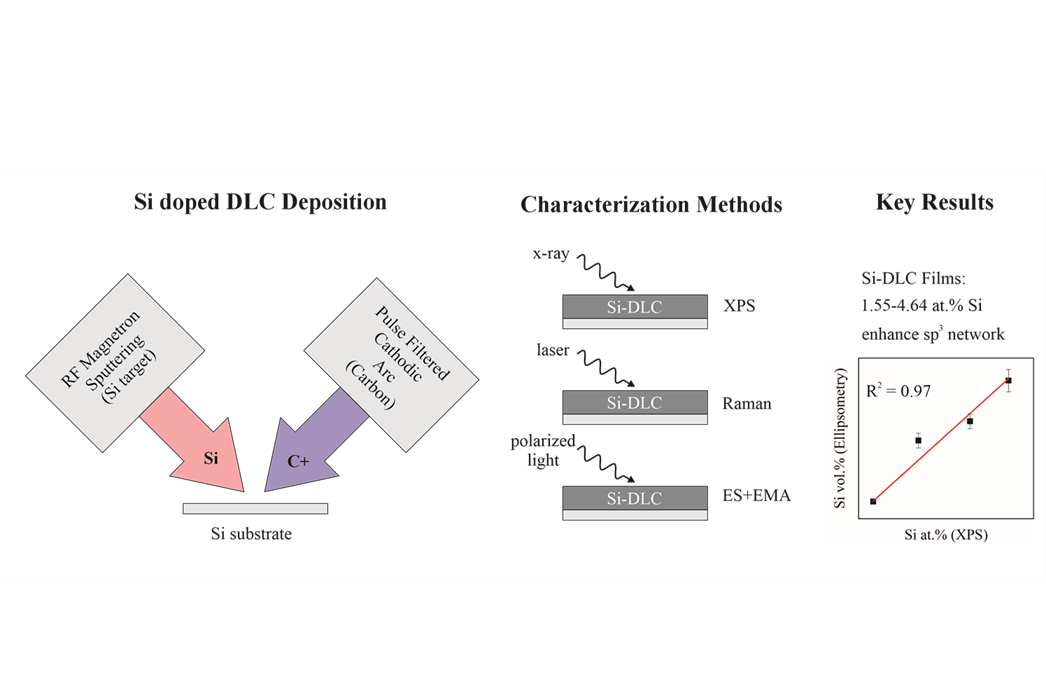
Diamond-like carbon (DLC) films offer exceptional mechanical and chemical properties but face limitations in adhesion and thermal stability, which restrict their broader applications. Current characterization methods for silicon-doped DLC films rely on destructive techniques, which pose challenges for industrial quality control. We investigate the effects of low-level silicon doping on the microstructure and optical properties of DLC while developing a non-destructive quantification method. Films were synthesized by co-deposition combining pulsed filtered cathodic vacuum arc and RF magnetron sputtering. Silicon incorporation was controlled by varying RF power up to 30 W. Characterization employed X-ray photoelectron spectroscopy (XPS), Raman spectroscopy, and spectroscopic ellipsometry, yielding silicon concentrations of 1.55 at.% to 4.64 at.% as determined by XPS. Microstructural analysis reveals C–Si bond formation and strengthened tetrahedral bonding networks with reduced graphitic clusters upon silicon doping. Wavelength-averaged optical properties show systematic decreases in both extinction coefficient and refractive index with increasing silicon content. Spectroscopic ellipsometry combined with Bruggeman effective-medium approximation modeling achieved a strong linear correlation (R2 = 0.97) with XPS-measured silicon concentrations. This non-destructive quantification at sub-5 at.% silicon levels, beyond the sensitivity range of conventional destructive techniques, offers a practical route to industrial-scale quality control of Si‒DLC films.
Downloads
References
A. Grill, “Diamond-like carbon: state of the art,” Diamond and Related Materials, vol. 8, no. 2–5, pp. 428–434, 1999. DOI: https://doi.org/10.1016/S0925-9635(98)00262-3
B. Schultrich, "Tetrahedrally bonded amorphous carbon films I: Basics, structure and preparation," Springer Series in Materials Science, vol. 263. Berlin, Heidelberg: Springer, 2018. DOI: https://doi.org/10.1007/978-3-662-55927-7
J. Robertson, “Diamond-like amorphous carbon,” Materials Science and Engineering: R: Reports, vol. 37, no. 4–6, pp. 129–281, 2002. DOI: https://doi.org/10.1016/S0927-796X(02)00005-0
Q. Wei, R. J. Narayan, A. K. Sharma, J. Sankar, and J. Narayan, “Preparation and mechanical properties of composite diamond-like carbon thin films,” Journal of Vacuum Science & Technology A, vol. 17, no. 6, pp. 3406–3414, 1999. DOI: https://doi.org/10.1116/1.582074
M. Azzi, P. Amirault, M. Paquette, J. E. Klemberg-Sapieha, and L. Martinu, “Corrosion performance and mechanical stability of 316L/DLC coating system: Role of interlayers,” Surface and Coatings Technology, vol. 204, no. 24, pp. 3986–3994, 2010. DOI: https://doi.org/10.1016/j.surfcoat.2010.05.004
X. Sui, J. Liu, S. Zhang, J. Yang, and J. Hao, “Microstructure, mechanical and tribological characterization of CrN/DLC/Cr-DLC multilayer coating with improved adhesive wear resistance,” Applied Surface Science, vol. 439, pp. 24–32, 2018. DOI: https://doi.org/10.1016/j.apsusc.2017.12.266
Q. Zeng, and Z. Ning, “High-temperature tribological properties of diamond-like carbon films: A review,” Reviews on Advanced Materials Science, vol. 60, no. 1, pp. 276–292, 2021. DOI: https://doi.org/10.1515/rams-2021-0028
H. Sun, L. Yang, H. Wu, and L. Zhao, “Effects of element doping on the structure and properties of diamond-like carbon films: A review,” Lubricants, vol. 11, no. 4, p. 186, 2023. DOI: https://doi.org/10.3390/lubricants11040186
J. Peng, M. Yang, J. Zeng, D. Su, J. Liao, and M. Yick, “Influence of nitrogen doping on the thermal stability of hydrogenated amorphous diamond coating,” Thin Solid Films, vol. 709, p. 138188, 2020. DOI: https://doi.org/10.1016/j.tsf.2020.138188
N. Konkhunthot, C. Euaruksakul, P. Photongkam, and P. Wongpanya, “Characterization of diamond-like carbon (DLC) films deposited by filtered cathodic vacuum arc technique,” Journal of Metals, Materials and Minerals, vol. 23, no. 1, pp. 35–40, 2013.
P. Ratchayotee, A. Chingsungnoen, and P. Poolcharuansin, “Controlling titanium incorporation in hydrogenated amorphous carbon films via closed-loop feedback in reactive high power impulse magnetron sputtering,” Journal of Metals, Materials and Minerals, vol. 34, no. 4, p. 2114, 2024. DOI: https://doi.org/10.55713/jmmm.v34i4.2114
Y.-J. Jang, J.-I. Kim, W.-S. Kim, D. H. Kim, and J. Kim, “Thermal stability of Si/SiC/ta-C composite coatings and improvement of tribological properties through high-temperature annealing,” Scientific Reports, vol. 12, no. 1, p. 3536, 2022. DOI: https://doi.org/10.1038/s41598-022-07514-8
M. Rouhani, J. Hobley, F. Chau-Nan Hong, and Y.-R. Jeng, “In-situ thermal stability analysis of amorphous Si-doped carbon films,” Carbon, vol. 184, pp. 772–785, 2021. DOI: https://doi.org/10.1016/j.carbon.2021.08.075
X. Wang, X. Zhang, C. Wang, Y. Lu, and J. Hao, “High temperature tribology behavior of silicon and nitrogen doped hydrogenated diamond-like carbon (DLC) coatings,” Tribology International, vol. 175, p. 107845, 2022. DOI: https://doi.org/10.1016/j.triboint.2022.107845
S. M. Fayed, D. Chen, S. Li, Y. Zhou, H. Wang, and M. M. Sadawy, “Corrosion behavior and passive stability of multilayer DLC-Si coatings,” Surface and Coatings Technology, vol. 431, p. 128001, 2022. DOI: https://doi.org/10.1016/j.surfcoat.2021.128001
D. Bociaga, A. Sobczyk-Guzenda, P. Komorowski, J. Balcerzak, K. Jastrzębski, K. Przybyszewska, and A. Kaczmarek, “Surface characteristics and biological evaluation of Si-DLC coatings fabricated using magnetron sputtering method on Ti6Al7Nb substrate,” Nanomaterials, vol. 9, no. 6, p. 812, 2019. DOI: https://doi.org/10.3390/nano9060812
Z. Yu, J. Shang, Q. Wang, H. Zheng, H. Mei, D. Zhao, X. Liu, J. Ding, and J. Zheng, “Influence of Si content on the microstructure and properties of hydrogenated amorphous carbon films deposited by magnetron sputtering technique,” Coatings, vol. 15, no. 7, p. 793, 2025. DOI: https://doi.org/10.3390/coatings15070793
H. Nakazawa, R. Kamata, and S. Okuno, “Deposition of silicon-doped diamond-like carbon films by plasma-enhanced chemical vapor deposition using an intermittent supply of organosilane,” Diamond and Related Materials, vol. 51, pp. 7–13, 2015. DOI: https://doi.org/10.1016/j.diamond.2014.10.010
T. F. Zhang, Z. X. Wan, J. C. Ding, S. Zhang, Q. M. Wang, and K. H. Kim, “Microstructure and high-temperature tribological properties of Si-doped hydrogenated diamond-like carbon films,” Applied Surface Science, vol. 435, pp. 963–973, 2018. DOI: https://doi.org/10.1016/j.apsusc.2017.11.194
G. G. Politano, and C. Versace, “Spectroscopic ellipsometry: Advancements, applications and future prospects in optical characterization,” Spectroscopy Journal, vol. 1, no. 3, pp. 163–181, 2023. DOI: https://doi.org/10.3390/spectroscj1030014
M. T. Othman, J. A. Lubguban, A. A. Lubguban, S. Gangopadhyay, R. D. Miller, W. Volksen, and H.-C. Kim, “Characterization of porous low-k films using variable angle spectroscopic ellipsometry,” Journal of Applied Physics, vol. 99, no. 8, p. 083503, 2006. DOI: https://doi.org/10.1063/1.2189018
Y. Liu, J. Qiu, and L. Liu, “Applicability of the effective medium approximation in the ellipsometry of randomly micro-rough solid surfaces,” Optics Express, vol. 26, no. 13, pp. 16560‒16571, 2018. DOI: https://doi.org/10.1364/OE.26.016560
W. J. Li, Z. R. Song, Y. H. Yu, X. Wang, S. C. Zou, and D. S. Shen, “sp3/sp2 ratio in amorphous-carbon thin film by spectroscopic ellipsometry,” Journal of Applied Physics, vol. 94, no. 1, pp. 284–287, 2003. DOI: https://doi.org/10.1063/1.1576304
I. Yaremchuk, Š. Meškinis, V. Fitio, Y. Bobitski, K. Šlapikas, A. Čiegis, Z. Balevičius, A. Selskis, and S. Tamulevičius, “Spectro-ellipsometric characterization and modeling of plasmonic diamond-like carbon nanocomposite films with embedded Ag nanoparticles,” Nanoscale Research Letters, vol. 10, no. 1, p. 157, 2015. DOI: https://doi.org/10.1186/s11671-015-0854-y
A. Zimmer, O. A. Williams, K. Haenen, and H. Terryn, “Optical properties of heavily boron-doped nanocrystalline diamond films studied by spectroscopic ellipsometry,” Applied Physics Letters, vol. 93, no. 13, p. 131910, 2008. DOI: https://doi.org/10.1063/1.2990679
A. G. Shard, “Practical guides for x-ray photoelectron spectroscopy: Quantitative XPS,” Journal of Vaccuum Science & Technology A, vol. 38, no. 4, p. 041201, 2020. DOI: https://doi.org/10.1116/1.5141395
G. Greczynski, and L. Hultman, “A step-by-step guide to perform x-ray photoelectron spectroscopy,” Journal of Applied Physics, vol. 132, no. 1, p. 011101, 2022. DOI: https://doi.org/10.1063/5.0086359
J. Choi, M. Kawaguchi, T. Kato, and M. Ikeyama, “Deposition of Si‒DLC film and its microstructural, tribological and corrosion properties,” Microsystem Technologies, vol. 13, no. 8–10, pp. 1353–1358, 2007. DOI: https://doi.org/10.1007/s00542-006-0368-8
Š. Meškinis, A. Vasiliauskas, M. Andrulevičius, D. Peckus, S. Tamulevičius, and K. Viskontas, “Diamond like carbon films containing Si: Structure and nonlinear optical properties,” Materials, vol. 13, no. 4, p. 1003, 2020. DOI: https://doi.org/10.3390/ma13041003
P. R. Riley, P. Joshi, N. Khosla, R. J. Narayan, and J. Narayan, “Formation of Q-carbon with wafer scale integration,” Carbon, vol. 196, pp. 972–978, 2022. DOI: https://doi.org/10.1016/j.carbon.2022.06.003
P. R. Riley, P. Joshi, S. Azizi Machekposhti, R. Sachan, J. Narayan, and R. J. Narayan, “Enhanced vapor transmission barrier properties via silicon-incorporated diamond-like carbon coating,” Polymers, vol. 13, no. 20, p. 3543, 2021. DOI: https://doi.org/10.3390/polym13203543
A. C. Ferrari, and J. Robertson, “Interpretation of Raman spectra of disordered and amorphous carbon,” Physical Review B, vol. 61, no. 20, pp. 14095–14107, 2000. DOI: https://doi.org/10.1103/PhysRevB.61.14095
J. Wang, J. Pu, G. Zhang, and L. Wang, “Tailoring the structure and property of silicon-doped diamond-like carbon films by controlling the silicon content,” Surface and Coatings Technology, vol. 235, pp. 326–332, 2013. DOI: https://doi.org/10.1016/j.surfcoat.2013.07.061
G. J. Wan, P. Yang, R. K. Y. Fu, Y. F. Mei, T. Qiu, S. C. H. Kwok, J. P. Y. Ho, N. Huang, X. L. Wu, and P. K. Chu, “Characteristics and surface energy of silicon-doped diamond-like carbon films fabricated by plasma immersion ion implantation and deposition,” Diamond and Related Materials, vol. 15, no. 9, pp. 1276–1281, 2006. DOI: https://doi.org/10.1016/j.diamond.2005.09.042
Y. Lu, S. Wang, G. Huang, L. Xi, G. Qin, M. Zhu, and H. Chu, “Fabrication and applications of the optical diamond-like carbon films: a review,” Journal of Materials Science, vol. 57, no. 6, pp. 3971–3992, 2022. DOI: https://doi.org/10.1007/s10853-021-06818-w
D. P. Dowling, K. Donnelly, M. Monclus, and M. McGuinness, “The use of refractive index as a measure of diamond-like carbon film quality,” Diamond and Related Materials, vol. 7, no. 2–5, pp. 432–434, 1998. DOI: https://doi.org/10.1016/S0925-9635(97)00233-1
H. G. Tompkins, "Optical components and the simple PCSA (polarizer, compensator, sample, analyzer) ellipsometer," in Handbook of Ellipsometry, H. G. Tompkins and E. A. Irene, Eds. Norwich, NY: William Andrew Publishing, 2005, pp. 299-328. DOI: https://doi.org/10.1016/B978-081551499-2.50006-X
D. E. Aspnes, J. B. Theeten, and F. Hottier, “Investigation of effective-medium models of microscopic surface roughness by spectroscopic ellipsometry,” Physical Review B, vol. 20, no. 8, pp. 3292–3302, 1979. DOI: https://doi.org/10.1103/PhysRevB.20.3292
Downloads
Published
How to Cite
Issue
Section
Categories
License
Copyright (c) 2026 Journal of Metals, Materials and Minerals

This work is licensed under a Creative Commons Attribution-NonCommercial-NoDerivatives 4.0 International License.
Authors who publish in this journal agree to the following terms:
- Authors retain copyright and grant the journal right of first publication with the work simultaneously licensed under a Creative Commons Attribution License that allows others to share the work with an acknowledgment of the work's authorship and initial publication in this journal.
- Authors are able to enter into separate, additional contractual arrangements for the non-exclusive distribution of the journal's published version of the work (e.g., post it to an institutional repository or publish it in a book), with an acknowledgment of its initial publication in this journal.