Effect of garnet incorporation on the functional properties of sunscreens
DOI:
https://doi.org/10.55713/jmmm.v36i1.2406คำสำคัญ:
garnet, sunscreen, UV, SPF, water resistanceบทคัดย่อ
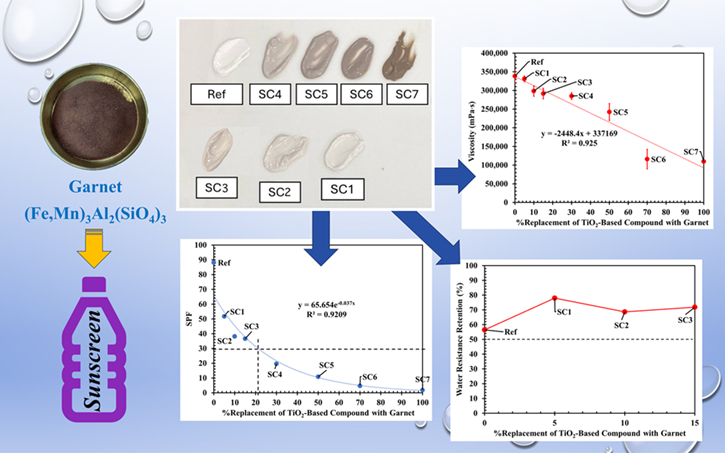
Garnet, a silicate mineral, was investigated as a replacement for the TiO2-based compound in sunscreen formulations. Samples containing garnet were evaluated for color shade, viscosity, sun protection factor (SPF), and water resistance. Substituting the TiO2-based compound with garnet reduced both viscosity and SPF but markedly enhanced water resistance. This improvement is attributed to the physical reinforcement provided by garnet particles, which strengthen the sunscreen film and reduce wash-off under water exposure. Garnet incorporation also altered the product’s appearance from white to a darker brownish-beige tone, improving visual compatibility with a wider range of skin tones.
Downloads
เอกสารอ้างอิง
R. Nasution, R. Azura, M. Bahi, N. B. Maulydia, R. A. Bastian, M. M. Hilda, and M. Marianne, "In silico investigation of γ-Sitosterol isolated from the ethanol extract of artocarpus camansi leaves as a sunscreen agent," Indonesian Journal of Chemistry, Article vol. 25, no. 1, pp. 221-231, 2025. DOI: https://doi.org/10.22146/ijc.99792
D. M. Manikrao, and D. S. Laxman, "Sunscreens: A review," Pharmacognosy Journals, vol. 8, no. 3, 2016. DOI: https://doi.org/10.5530/pj.2016.3.1
C. Corinaldesi, E. Damiani, F. Marcellini, C. Falugi, L. Tiano, F. Bruge, and R. Danovaro, "Sunscreen products impair the early developmental stages of the sea urchin Paracentrotus lividus," Scientific Reports, vol. 7, no. 1, p. 7815, 2017. DOI: https://doi.org/10.1038/s41598-017-08013-x
D. Olson, "The Truth About Corals and Sunscreen." [Online]. Available: https://ocean.si.edu/ecosystems/coral-reefs/truth-about-corals-and-sunscreen.
US National Ocean Service, "Skincare chemicals and coral reefs." [Online]. Available: https://oceanservice.noaa.gov/news/ sunscreen-corals.html.
R.V. Dietrich, "Garnet," in Britannica, ed, 2025.
D. C. Stewart, "Garnet (mineral)," in Salem Press Encyclopedia of Science, ed, 2023.
N. F. A. Jamaludin, K. Muthusamy, N. N. Isa, M. F. Md Jaafar, and N. Ghazali, "Use of spent garnet in industry: A review," Materials Today: Proceedings, vol. 48, pp. 728-733, 2022. DOI: https://doi.org/10.1016/j.matpr.2021.02.210
C. Balasubramaniyan, K. Rajkumar, B. Suresh Krishnan, and A. Arun, "Performance evaluation of abrasive water jet machining on spent garnet reinforced hybrid composite," Materials Today: Proceedings, vol. 98, pp. 16-20, 2024. DOI: https://doi.org/10.1016/j.matpr.2023.08.306
G.-W. Joo, T.-M. Oh, H.-J. Hwang, and G.-C. Cho, "Evaluating the efficacy of recycled garnet abrasives in enhancing hard rock cutting performance of abrasive waterjet systems," International Journal of Rock Mechanics and Mining Sciences, vol. 167, p. 105407, 2023.. DOI: https://doi.org/10.1016/j.ijrmms.2023.105407
N. F. A. Jamaludin, K. Muthusamy, M. F. Md Jaafar, Z. Ali, Z. Abdul Majid, and M. A. Ismail, "Preliminary investigation on spent garnet as a novel supplementary cementitious material," Construction and Building Materials, vol. 451, p. 138789, 2024. DOI: https://doi.org/10.1016/j.conbuildmat.2024.138789
K. R. Usman, M. R. Hainin, M. K. Idham, M. Satar, M. N. M. Warid, A. Usman, Z. H. Al-Saffar, and M. A. Bilema, "A comparative assessment of the physical and microstructural properties of waste garnet generated from automated and manual blasting process," Case Studies in Construction Materials, vol. 14, p. e00474, 2021. DOI: https://doi.org/10.1016/j.cscm.2020.e00474
H. L. Muttashar, N. B. Ali, M. A. Mohd Ariffin, and M. W. Hussin, "Microstructures and physical properties of waste garnets as a promising construction materials," Case Studies in Construction Materials, vol. 8, pp. 87-96, 2018. DOI: https://doi.org/10.1016/j.cscm.2017.12.001
K. Kunchariyakun, and P. Sukmak, "Utilization of garnet residue in radiation shielding cement mortar," Construction and Building Materials, vol. 262, p. 120122, 2020. DOI: https://doi.org/10.1016/j.conbuildmat.2020.120122
T. Smijs, and S. Pavel, "Titanium dioxide and zinc oxide nano-particles in sunscreens: Focus on their safety and effectiveness," Nanotechnol Sci Appl, vol. 4, pp. 95–112, 2011. DOI: https://doi.org/10.2147/NSA.S19419
US Food and Drug Administration, "Guidance for industry labeling and effectiveness testing: sunscreen drug products for overthe-counter human use — small entity compliance guide." [Online]. Available: https://www.fda.gov/media/85172/ download
A. J. Addae and P. S. Weiss, "Standardizing the white cast potential of sunscreens with metal oxide ultraviolet filters," Accounts of Materials Research, vol. 5, no. 4, pp. 392-399, 2024. DOI: https://doi.org/10.1021/accountsmr.4c00004
K. Geoffrey, A. N. Mwangi, and S. M. Maru, "Sunscreen products: Rationale for use, formulation development and regulatory considerations," Saudi Pharmaceutical Journal, vol. 27, no. 7, pp. 1009-1018, 2019. DOI: https://doi.org/10.1016/j.jsps.2019.08.003
ISO 23675: 2021 Cosmetics — Sun protection test methods — In Vitro determination of Sun Protection Factor (SPF), International Organization for Standardization, Switzerland, 2021.
ISO 24443:2021 Cosmetics — Determination of sunscreen UVA photoprotection in vitro, International Organization for Standardization, Switzerland, 2021.
A. Springsteen, R. Yurek, M. Frazier, and K. F. Carr, "In vitro measurement of sun protection factor of sunscreens by diffuse transmittance," Analytica Chimica Acta, vol. 380, no. 2, pp. 155-164, 1999. DOI: https://doi.org/10.1016/S0003-2670(98)00577-7
J. F. Dlugos, "A Spectroscopic In vitro method for the calculation of sunscreen spf values." [Online]. Available: https://resources.
perkinelmer.com/lab-solutions/resources/docs/APP_Spectroscopic-
InVitro-Sunscreen-SPF-Values.pdf
W. Zou, R. Ramanathan, S. Urban, C. Sinclair, K. King, R. Tinker, and V. Bansal, "Sunscreen testing: A critical perspective and future roadmap," TrAC Trends in Analytical Chemistry, vol. 157, p. 116724, 2022. DOI: https://doi.org/10.1016/j.trac.2022.116724
ISO 16217:2020 Cosmetics — Sun protection test methods — Water immersion procedure for determining water resistance, International Organization for Standardization, Switzerland, 2020.
M. Pissavini, V. Alard, U. Heinrich, K. Jenni, V. Perier, V. Tournier, D. Lutz, M. Meloni, D. Kockott, L. Ferrero, B. Gonzalez, L. Zastrow, and H. Tronnier, "In vitro assessment of water resistance of sun care products: A reproducible and optimized in vitro test method," International journal of cosmetic science, vol. 29, pp. 451-460, 2008. DOI: https://doi.org/10.1111/j.1468-2494.2007.00407.x
M. Rincón-Fontán, L. Rodríguez-López, X. Vecino, J. M. Cruz, and A. B. Moldes, "Design and characterization of greener sun-screen formulations based on mica powder and a biosurfactant extract," Powder Technology, vol. 327, pp. 442-448, 2018. DOI: https://doi.org/10.1016/j.powtec.2017.12.093
J. Kim, J. Choi, S. Choi, W. Kim, and S. Lee, "Study on the dependence of sun protection factor on particle size distribution of mica using gravitational field-flow fractionation: Dependence of SPF on particle size distribution of mica," Bulletin of the Korean Chemical Society, vol. 41, 2019. DOI: https://doi.org/10.1002/bkcs.11920
Y.-H. Chang, P.-H. Huang, B.-Y. Wu, and S.-W. Chang, "A study on the color change benefits of sustainable green building materials," Construction and Building Materials, vol. 83, pp. 1-6, 2015. DOI: https://doi.org/10.1016/j.conbuildmat.2015.02.065
M. Xaba, S. Mapukata, and T. Mokhena, "ChatGPT based method for obtaining repeatable and quantitative colorimetric measurements," MethodsX, vol. 15, p. 103525, 2025. DOI: https://doi.org/10.1016/j.mex.2025.103525
Colormine. https://colormine.org/convert/rgb-to-lab (accessed 2025).
M. Ullah, J. Mir, and A. Ahmad, "Assessing the influence of cement replacement materials on concrete performance through image processing," Measurement, vol. 256, p. 118014, 2025. DOI: https://doi.org/10.1016/j.measurement.2025.118014
L. Tan, and J. Jiang, "Chapter 13 - Image processing basics," in Digital Signal Processing (Third Edition), L. Tan, and J. Jiang Eds.: Academic Press, 2019, pp. 649-726. DOI: https://doi.org/10.1016/B978-0-12-815071-9.00013-0
Y. Arai, T. Tomai, G. Seong, R. Ito, A. Yoko, and T. Adschiri, "Unified formulation of particle-size-dependent viscosity for Newtonian dispersions of micro- and nanoparticles," Journal of Molecular Liquids, vol. 411, p. 125659, 2024. DOI: https://doi.org/10.1016/j.molliq.2024.125659
C. Wang, J. Zhang, and L. Lei, "Effect of particle size on silicon
nitride ceramic slurry by stereolithography," Journal of Wuhan University of Technology- Materials Science Edition, vol. 38, no. 3, pp. 514-519, 2023. DOI: https://doi.org/10.1007/s11595-023-2726-0
World Health Organization (WHO). "Radiation: Protecting against skin cancer." https://www.who.int/news-room/questions- and-answers/item/radiation-protecting-against-skin-cancer (accessed 2025).
Y. Etafa Tasisa, T. Kumar Sarma, R. Krishnaraj, and S. Sarma, "Band gap engineering of titanium dioxide (TiO2) nanoparticles prepared via green route and its visible light driven for environmental remediation," Results in Chemistry, vol. 11, p. 101850, 2024.. DOI: https://doi.org/10.1016/j.rechem.2024.101850
Y. Kou, D. Liao, T. Du, L. Peng, and Y. Wang, "Zincophilic-hydrophobic fluorophlogopite mica protective layer enables dendrite-free and anticorrosive Zn anodes," Chemical Engineering Journal, vol. 508, p. 160888, 2025. DOI: https://doi.org/10.1016/j.cej.2025.160888
M. Zhu, and Y. Guo, "Combined colorimetry and spectroscopy: A novel nondestructive method for identifying orange garnet species," Spectrochimica Acta Part A: Molecular and Bio-molecular Spectroscopy, vol. 341, p. 126461, 2025. DOI: https://doi.org/10.1016/j.saa.2025.126461
M. R. M. Izawa, E. A. Cloutis, T. Rhind, S. A. Mertzman, J. Poitras, D. M. Applin, and P. Mann, "Spectral reflectance (0.35–2.5 µm) properties of garnets: Implications for remote sensing detection and characterization," Icarus, vol. 300, pp. 392-410, 2018. DOI: https://doi.org/10.1016/j.icarus.2017.09.005
C. Couteau, D. Alexandre, C. Clotilde, and L. J. M. and Coiffard, "Influence of the hydrophilic–lipophilic balance of sunscreen emulsions on their water resistance property," Drug Development and Industrial Pharmacy, vol. 38, no. 11, pp. 1405-1407, 2012. DOI: https://doi.org/10.3109/03639045.2011.653362
F. Keshavarzi, N. Knudsen, N. M. Komjani, M. F. Ebbesen, J. Brewer, S. Jafarzadeh, and E. Thormann, "Enhancing the sweat resistance of sunscreens," Skin Research and Technology, vol. 28, no. 2, pp. 225-235, 2022. DOI: https://doi.org/10.1111/srt.13115
I. Fenoglio, B. Fubini, E. M. Ghibaudi, and F. Turci, "Multiple aspects of the interaction of biomacromolecules with inorganic surfaces," Advanced Drug Delivery Reviews, vol. 63, no. 13, pp. 1186-1209, 2011. DOI: https://doi.org/10.1016/j.addr.2011.08.001
Z. Zhang, C. Fan, F. Jiao, and Q. Wei, "Garnet in the flotation of fine-grained lepidolite: Strengthening role and action mechanism," Colloids and Surfaces A: Physicochemical and Engineering Aspects, vol. 716, p. 136730, 2025. DOI: https://doi.org/10.1016/j.colsurfa.2025.136730
J. Poon, D. C. Madden, M. H. Wood, R. van Tol, H. Sonke, and S. M. Clarke, "Surface chemistry of almandine garnet," The Journal of Physical Chemistry C, vol. 124, no. 9, pp. 5099-5117, 2020. DOI: https://doi.org/10.1021/acs.jpcc.9b08951
Y. Xi, Y. Qi, Z. Mao, Z. Yang, and J. Zhang, "Surface hydro-phobic modification of TiO2 and its application to preparing PMMA/TiO2 composite cool material with improved hydro-phobicity and anti-icing property," Construction and Building Materials, vol. 266, p. 120916, 2021. DOI: https://doi.org/10.1016/j.conbuildmat.2020.120916
N. Sakai, A. Fujishima, T. Watanabe, and K. Hashimoto, "Quantitative evaluation of the photoinduced hydrophilic conversion properties of TiO2 thin film surfaces by the reciprocal of contact angle," The Journal of Physical Chemistry B, vol. 107, no. 4, pp. 1028-1035, 2003. DOI: https://doi.org/10.1021/jp022105p
C.-Y. Wu, K.-J. Tu, J.-P. Deng, Y.-S. Lo, and C.-H. Wu, "Markedly enhanced surface hydroxyl groups of TiO2 nano-particles with superior water-dispersibility for photocatalysis," Materials, vol. 10, no. 5, p. 566, 2017. DOI: https://doi.org/10.3390/ma10050566
Y. Jiang, F. Xu, K. Liu, and Q. Feng, "Surface-modified garnet particles for reinforcing epoxy composites," Minerals, vol. 8, no. 5, p. 217, 2018. DOI: https://doi.org/10.3390/min8050217
ดาวน์โหลด
เผยแพร่แล้ว
วิธีการอ้างอิง
การอนุญาต
ลิขสิทธิ์ (c) 2025 วารสารโลหะ, วัสดุ และแร่

This work is licensed under a Creative Commons Attribution-NonCommercial-NoDerivatives 4.0 International License.
Authors who publish in this journal agree to the following terms:
- Authors retain copyright and grant the journal right of first publication with the work simultaneously licensed under a Creative Commons Attribution License that allows others to share the work with an acknowledgment of the work's authorship and initial publication in this journal.
- Authors are able to enter into separate, additional contractual arrangements for the non-exclusive distribution of the journal's published version of the work (e.g., post it to an institutional repository or publish it in a book), with an acknowledgment of its initial publication in this journal.