ZnO-enhanced PVA/HPMC electrospun fibers as multifunctional wound dressing materials
-
DOI:
https://doi.org/10.55713/jmmm.v37i1.2562Keywords:
Nanocomposite fibrous mats, Electrospinning technique, Wound exudate management, Antibacterial performance, Mechanical propertiesAbstract
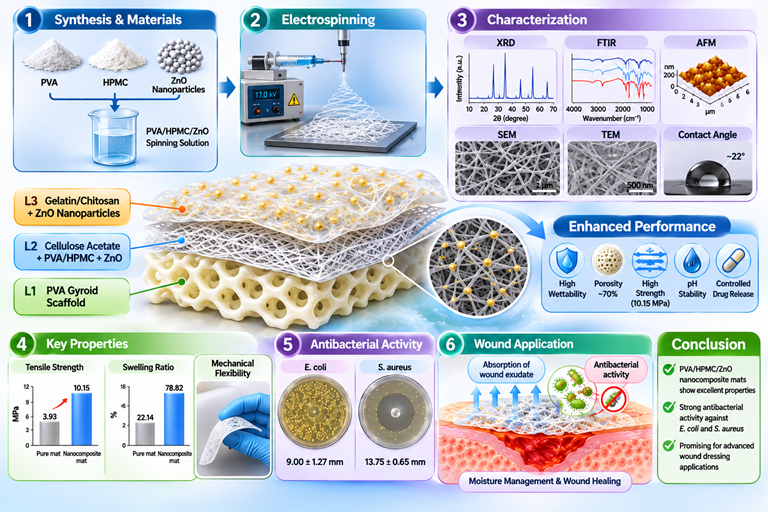
Electrospun fibers are highly promising for wound dressings due to their high surface area, porosity, and capacity to carry bioactive agents. In this study, polyvinyl alcohol (PVA)/hydroxypropyl methylcellulose (HPMC)/Zinc Oxide (ZnO) nanocomposite fibrous mats were developed for wound healing applications. ZnO nanoparticles synthesized via a solution combustion method were successfully incorporated into the polymer matrix and electrospun onto nonwoven fiber paper. X-ray diffraction (XRD) and Fourier transform infrared spectroscopy (FTIR) confirmed ZnO integration and enhanced polymer-nanoparticle interactions. Atomic force microscopy revealed increased surface roughness, while scanning electron microscopy confirmed that ZnO incorporation maintained uniform, bead-free fibers with only a slight increase in average fiber diameter, suggesting improved interactions with wound exudates and bacteria. Mechanical testing revealed substantial enhancements: tensile strength increased from 3.93 ± 0.23 MPa to 10.15 ± 1.02 MPa, Young’s modulus increased from 0.97 ± 0.18 MPa to 1.91 ± 0.33 MPa, and elongation at break increased from 10.60% to 18.85%, indicating improved flexibility and toughness. The contact angle ranged from 18.22° to 43.15°, showing balanced hydrophilicity, while the swelling ratio increased from 22.14 ± 3.27% to 78.82 ± 1.55%, supporting effective exudate absorption. Antibacterial activity was enhanced, with inhibition zones expanding from 9.00 ± 1.27 mm to 13.00 ± 0.79 mm for E. coli and from 13.75 ± 0.65 mm to 17.88 ± 0.25 mm for S. aureus. These findings demonstrate that PVA/HPMC/ ZnO nanocomposite fibrous mats combine enhanced mechanical strength, moisture management, and antibacterial performance, highlighting their strong potential for advanced wound dressing applications.
Downloads
References
H. Ragupathi, M. M. Pushparaj, S. M. Gopi, D. K. Govindarajan, and K. Kandaswamy, “Biofilm matrix: a multifaceted layer of biomolecules and a defensive barrier against antimicrobials,” Archives of Microbiology, vol. 206, no. 11, p. 432, 2024. DOI: https://doi.org/10.1007/s00203-024-04157-3
R. S.-Y. Wong, T. Tan, A. S.-R. Pang, and D. K. Srinivasan, “The role of cytokines in wound healing: from mechanistic insights to therapeutic applications,” Exploration of Immunology, vol. 5, p. 1003183, 2025. DOI: https://doi.org/10.37349/ei.2025.1003183
J. G. Powers, L. M. Morton, and T. J. Phillips, “Dressings for chronic wounds,” Dermatologic Therapy, vol. 26, no. 3, pp. 197–206, 2013. DOI: https://doi.org/10.1111/dth.12055
D. C. Aduba, and H. Yang, “Polysaccharide fabrication platforms and biocompatibility assessment as candidate wound dressing materials,” Bioengineering, vol. 4, no. 1, p. 1, 2017. DOI: https://doi.org/10.3390/bioengineering4010001
F. Jonidi Shariatzadeh, S. Currie, S. Logsetty, R. Spiwak, and S. Liu, “Enhancing wound healing and minimizing scarring: A comprehensive review of nanofiber technology in wound dressings,” Progress in Materials Science, vol. 147, p. 101350, 2025. DOI: https://doi.org/10.1016/j.pmatsci.2024.101350
M. S. Ahmed, S. Yun, H.-Y. Kim, S. Ko, M. Islam, and K.-W. Nam, “Hydrogels and microgels: Driving revolutionary innovations in targeted drug delivery, strengthening infection management, and advancing tissue repair and regeneration,” Gels, vol. 11, no. 3, p. 179, 2025. DOI: https://doi.org/10.3390/gels11030179
M. Ribeiro, M. Simões, C. Vitorino, and F. Mascarenhas-Melo, “Hydrogels in cutaneous wound healing: Insights into characterization, properties, formulation and therapeutic potential,” Gels, vol. 10, no. 3, p. 188, 2024. DOI: https://doi.org/10.3390/gels10030188
M. P. Ferraz, “Wound dressing materials: Bridging material science and clinical practice,” Applied Sciences, vol. 15, no. 4, p. 1725, 2025. DOI: https://doi.org/10.3390/app15041725
J.-C. Park, T. Ito, K.-O. Kim, K.-W. Kim, B.-S. Kim, M.-S. Khil, H.-Y. Kim, and I.-S. Kim, “Electrospun poly(vinyl alcohol) nanofibers: Effects of degree of hydrolysis and enhanced water stability,” Polymer Journal, vol. 42, no. 3, pp. 273–276, 2010. DOI: https://doi.org/10.1038/pj.2009.340
Y. Zhou, Q. Dong, H. Yang, X. Liu, X. Yin, Y. Tao, Z. Bai, and W. Xu, “Photocrosslinked maleilated chitosan/methacrylated poly(vinyl alcohol) bicomponent nanofibrous scaffolds for use as potential wound dressings,” Carbohydrate Polymers, vol. 168, pp. 220–226, 2017. DOI: https://doi.org/10.1016/j.carbpol.2017.03.044
R.-A. Vlad, A. Pintea, C. Pintea, E.-M. Redai, P. Antonoaea, M. Birsan, and A. Ciurba, “Hydroxypropyl methylcellulose-A key excipient in pharmaceutical drug delivery systems,” Pharmaceutics, vol. 17, no. 6, p. 784, 2025. DOI: https://doi.org/10.3390/pharmaceutics17060784
N. Palani, P. Vijayakumar, P. Monisha, S. Ayyadurai, and S. Rajadesingu, “Electrospun nanofibers synthesized from polymers incorporated with bioactive compounds for wound healing,” Journal of Nanobiotechnology, vol. 22, no. 1, p. 211, 2024. DOI: https://doi.org/10.1186/s12951-024-02491-8
Y. Wang, J. Liu, T. Wang, L.-Z. Liu, C. Tian, Y. Cui, W. Shao, X. Hua, Y. Shi, and Y. Wang, “Antibacterial properties and mechanism of nanometer zinc oxide composites,” Food Packaging and Shelf Life, vol. 40, p. 101167, 2023. DOI: https://doi.org/10.1016/j.fpsl.2023.101167
C. R. Mendes, G. Dilarri, C. F. Forsan, V. de. Moraes, R. Sapata, P. R. M. Lopes, P. B. de. Moraes, R. N. Montagnolli, H. Ferreira, and E. D. Bidoia, “Antibacterial action and target mechanisms of zinc oxide nanoparticles against bacterial pathogens,” Scientific Reports, vol. 12, no. 1, p. 2658, 2022. DOI: https://doi.org/10.1038/s41598-022-06657-y
B. da Silva, M. P. Abucafy, E. B. Manaia, J. A. O. Junior, B. G. Chiari-Andreo, R. C. R. Pietro, and L. A. Chiavacci, “Relationship between structure and antimicrobial activity of zinc oxide nanoparticles: An overview,” International Journal of Nano-medicine, vol. 14, pp. 9395–9410, 2019. DOI: https://doi.org/10.2147/IJN.S216204
P. P. Mahamuni-Badiger, P. M. Patil, M. V. Badiger, P. R. Patel, B. S. Thorat-Gadgit, A. Pandit, and R. A. Bohara, “Biofilm formation to inhibition: Role of zinc oxide-based nanoparticles,” Materials Science and Engineering: C, vol. 108, p. 110319, 2020. DOI: https://doi.org/10.1016/j.msec.2019.110319
L. K. Sellappan, and S. Manoharan, “Fabrication of bioinspired keratin/sodium alginate based biopolymeric mat loaded with herbal drug and green synthesized zinc oxide nanoparticles as a dual drug antimicrobial wound dressing,” International Journal of Biological Macromolecules, vol. 259, p. 129162, 2024. DOI: https://doi.org/10.1016/j.ijbiomac.2023.129162
S. Manoharan, P. Balakrishnan, and L. K. Sellappan, “Fabrication of highly flexible biopolymeric chitosan/agarose based bioscaffold with Matricaria recutita herbal extract for antimicrobial wound dressing applications,” International Journal of Biological Macromolecules, vol. 281, p. 136195, 2024. DOI: https://doi.org/10.1016/j.ijbiomac.2024.136195
L. K. Sellappan, S. Mishra, S. Sundaresan, T. Rathinavelan, and S. Majumdar, “Multifunctional NiO-curcumin nanocomposite-loaded chitosan-alginate scaffolds for enhanced bone tissue regeneration and antibacterial activity,” Journal of Drug Delivery Science and Technology, vol. 110, p. 107114, 2025. DOI: https://doi.org/10.1016/j.jddst.2025.107114
K. P. Greeshma, S. Muthulingam, R. Thamizselvi, and D. B. Sen, “Antimicrobial studies and characterization of ZnO nanoparticles by chemical method,” GSC Advanced Research and Reviews, vol. 8, pp. 071-077, 2021. DOI: https://doi.org/10.30574/gscarr.2021.8.2.0150
G. Nagaraju, G. C. Shivaraju, G. Banuprakash, and D. Rangappa, “Photocatalytic activity of ZnO nanoparticles: Synthesis via solution combustion method,” Materials Today: Proceedings, vol. 4, pp. 11700‒11705, 2017. DOI: https://doi.org/10.1016/j.matpr.2017.09.085
R. Kumar, A. Umar, G. Kumar, and H. S. Nalwa, “Antimicrobial properties of ZnO nanomaterials: A review,” Ceramics International, vol. 43, no. 5, pp. 3940‒3961, 2017 DOI: https://doi.org/10.1016/j.ceramint.2016.12.062
B. Qu, Z. Xiao, and Y. Luo, “Sustainable nanotechnology for
food preservation: Synthesis, mechanisms, and applications of zinc oxide nanoparticles,” Journal of Agriculture and Food Research, vol. 19, p. 101743, 2025. DOI: https://doi.org/10.1016/j.jafr.2025.101743
S. -E. Jin, and H.-E. Jin, “Antimicrobial activity of zinc oxide nano/microparticles and their combinations against pathogenic microorganisms for biomedical applications: From physico-chemical characteristics to pharmacological aspects,” Nanomaterials, vol. 11, no. 2, p. 263, 2021. DOI: https://doi.org/10.3390/nano11020263
U. Pal, C. Kim, N. Jadhav, and Y. Kang, “Ultrasound-assisted synthesis of mesoporous ZnO nanostructures of different porosities,” Journal of Physical Chemistry C, vol. 113, pp. 14676‒14680, 2009. DOI: https://doi.org/10.1021/jp904377n
S. Jiang, K. Lin, and M. Cai, “ZnO nanomaterials: Current advancements in antibacterial mechanisms and applications,” Frontiers in Chemistry, vol. 8, p. 580, 2020. DOI: https://doi.org/10.3389/fchem.2020.00580
V. Sethi, M. Kaur, A. Thakur, P. Rishi, and A. Kaushik, “Unravelling the role of hemp straw derived cellulose in CMC/ PVA hydrogel for sustained release of fluoroquinolone antibiotic,” International Journal of Biological Macromolecules, vol. 222, pp. 844‒855, 2022. DOI: https://doi.org/10.1016/j.ijbiomac.2022.09.212
I. M. Jipa, A. Stoica, M. Stroescu, L.-M. Dobre, T. Dobre, S. Jinga, and C. Tardei, “Potassium sorbate release from poly(vinyl alcohol)-bacterial cellulose films,” Chemical Papers, vol. 66, pp. 138–143, 2012. DOI: https://doi.org/10.2478/s11696-011-0068-4
P. Mondal, M. Mondal, J. Chakraborty, N. Sing, B. Ghosh, S. Ray, K. Mahali, “Advances in upcycling waste cellulose into functional materials: Strategies, challenges, and emerging applications—A comprehensive review,” Next Research, vol. 2, no. 4, p. 100768, 2025. DOI: https://doi.org/10.1016/j.nexres.2025.100768
C. Aumnate, N. Soatthiyanon, T. Makmoon, and P. Potiyaraj, “Polylactic acid/kenaf cellulose biocomposite filaments for melt extrusion based-3D printing,” Cellulose, vol. 28, pp. 8509‒8525, 2021. DOI: https://doi.org/10.1007/s10570-021-04069-1
U. Ejaz, R. Rashid, S. Ahmed, K. K. Narejo, A. Qasim, M. Sohail, S. T. Ali, J. T. Althakafy, A. K. Alanazi, H. M. Abo-Dief, and S. F. Moin, “Synthesis of methylcellulose-polyvinyl alcohol composite, biopolymer film and thermostable enzymes from sugarcane bagasse,” International Journal of Biological Macro-molecules, vol. 235, p. 123903, 2023. DOI: https://doi.org/10.1016/j.ijbiomac.2023.123903
F. Van den Berg, “Extracellular matrix,” in Fascia: The Tensional Network of the Human Body, R. Schleip, T. W. Findley, L. Chaitow, and P. A. Huijing, Eds. Oxford: Churchill Livingstone, 2012, pp. 165–170. DOI: https://doi.org/10.1016/B978-0-7020-3425-1.00058-1
L. Li, K. Crosby, M. Sawicki, L. L. Shaw, and Y. Wang “Effects of surface roughness of hydroxyapatite on cell attachment and proliferation,” Journal of Biotechnology & Biomaterials, vol. 2, p. 150, 2012. DOI: https://doi.org/10.4172/2155-952X.1000150
M. J. Dalby, N. Gadegaard, R. Tare, A. Andar, M. O. Riehle, P. Herzyk, C. D. W. Wilkinson, and R. O. C. Oreffo, “The control of human mesenchymal cell differentiation using nanoscale symmetry and disorder,” Nature Materials, vol. 6, no. 12, pp. 997–1003, 2007. DOI: https://doi.org/10.1038/nmat2013
E. S. Place, N. D. Evans, and M. M. Stevens, “Complexity in biomaterials for tissue engineering,” Nature Materials, vol. 8, no. 6, pp. 457–470, 2009. DOI: https://doi.org/10.1038/nmat2441
K. Menzies, and L. Jones, “The impact of contact angle on the biocompatibility of biomaterials,” Optometry and Vision Science, vol. 87, pp. 387–399, 2010. DOI: https://doi.org/10.1097/OPX.0b013e3181da863e
J. A. Ortiz, F. A. Sepulveda, S. Flores, M. Saavedra, S. Saez-Silva, T. Jimenez, P. Murgas, S. Troncoso, C. Sanhueza, M. T. Ulloa, L. P. Torre, M. Ahumada, T. Corrales, H. Palza, and P. A. Zapata, “Electrospun polyvinyl alcohol/sodium alginate nanocomposite dressings loaded with ZnO and bioglass: Characterization, antibacterial activity, and cytocompatibility,” Polymers, vol. 17, no. 16, p. 2185, 2025,
L. Ding, Q. Qi, S. Zhang, C. Ren, M. Deng, Z. Sun, R. Zhang, Q. Liu, S. Duan, X. Wang, and L. Wang “Hydroxypropyl methylcellulose reinforced collagen/ PVA composite hydrogel wound dressing with self-adaptive, hemostasis and antibacterial ability for wound healing,” International Journal of Biological Macromolecules, vol. 304, pt. 2, p. 140811, 2025. DOI: https://doi.org/10.1016/j.ijbiomac.2025.140811
J. A. Ortiz, F. A. Sepulveda, S. Flores, M. Saavedra, S. Saez-Silva, T. Jimenez, P. Murgas, S. Troncoso, C. Sanhueza, M. T. Ulloa, L. P. Torre, M. Ahumada, T. Corrales, H. Palza, and P. A. Zapata, “Electrospun polyvinyl alcohol/sodium alginate nanocomposite dressings loaded with ZnO and bioglass: Characterization, antibacterial activity, and cytocompatibility,” Polymers, vol. 17, no. 16, p. 2185, 2025. DOI: https://doi.org/10.3390/polym17162185
R. M. Abdel-Rahman, J. Frankova, R. Sklenarova, L. Kapralkova, I. Kelnar, and A. M. Abdel-Mohsen, “Hyaluronan/zinc oxide nanocomposite-based membrane: Preparation, characterization, and in vitro and in vivo evaluation,” ACS Applied Polymer Materials, vol. 4, no. 10, pp. 7723–7738, 2022. DOI: https://doi.org/10.1021/acsapm.2c01296
S. Reiisi, N. Khalighi, S. Akkoc, and S. Shirian, “Biocompatible ZnO nanoflower-infused chitosan/alginate/PVA composite for accelerated skin regeneration,” Journal of Materials Science: Materials in Medicine, vol. 36, no. 1, p. 87, 2025. DOI: https://doi.org/10.1007/s10856-025-06950-y
Downloads
Published
How to Cite
Issue
Section
Categories
License
Copyright (c) 2026 Journal of Metals, Materials and Minerals

This work is licensed under a Creative Commons Attribution-NonCommercial-NoDerivatives 4.0 International License.
Authors who publish in this journal agree to the following terms:
- Authors retain copyright and grant the journal right of first publication with the work simultaneously licensed under a Creative Commons Attribution License that allows others to share the work with an acknowledgment of the work's authorship and initial publication in this journal.
- Authors are able to enter into separate, additional contractual arrangements for the non-exclusive distribution of the journal's published version of the work (e.g., post it to an institutional repository or publish it in a book), with an acknowledgment of its initial publication in this journal.