Hybrid interface effect of g-C3N4/ZnO nanocomposites on the photoelectrochemical cathodic protection of 304 stainless steel in chloride solution
DOI:
https://doi.org/10.55713/jmmm.v36i3.2642คำสำคัญ:
Metal corrosion, Photoelectrochemical cathodic protection, g-C3N4, ZnO, Composite materialsบทคัดย่อ
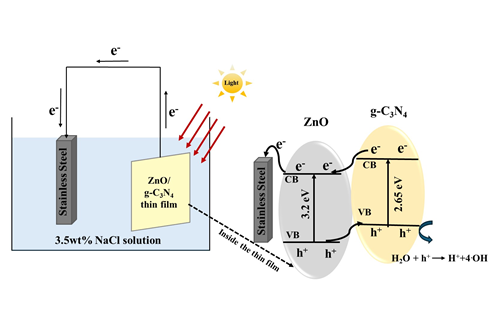
The development of efficient and environmentally friendly corrosion protection systems for metals in aggressive environments has become a critical area of research, particularly for stainless steel used in marine and industrial applications. In this study, a series of graphitic carbon nitride (g-C3N4) and zinc oxide (ZnO) composites with varying g-C3N4 weight ratios (10 wt% and 30 wt%), are integrated to form heterojunction structures with enhanced charge separation and interfacial activity. The g-C3N4/ ZnO (ZCN) composite thin films were prepared using a facile thermal mixing method and were characterized using XRD, SEM, BET, FTIR, UV-Vis, and PL to confirm their structural, morphological, and optical properties. Electrochemical impedance spectroscopy (EIS) and potentiodynamic polarization measurements of the ZCN thin films and 304 stainless steel samples under 3.5 wt% NaCl solution showed higher photocurrent density, more negative photopotential displacement, and lower charge-transfer resistance, confirming accelerated electron migration from the ZCN thin film to the stainless-steel substrate. The open circuit potential (OCP) of the steel shifted negatively under illumination, confirming the generation of photogenerated cathodic protection. These results highlight the critical role of the hybrid interface and optimized g-C3N4 content in improving light-driven corrosion protection systems. The 10 wt% g-C3N4/ZnO nanocomposite offers a promising approach for the development of efficient photo-electrochemical coatings aimed at protecting stainless steel in harsh electrolyte environments.
Downloads
เอกสารอ้างอิง
Z. Jin, Z. Gao, H. Jiang, X. Li, Y. Chen, and X. Zhang, “Corrosion resistance improvement of carbon steel by novel flower cluster photocathodic protection coating in marine environment,” Journal of Building Engineering, vol. 112, p. 113652, 2025. DOI: https://doi.org/10.1016/j.jobe.2025.113652
J. Tian, Y. Cheng, Z. Zhang, Z. Zhao, Z. Xu, and J. Li, “Photo-generated carrier-directed modulation of WO3/Bi2WO6 Z-scheme heterojunction for marine anti-corrosion and anti-fouling,” npj Materials Degradation, vol. 9, no. 1, p. 163, 2025. DOI: https://doi.org/10.1038/s41529-025-00707-2
P. Wipataphan, W. Sripianem, N. B. Oo, T. Na Wichean, B. Dachbumroong, O. Jongprateep, G. Panomsuwan, N. Pewnim, and R. Techapiesancharoenkij, “Photoelectrochemical cathodic protection of amorphous zinc oxide coating on hot rolled steel SS400 in a 3 wt% NaCl solution and a Na2S-NaOH solution,” Journal of Metals, Materials and Minerals, vol. 31, no. 4, pp. 129–142, 2021.
S. Yang, J. Wang, C. Liu, P. Ren, Q. Yang, and G. Zhao, “Morphology control and photocatalytic properties of ZnO sheets grown on an AAO template,” Ceramics International, vol. 47, no. 6, pp. 8610–8617, 2021. DOI: https://doi.org/10.1016/j.ceramint.2020.11.229
X. Zhang, G. Chen, W. Li, and D. Wu, “Preparation and photo-cathodic protection properties of ZnO/TiO2 heterojunction film under simulated solar light,” Materials, vol. 12, no. 23, p. 3856, 2019. DOI: https://doi.org/10.3390/ma12233856
S. Veerapong, N.B. Oo, B. Dachbumroong, P. Chaum, T. Na Wichean, O. Jongprateep, N. Pewnim, G. Panomsuwan, and R. Techapiesnacharoenkij, “Investigation of photocathodic corrosion protection of ZnO/ZnS thin film for AISI 304 stainless steel in 3.5 wt% NaCl solution,” Journal of Metals, Materials and Minerals, vol. 35, no. 1, p. e2105, 2025. DOI: https://doi.org/10.55713/jmmm.v35i1.2105
R. Techapiesancharoenkij, W. Sripianem, K. Tongpul, C. Peamjharean, T. Na Wichean, T. Meesak, and P. Eiamchai, “Investigation of the photocathodic protection of a transparent ZnO coating on an AISI type 304 stainless steel in a 3% NaCl solution,” Surface and Coatings Technology, vol. 320, pp. 97‒102, 2017. DOI: https://doi.org/10.1016/j.surfcoat.2017.01.096
F. Nabhan, E. M. Fayyad, M. H. Sliem, F. M. Shurrab, K. Eid, G. Nasrallah, and A. M. Abdullah, “ZnO-doped g-C3N4 nano-capsules for enhancing the performance of electroless NiP coating—mechanical, corrosion protection, and antibacterial properties,” ACS Omega, vol. 8, no. 25, pp. 22361–22381, 2023. DOI: https://doi.org/10.1021/acsomega.2c07288
Y. Bu, and Z. Chen, “Highly efficient photoelectrochemical anticorrosion for 304 stainless steel by C3N4@ZnO composite with quasi-shell-core structure,” RSC Advances, vol. 4, pp. 45397‒45406, 2014. DOI: https://doi.org/10.1039/C4RA06641C
Y. Lv, Y. Zheng, H. Zhu, and Y. Wu, “Designing a dual-functional material with barrier anti-corrosion and photocatalytic antifouling properties using g-C3N4 nanosheet with ZnO nanoring,” Journal of Materials Science & Technology, vol. 106, pp. 56–69, 2022. DOI: https://doi.org/10.1016/j.jmst.2021.07.029
H. Zheng, Y. Liu, Y. Zhou, D. Zhao, D. Wang, L. Yun, D. Zhang, and L. Zhang, “Improved photocathodic protection performance of g-C3N4/rGO/ZnS for 304 stainless steel,” Journal of Physics and Chemistry of Solids, vol. 148, p. 109672, 2021. DOI: https://doi.org/10.1016/j.jpcs.2020.109672
J. Jing, Z. Chen, C. Feng, M. Sun, and J. Hou, “Transforming g-C3N4 from amphoteric to n-type semiconductor: The important role of p/n type on photoelectrochemical cathodic protection,” Journal of Alloys and Compounds, vol. 851, p. 156820, 2021. DOI: https://doi.org/10.1016/j.jallcom.2020.156820
D. R. Paul, S. Gautam, P. Panchal, S. P. Nehra, P. Choudhary, and A. Sharma, “ZnO-modified g-C3N4: A potential photocatalyst for environmental application,” ACS Omega, vol. 5, no. 8, pp. 3828–3838, 2020. DOI: https://doi.org/10.1021/acsomega.9b02688
C. Li, X. Yang, B. Yang, Y. Yan, and Y. Qian, “Synthesis and characterization of nitrogen-rich graphitic carbon nitride,” Materials Chemistry and Physics, vol. 103, no. 2, pp. 427–432, 2007. DOI: https://doi.org/10.1016/j.matchemphys.2007.02.057
N. Sabri, M. Nawi, and W. Nawawi, “Porous immobilized C-coated N-doped TiO2 containing in-situ generated polyenes for enhanced visible light photocatalytic activity,” Optical Materials, vol. 48, pp. 258–266, 2015. DOI: https://doi.org/10.1016/j.optmat.2015.08.010
F. Fina, S. K. Callear, G. M. Carins, and J. T. Irvine, “Structural investigation of graphitic carbon nitride via XRD and neutron diffraction,” Chemistry of Materials, vol. 27, no. 7, pp. 2612–2618, 2015. DOI: https://doi.org/10.1021/acs.chemmater.5b00411
F. Hassan, S. N. Backer, I. W. Almanassra, M. A. Atieh, M. Elbahri, and A. Shanableh, “Solar-matched S-scheme ZnO/ g-C₃N₄ for visible light-driven paracetamol degradation,” Scientific Reports, vol. 14, no. 1, p. 12220, 2024. DOI: https://doi.org/10.1038/s41598-024-60306-0
M. Ramachandra, S. D. K. R. Pai, J. R. Jaleel, and D. Pinheiro, “Improved photocatalytic activity of g-C₃N₄/ZnO: A potential direct Z-scheme nanocomposite,” Chemistry Select, vol. 5, no. 38, pp. 11986–11995, 2020. DOI: https://doi.org/10.1002/slct.202003166
M. Suhag, A. Khatun, I. Tateishi, M. Furukawa, H. Katsumata, and S. Kaneco, “One-step fabrication of the ZnO/g-C₃N₄ composite for visible light-responsive photocatalytic degradation of bisphenol E in aqueous solution,” ACS Omega, vol. 8, pp. 11824–11836, 2023. DOI: https://doi.org/10.1021/acsomega.2c06678
Q. Sun, Y. Sun, M. Zhou, H. Cheng, H. Chen, B. Dorus, M. Lu, and T. Le, “A 2D/3D g-C₃N₄/ZnO heterojunction enhanced visible-light driven photocatalytic activity for sulfonamides degradation,” Ceramics International, vol. 48, no. 5, pp. 7283–7290, 2022. DOI: https://doi.org/10.1016/j.ceramint.2021.11.289
C. Yan, A.M. Abed, M. Shaban, X. Li, X. Zhou, G. Lei, S. Abdullaev, and I. Mahariq, “Superb photocatalytic H₂ production/ tetracycline pollutant degradation by synthesizing novel and recyclable ternary g-C₃N₄-based photocatalyst: Characterization, optimization, mechanism, and toxicity assessment,” Journal of Water Process Engineering, vol. 69, p. 106642, 2025. DOI: https://doi.org/10.1016/j.jwpe.2024.106642
H. Asghar, M. Saeed, F. S. Mirsafi, M. K. Ismael, T. Leißner, and Y. K. Mishra, “Zinc oxide–graphitic carbon nitride composites: Synthesis, properties, and application scopes in environmental remediations,” Small, vol. 21, e09637, 2025. DOI: https://doi.org/10.1002/smll.202409637
S. Qiu, and J. Li, “High-efficiency Ag-modified ZnO/g-C₃N₄ photocatalyst with 1D-0D-2D morphology for methylene blue degradation,” Molecules, vol. 29, no. 10, p. 2182, 2024. DOI: https://doi.org/10.3390/molecules29102182
X. Wang, K. Maeda, A. Thomas, K. Takanabe, G. Xin, J. M. Carlsson, K. Domen, and M. Antonietti, “A metal-free polymeric photocatalyst for hydrogen production from water under visible light,” Nature Materials, vol. 8, no. 1, pp. 76–80, 2009. DOI: https://doi.org/10.1038/nmat2317
J.-X. Sun, Y.-P. Yuan, L.-G. Qiu, X. Jiang, A.-J. Xie, Y.-H. Shen, and J, Zhu, “Fabrication of composite photocatalyst g-C₃N₄–ZnO and enhancement of photocatalytic activity under visible light,” Dalton Transactions, vol. 41, no. 22, pp. 6756–6763, 2012. DOI: https://doi.org/10.1039/c2dt12474b
B. Sert, Z. Bilici, K. Ocakoglu, N. Dizge, T. S. Rad, and A. Khataee, “Preparation of S-scheme g-C₃N₄/ZnO heterojunction composite for highly efficient photocatalytic destruction of refractory organic pollutant,” Catalysts, vol. 13, no. 3, p. 485, 2023. DOI: https://doi.org/10.3390/catal13030485
J. Tauc, “Optical properties and electronic structure of amorphous Ge and Si,” Materials Research Bulletin, vol. 3, no. 1, pp. 37–46, 1968. DOI: https://doi.org/10.1016/0025-5408(68)90023-8
P. Makuła, M. Pacia, and W. Macyk, “How to correctly determine the band gap energy of modified semiconductor photocatalysts based on UV–Vis spectra,” Journal of Physical Chemistry Letters, vol. 9, pp. 6814–6817, 2018. DOI: https://doi.org/10.1021/acs.jpclett.8b02892
X. Zhang, J. Qin, Y. Xue, P. Yu, B. Zhang, L. Wang, and R. Liu, “Effect of aspect ratio and surface defects on the photo-catalytic activity of ZnO nanorods,” Scientific Reports, vol. 4, no. 1, p. 4596, 2014. DOI: https://doi.org/10.1038/srep04596
H. Xu, W. Liu, L. Cao, G. Su, and R. Duan, “Preparation of porous TiO2/ZnO composite film and its photocathodic protection properties for 304 stainless steel,” Applied Surface Science, vol. 301, pp. 508–514, 2014. DOI: https://doi.org/10.1016/j.apsusc.2014.02.114
A. C. Lazanas, and M. I. Prodromidis, “Electrochemical impedance spectroscopy—A tutorial,” ACS Measurement Science Au, vol. 3, no. 3, pp. 162–193, 2023. DOI: https://doi.org/10.1021/acsmeasuresciau.2c00070
R. Guan, J. Li, J. Zhang, Z. Zhao, D. Wang, H. Zhai, and D. Sun, “Photocatalytic performance and mechanistic research of ZnO/g-C3N4 on degradation of methyl orange,” ACS Omega, vol. 4, no. 24, pp. 20742–20747, 2019. DOI: https://doi.org/10.1021/acsomega.9b03129
Z.-X. Liu, J.-J. Tian, P. Liu, J.-C. Liu, and J.-K. Liu, "Design and synthesis of mosaic ZnO/g-C3N4 heterojunction materials with excellent anticorrosion performance," Industrial & Engineering Chemistry Research, vol. 63, no. 30, pp. 13218-13229, 2024. DOI: https://doi.org/10.1021/acs.iecr.4c01370
S. Brunauer, P. H. Emmett, and E. Teller, “Adsorption of gases in multimolecular layers,” Journal of the American Chemical Society, vol. 60, no. 2, pp. 309–319, 1938. DOI: https://doi.org/10.1021/ja01269a023
S. Pourali, R. Amrollahi, S. Alamolhoda, and S. Masoudpanah, “In situ synthesis of ZnO/g-C3N4 based composites for photo-degradation of methylene blue under visible light,” Scientific Reports, vol. 15, no. 1, p. 462, 2025. DOI: https://doi.org/10.1038/s41598-024-84645-0
ดาวน์โหลด
เผยแพร่แล้ว
วิธีการอ้างอิง
ฉบับ
บท
Categories
การอนุญาต
ลิขสิทธิ์ (c) 2026 วารสารโลหะ, วัสดุ และแร่

This work is licensed under a Creative Commons Attribution-NonCommercial-NoDerivatives 4.0 International License.
Authors who publish in this journal agree to the following terms:
- Authors retain copyright and grant the journal right of first publication with the work simultaneously licensed under a Creative Commons Attribution License that allows others to share the work with an acknowledgment of the work's authorship and initial publication in this journal.
- Authors are able to enter into separate, additional contractual arrangements for the non-exclusive distribution of the journal's published version of the work (e.g., post it to an institutional repository or publish it in a book), with an acknowledgment of its initial publication in this journal.