Development of 4-vinylbenzyl chloride (VBC) grafted onto branched polyethylenimine (PEI) onto bacterial cellulose sheet by gamma-induced irradiation technique for Cu\(_{2+}\) ion adsorption
DOI:
https://doi.org/10.55713/jmmm.v36i1.2424Keywords:
Bacterial cellulose, 4-vinylbenzyl chloride (VBC) grafted onto branched polyethylenimine (PEI), Cu2 adsorption, Composite membraneAbstract
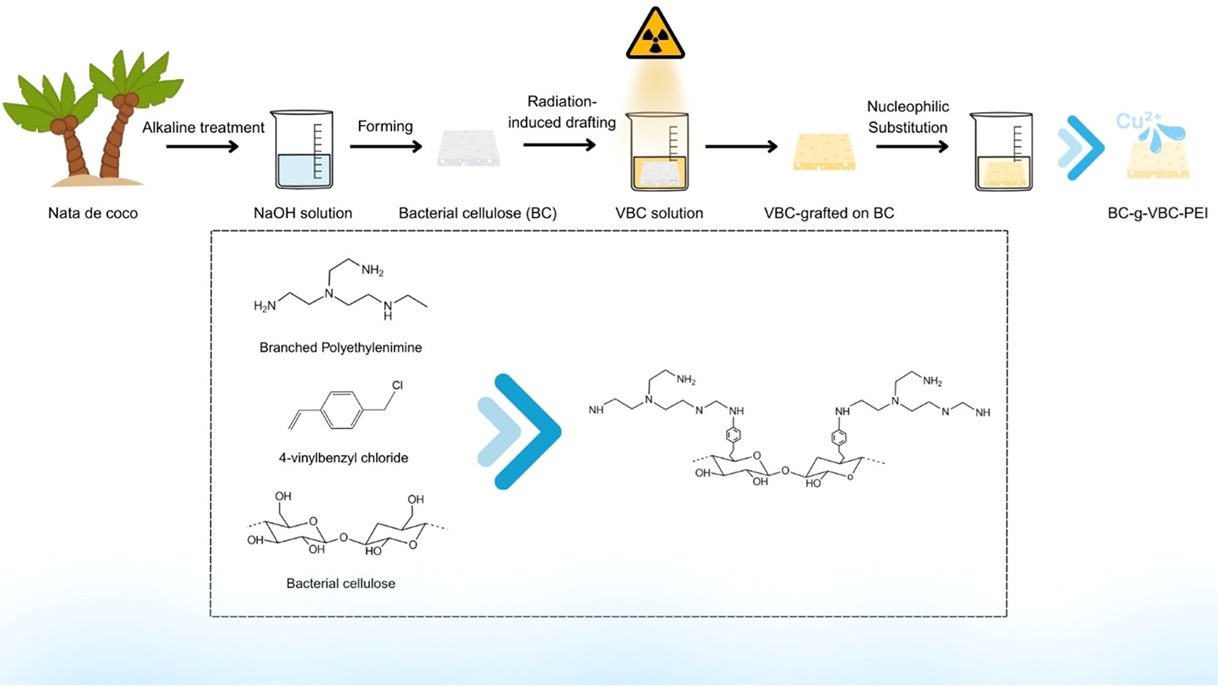
Bacterial cellulose extracted and purified from Nata de coco was employed as a platform for Cu2+ ion adsorption. 4-vinylbenzyl chloride (VBC) was successfully grafted at the hydroxyl position by using gamma irradiation. The optimum was typically related to VBC concentration of 2% (v/v) and a radiation dose of 50 kGy. FTIR significantly reported the functional group of C-Cl related to VBC. No change of crystallinity and morphology was observed. The thermal decomposition was stable up to 200℃. The modification of branched polyethylenimine (PEI) was prepared in order to change the functionality to N‒H stretching. This was expected to adsorb Cu2+ ion. It was evaluated under the variation of concentration, pH and time. Efficiency reported that concentration of 50 mg∙L‒1, pH of 7, and adsorption time of 2 h were reported. The results exhibited that gamma ray–induced grafting, followed by PEI functionalization onto bacterial cellulose surface was considered as one of the most effective strategies for effective platform for Cu2+ ions in aqueous systems. It was remarkably noted that modified bacterial cellulose extremely provided the great promise as the eco-friendly platform for wastewater remediation.
Downloads
References
J. Li, X. Li, Y. Li, H. Liu, and Q. Wang, "Artificial sweeteners in wastewater treatment plants: A systematic review of global occurrence, distribution, removal, and degradation pathways," Journal of Hazardous Materials, vol. 494, p. 138644, 2025. DOI: https://doi.org/10.1016/j.jhazmat.2025.138644
J. Zhang, J. Gao, Y. Zhao, Y. Zhang, K. Zhang, and T. Lu, "Impacts of disinfectant and antipyretic on aged ethylene-vinyl acetate copolymer microplastics in hospital wastewater: Resistance genes, microbial community and carbon source metabolism," Journal of Hazardous Materials, vol. 492, p. 138191, 2025. DOI: https://doi.org/10.1016/j.jhazmat.2025.138191
N. Phutanon, P. Pisitsak, H. Manuspiya, and S. Ummartyotin, "Synthesis of three-dimensional hierarchical CuO flower-like architecture and its photocatalytic activity for rhodamine b degradation," Journal of Science: Advanced Materials and Devices, vol. 3, no. 3, p. 310-316, 2018. DOI: https://doi.org/10.1016/j.jsamd.2018.05.001
M. Atif, H. Z. Haider, R. Bongiovanni, M. Fayyaz, T. Razzaq, and S. Gul, "Physisorption and chemisorption trends in surface modification of carbon black," Surfaces and Interfaces, vol. 31, p. 102080, 2022. DOI: https://doi.org/10.1016/j.surfin.2022.102080
B. Roldan Cuenya, and F. Behafarid, "Nanocatalysis: size- and shape-dependent chemisorption and catalytic reactivity," Surface Science Reports, vol. 70, no. 2, p. 135-187, 2015. DOI: https://doi.org/10.1016/j.surfrep.2015.01.001
Z. Shirani, V. Carrasco-Navarro, S. Majlesi, P. Yli-Pirila, J. V. K. Kukkonen, and J. Akkanen, "Efficiency and ecotoxicity of activated biochar in the treatment of artificial wastewater contaminated by pharmaceuticals," Journal of Environmental Management, vol. 371, p. 123224, 2024. DOI: https://doi.org/10.1016/j.jenvman.2024.123224
Md. A. Hashem, S. F. Rahman, S. R. Sium, M. Maoua, Md. M. Miem, A. A. Mini, and Md. E. H. Zahin, "Thermally activated adsorbent derived from kitchen biowaste for treatment of tannery wastewater," Cleaner Chemical Engineering, vol. 11, p. 100156, 2025. DOI: https://doi.org/10.1016/j.clce.2025.100156
S. Jiang, L. Xu, Y. Lyu, J. Zhang, F. Wu, X. Zhang, W. Xiong, B. He, and H. Yi, "Adsorption mechanism of Rhodamine wastewater in the MOFs materials: Effect of metal center and organic ligand," Separation and Purification Technology, vol. 363, p. 132056, 2025. DOI: https://doi.org/10.1016/j.seppur.2025.132056
A. A. Ransing, Q. Wang, R. P. Dhavale, H. Choi, U. K. H. Bangi, V. G. Parale, W. Lee, K. Kanamori, and H-H. Park, "Ionotropically-engineered synthesis of mechanically robust hybrid sodium alginate–silica aerogels with enhanced specific surface area for high-capacity and selective dye adsorption from wastewater," Chemical Engineering Journal, vol. 507, p. 160590, 2025. DOI: https://doi.org/10.1016/j.cej.2025.160590
Y.-W. Tai, P. Khamwongsa, X.-T. Chen, Y.-S. Lin, Z.-J. Lee, S. Ummartyotin, and Y. Wei, "Bacterial cellulose and keratin reinforced PAM hydrogels for advanced dye removal: Insights from batch and QCM analyses," International Journal of Biological Macromolecules, vol. 308, p. 142458, 2025. DOI: https://doi.org/10.1016/j.ijbiomac.2025.142458
I. Ijaz, A. Bukhari, A. Nazir, E. Gilani, H. Zain, A. Shaheen, M. R. Shaik, and M. Khan, "Modification of bacterial cellulose by MoBTx MBene and 1,4-dithiothreitol for rapid and efficient adsorption of indomethacin and losartan potassium," International Journal of Biological Macromolecules, vol. 304, p. 140745, 2025. DOI: https://doi.org/10.1016/j.ijbiomac.2025.140745
Z.-W. Liu, X.-L. Wang, H.-J. Xian, J.-H. Zhong, X.-G. Ye, Y.-X. Yang, Y. Hu, Y. Chen, D.-M. Li, and C. Huang, "Highly efficient malachite green adsorption by bacterial cellulose and bacterial cellulose/locust bean gum composite," International Journal of Biological Macromolecules, vol. 279, p. 134991, 2024. DOI: https://doi.org/10.1016/j.ijbiomac.2024.134991
H. Fansuri, M. Ali, A. Rahman, S. Putra, F. Nurfiana, and W. M. Yusmaman, "Effect of γ-irradiation pretreatment on cellulose degradation of corn stover and its implication for bioethanol production," Bioresource Technology Reports, vol. 30, p. 102115, 2025. DOI: https://doi.org/10.1016/j.biteb.2025.102115
F. Whba, F. Mohamed, R. Whba, M. I. Idris, N. M. Noor, and M. K. B. Mahmood, "Synthesis and characterization of cellulose nanocrystals/Gd2O3 nanocomposite as a dual-mode contrast agent for MRI via gamma-ray irradiation," Radiation Physics and Chemistry, vol. 221, p. 111727, 2024. DOI: https://doi.org/10.1016/j.radphyschem.2024.111727
N. Khiewsawai, T. Rattanawongwiboon, and S. Ummartyotin, "Cellulose fiber derived from sugarcane bagasse and poly-ethylene glycol/acrylic acid/branched polyethylenimine-based hydrogel composite prepared by gamma irradiation: A platform for mercury(II) ions adsorption," Environmental Advances, vol. 17, p. 100561, 2024. DOI: https://doi.org/10.1016/j.envadv.2024.100561
C. Kanbua, T. Rattanawongwiboon, R. Khamlue, and S. Ummartyotin, "Green synthesis of sulfonated cellulose/polyether block amide/polyethylene glycol diacrylate (SC/PEBAX/PEGDA) composite membrane by gamma radiation and sulfonation techniques for battery application," International Journal of Biological Macromolecules, vol. 248, p. 125844, 2023. DOI: https://doi.org/10.1016/j.ijbiomac.2023.125844
W. Treesuppharat, P. Rojanapanthu, C. Siangsanoh, H. Manuspiya, and S. Ummartyotin, "Synthesis and characterization of bacterial cellulose and gelatin-based hydrogel composites for drug-delivery systems," Biotechnology Reports, vol. 15, p. 84-91, 2017. DOI: https://doi.org/10.1016/j.btre.2017.07.002
L. Sakwises, N. Rodthongkum, and S. Ummartyotin, "SnO2- and bacterial-cellulose nanofiber-based composites as a novel platform for nickel-ion detection," Journal of Molecular Liquids, vol. 248, p. 246-252, 2017. DOI: https://doi.org/10.1016/j.molliq.2017.10.047
N. Chunshom, P. Chuysinuan, S. Techasakul, and S. Ummartyotin, "Dried-state bacterial cellulose (Acetobacter xylinum) and polyvinyl-alcohol-based hydrogel: An approach to a personal care material," Journal of Science: Advanced Materials and Devices, vol. 3, no. 3, p. 296-302. 2018. DOI: https://doi.org/10.1016/j.jsamd.2018.06.004
D. Li, X. Tian, Z. Wang, Z. Guan, X. Li, H. Qiao, H. Ke, L. Luo, and Q. Wei, "Multifunctional adsorbent based on metal-organic framework modified bacterial cellulose/chitosan composite aerogel for high efficient removal of heavy metal ion and organic pollutant," Chemical Engineering Journal, vol. 383, p. 123127, 2020. DOI: https://doi.org/10.1016/j.cej.2019.123127
R. J. Gomes, E. I. Ida, and W. A. Spinosa, "Nutritional supplementation with amino acids on bacterial cellulose production by komagataeibacter intermedius: Effect analysis and application of response surface methodology," Applied Biochemistry and Biotechnology, vol. 194, no. 11, p. 5017-5036, 2022. DOI: https://doi.org/10.1007/s12010-022-04013-4
N. D. Koromilas, G. Ch, Lainioti, E. K. Oikonomou, G. Bokias, and J. K. Kallitsis, "Synthesis and self-association in dilute aqueous solution of hydrophobically modified polycations and polyampholytes based on 4-vinylbenzyl chloride," European Polymer Journal, vol. 54, p. 39-51, 2014. DOI: https://doi.org/10.1016/j.eurpolymj.2014.02.009
M. E. Mathew, I. Ahmad, S. Thomas, M. Kassim, and R. Daik, "A preliminary study on the synthesis of poly(vinylbenzyl chloride) with different solvents," Sains Malaysiana, vol. 50. no. 6, p. 1767-1773, 2021. DOI: https://doi.org/10.17576/jsm-2021-5006-22
X. Bai, Q. Wang, M. Tan, P. Zhang, S. Sun, D. Wu, H. Mei, G. Shan, N. Wang, H. Hao, T. Wang, and X. Huang, "Spongy and anti-pollution MXene/Ag2S/cellulose acetate membrane for sustainable solar-driven interfacial evaporation and water purification," Chemical Engineering Journal, vol. 489, p. 151441, 2024. DOI: https://doi.org/10.1016/j.cej.2024.151441
Y. Qin, B. Chai, Y. Sun, X. Zhang, G. Fan, and G. Song, "Amino-functionalized cellulose composite for efficient simultaneous adsorption of tetracycline and copper ions: Performance, mechanism and DFT study," Carbohydrate Polymers, vol. 332, p. 121935, 2024. DOI: https://doi.org/10.1016/j.carbpol.2024.121935
Downloads
Published
How to Cite
Issue
Section
Categories
License
Copyright (c) 2025 Journal of Metals, Materials and Minerals

This work is licensed under a Creative Commons Attribution-NonCommercial-NoDerivatives 4.0 International License.
Authors who publish in this journal agree to the following terms:
- Authors retain copyright and grant the journal right of first publication with the work simultaneously licensed under a Creative Commons Attribution License that allows others to share the work with an acknowledgment of the work's authorship and initial publication in this journal.
- Authors are able to enter into separate, additional contractual arrangements for the non-exclusive distribution of the journal's published version of the work (e.g., post it to an institutional repository or publish it in a book), with an acknowledgment of its initial publication in this journal.